Technology, zBlog
What Is Conceptual Design in Engineering? Why It Decides Most of What Happens Next
trantorindia | Updated: July 8, 2026

Conceptual design in engineering is the first stage of the engineering design process, where the goal is not to specify exact dimensions or select final materials, but to determine which possible solutions satisfy the project requirements before any of those details are locked in. It is the phase where an abstract problem, building a lighter chassis, designing a drone that can fly for forty minutes, and an assembly line that does not bottleneck, first gets turned into a small set of rough, comparable concepts that a team can actually evaluate against each other.
Here is the part most explanations of conceptual design skip, and the part that actually matters if you are deciding how much time and rigor to put into this phase. According to the NASA Systems Engineering Handbook, roughly 80 percent of a product’s total lifecycle cost is effectively locked in by decisions made during the earliest design phases, well before detailed engineering or manufacturing even begins. A separate analysis published in the International Design Conference found that early design-phase decisions accounted for 86 percent of the total potential rework cost across the projects studied. Conceptual design is not a creative warm-up before the real engineering starts. It is the phase where most of the real engineering risk and cost gets decided, whether anyone in the room realizes it at the time or not.
This guide on conceptual design in engineering covers the actual cost data behind why this phase matters so much, the standard step-by-step conceptual design process used across mechanical, civil, electrical, and systems engineering, how conceptual design compares to logical and physical design, the tools engineers actually use, and real industry examples with enough specificity to be useful rather than generic.
Conceptual design in engineering is where you have the most freedom to change direction and the least amount of money already spent. Every phase after it inherits the assumptions made here, and the data is consistent across aerospace, construction, and product development: the cost of fixing a decision rises by roughly an order of magnitude with every phase you wait to fix it in.
Why Conceptual Design in Engineering Costs So Little and Matters So Much
The single most important fact to understand about conceptual design in engineering is the relationship between when a change happens and what it costs to make. This relationship has a name in engineering practice: the Rule of Ten.
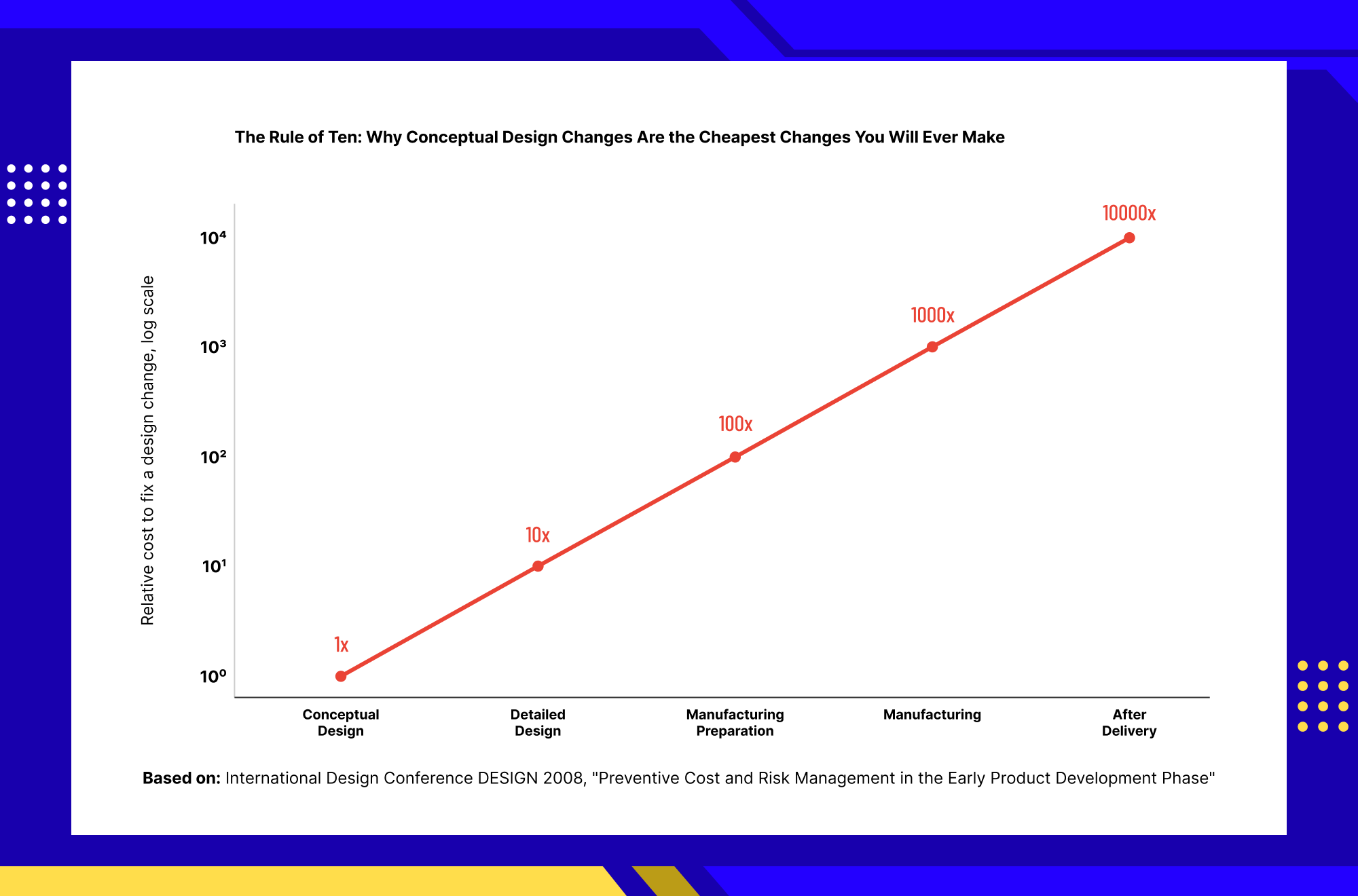
The Rule of Ten holds that if a design change costs one unit of money during the conceptual or feasibility phase, that same conceptual change in substance costs roughly ten times as much once it has to be made during detailed construction or design, a hundred times as much during manufacturing preparation, a thousand times as much once manufacturing has actually started, and an order of magnitude beyond that again if the product has already been delivered. This is not a rough guess. It reflects a simple structural reality of engineering work: every phase after conceptual design adds commitments, drawings, tooling, purchased materials, and built components that a later change has to unwind, rework, or scrap.
A related way of seeing the same pattern comes directly from NASA’s systems engineering practice, which tracks two curves across a project’s life: how much influence the team still has over the final lifecycle cost of the system, and how much of that cost has actually been spent so far.
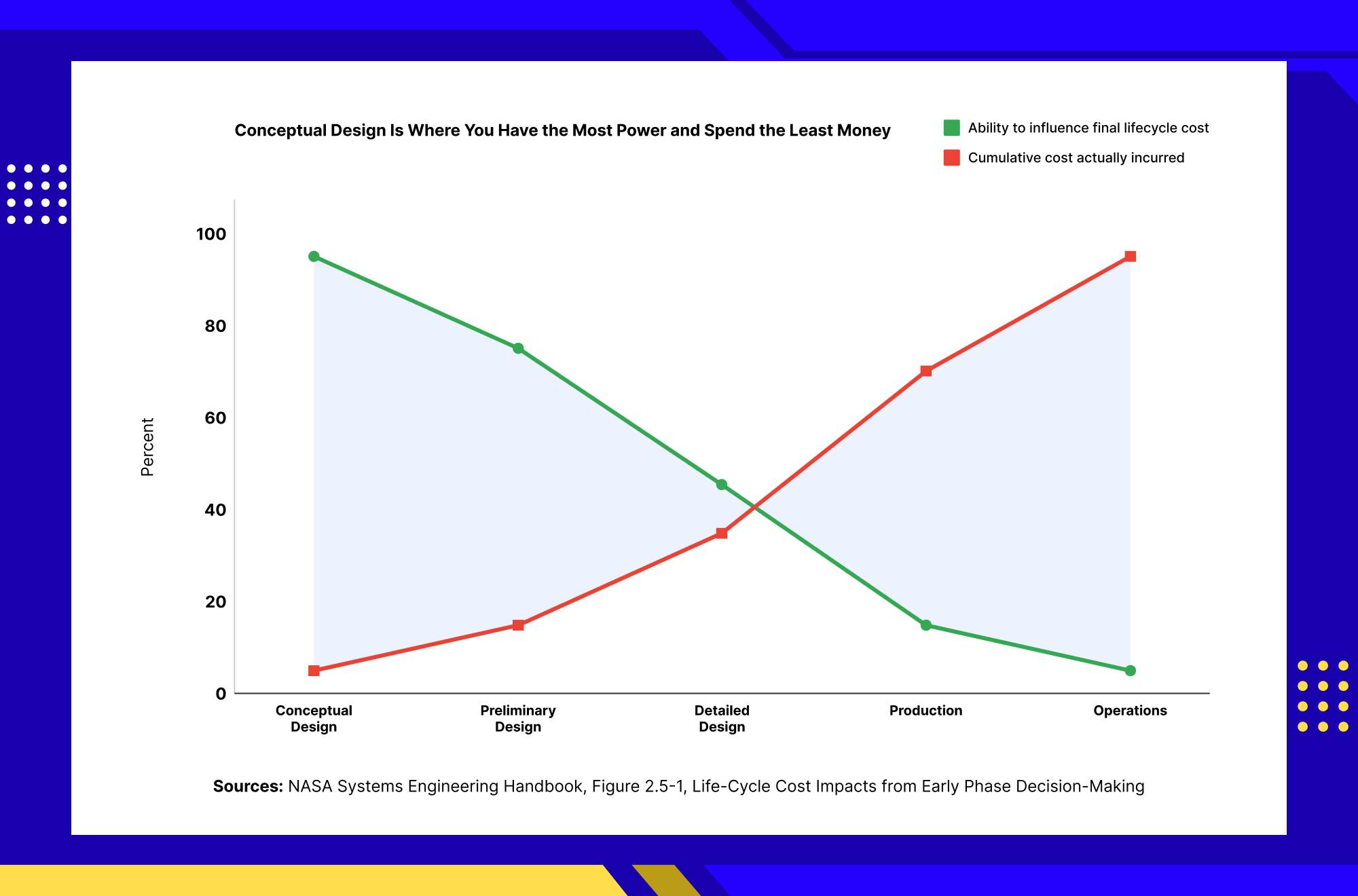
At the conceptual design stage, a team still has the ability to influence the vast majority of the final lifecycle cost, while having spent only a small fraction of the eventual total budget. That relationship inverts almost completely by the time a system reaches production and operations. By then, the team has spent most of the money, but has very little remaining ability to change the fundamentals of what was built. This is precisely why conceptual design in engineering deserves real rigor rather than being treated as a quick whiteboard exercise before the “real” work starts. The real work, in terms of cost consequence, is already happening here.
THE PRACTICAL TAKEAWAY:
If a stakeholder pushes to skip or rush conceptual design in engineering to save time, the honest response is that doing so does not actually save money. It defers the cost of getting requirements wrong to a phase where fixing that mistake costs ten to a thousand times more, according to the data above. Time spent in conceptual design is the cheapest insurance available anywhere in the engineering process.
The Conceptual Design Process in Engineering: A 7-Step Framework
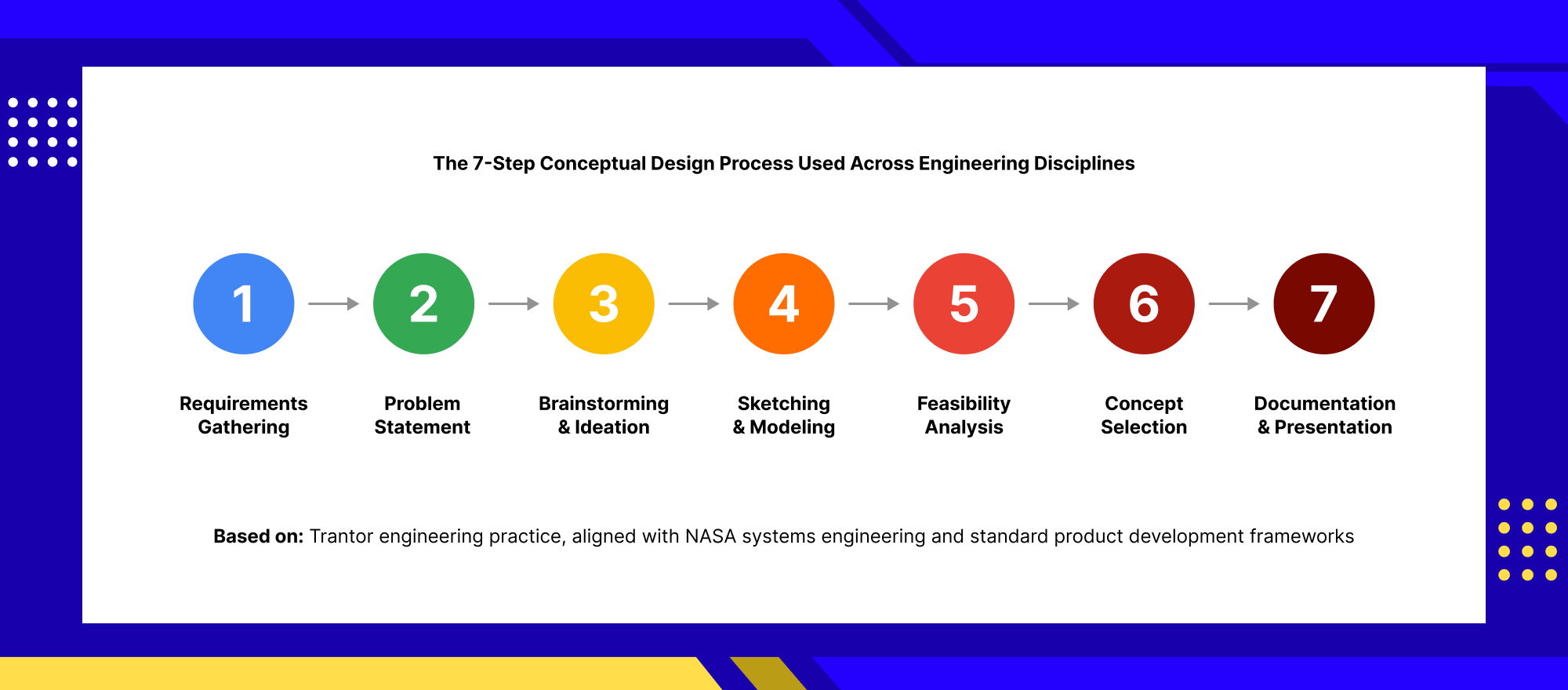
Conceptual design in engineering follows a structured, though genuinely iterative, sequence. Teams move forward through these steps and frequently loop back as feasibility analysis or stakeholder feedback reveals that an earlier assumption needs revisiting.
Conceptual Design vs Logical Design vs Physical Design in Engineering
Conceptual design in engineering is frequently discussed alongside two related stages that come after it, logical design and physical design, and understanding how the three differ clarifies what conceptual design is actually for.
Conceptual Design vs Logical Design vs Physical Design
| Conceptual Design | Logical Design | Physical Design | |
|---|---|---|---|
| Perspective | Owner’s view | Designer’s view | Builder’s view |
| Focus | Business goals, requirements, feasibility | Structure, components, relationships | Materials, technology, implementation |
| Audience | Stakeholders, executives, non-technical decision makers | Engineers, architects, analysts | Engineers, fabricators, system administrators |
| Deliverable | Sketches, concept boards, decision matrices | Diagrams, block models, specifications | CAD drawings, build plans, working prototypes |
| Conceptual Design | |
|---|---|
| Perspective | Owner’s view |
| Focus | Business goals, requirements, feasibility |
| Audience | Stakeholders, executives, non-technical decision makers |
| Deliverable | Sketches, concept boards, decision matrices |
| Logical Design | |
|---|---|
| Perspective | Designer’s view |
| Focus | Structure, components, relationships |
| Audience | Engineers, architects, analysts |
| Deliverable | Diagrams, block models, specifications |
| Physical Design | |
|---|---|
| Perspective | Builder’s view |
| Focus | Materials, technology, implementation |
| Audience | Engineers, fabricators, system administrators |
| Deliverable | CAD drawings, build plans, working prototypes |
Conceptual design represents the owner’s perspective. It communicates the overall vision, business goals, and requirements of a system in a way that non-technical stakeholders, executives, and decision makers can actually evaluate and approve, without requiring them to understand specific technologies or implementation choices.
Logical design translates the approved conceptual design into a more detailed, but still technology-agnostic, specification. It defines the overall structure of the system, its major components, and how those components relate to and exchange information with each other. The audience here shifts to architects, engineers, and business analysts who need structural clarity but do not yet need to know which specific vendor, material, or platform will be used.
Physical design addresses the actual technical implementation: specific materials, technologies, platforms, and infrastructure. This is where decisions about performance, scalability, and deployment get made, and the audience shifts again to the engineers and fabricators who will actually build the system.
The practical reason this distinction matters for conceptual design in engineering specifically is that conflating it with the later two stages is exactly how teams end up spending physical design effort, choosing materials, drafting detailed CAD models, before the conceptual question of whether the underlying approach is even feasible has actually been answered. Keeping conceptual design genuinely separate, and genuinely abstract, protects the cost advantage described in the Rule of Ten data above.
Tools Engineers Actually Use During Conceptual Design
Conceptual design in engineering relies on a different set of tools than detailed design, reflecting the phase’s emphasis on speed of comparison over precision of specification.
Sketching and whiteboarding remain the fastest way to externalize and compare ideas before committing engineering time to any one of them. Speed of iteration matters more than visual polish at this stage.
CAD software including AutoCAD, SolidWorks, and Fusion 360, gets used in conceptual design specifically for rough 2D and 3D models that let a team visualize and compare concepts, not for the dimensioned, manufacturing-ready models that come later in detailed design.
Finite element analysis, commonly abbreviated FEA, allows engineers to run early simulations of stress and strain on a rough concept, catching structural problems before any physical prototype exists.
Computational fluid dynamics, or CFD, plays the same early-warning role for systems involving airflow or fluid movement, such as vehicle aerodynamics or HVAC duct layouts, letting a team rule out a concept on physics grounds before investing further design time in it.
Parametric and generative design software, including tools like Autodesk Fusion 360 and nTopology, can generate and compare a wide range of structurally optimized variations on a concept automatically, which is particularly valuable when a project has many competing constraints to balance.
Structured brainstorming techniques, including mind mapping, SCAMPER, and morphological charts, give brainstorming and ideation sessions enough structure to be productive without constraining the breadth of ideas the team considers.
Collaborative platforms such as Miro and Conceptboard let distributed engineering teams run conceptual design sessions together in real time, which has become standard practice as more engineering teams work across multiple sites or remotely.
Rapid prototyping, most commonly through 3D printing, lets a team validate a physical concept quickly and cheaply, still well within the low-cost window the Rule of Ten describes for the conceptual design phase.
Real Examples of Conceptual Design in Engineering, by Industry
Automotive engineering: conceptual design work on a new vehicle platform typically starts with chassis concepts that balance weight, structural strength, and manufacturability against each other, long before a single panel is drawn in detail. Aerodynamic shape exploration using early CFD models lets engineers rule out shapes that will never hit a drag target, and for electric vehicles specifically, battery pack layout gets conceptualized early because it drives so many downstream decisions about chassis geometry, weight distribution, and crash structure.
Industrial manufacturing: before a manufacturing facility commits to a specific assembly line layout, conceptual design work compares multiple workflow configurations against space constraints and throughput targets. The same applies to robotic automation integration, where the conceptual question of how a robotic cell fits into an existing line, not yet which specific robot model to buy, gets resolved first.
Consumer electronics: conceptual design for a wearable device or smartphone typically starts with ergonomic exploration, how the device sits on a body, how a user’s hand actually interacts with it, well before specific component selection. UI and UX flow gets sketched at a conceptual level for the same reason: it is far cheaper to discover that a navigation structure confuses users during conceptual sketching than after a working interactive prototype has been built.
Civil and structural engineering: a bridge or building project starts with basic framework models that test load assumptions and environmental constraints against multiple structural approaches. Infrastructure layout decisions, optimizing material use and long-term sustainability, get made conceptually because they constrain nearly every later structural and cost decision on the project.
HVAC system design: engineers use conceptual design to compare multiple HVAC configurations against energy usage, installation cost, and long-term maintainability before committing to detailed blueprints, with early CFD simulations guiding airflow pattern and duct layout decisions while changes are still cheap to make.
Agricultural drone development: conceptual design work explores frame material options, sensor placement, and propulsion approach together, since each choice affects the others. Battery capacity and flight time get evaluated through rough calculations and early prototype tests rather than final-spec components, because the goal at this stage is comparing approaches, not finalizing one.
Best Practices for Conceptual Design in Engineering
Involve a genuinely multidisciplinary team from the start. A conceptual design reviewed only by mechanical engineers will miss manufacturing constraints, cost realities, or user experience problems that a broader team would catch while the cost of catching them is still low.
Define clear objectives and constraints before ideation begins. Brainstorming without a defined problem statement produces a wide range of ideas that cannot actually be compared against each other on consistent terms.
Use visuals over text wherever possible. Sketches, rough models, and simulations communicate a concept’s tradeoffs to stakeholders far faster and more accurately than a written description can.
Iterate deliberately rather than converging too early. Feedback loops that send a concept back through brainstorming or feasibility analysis are not a sign the process is failing. They are the process working as intended, while changes are still cheap.
Evaluate concepts holistically. Weighing only technical performance while ignoring cost, regulatory exposure, or environmental impact produces a concept that looks good in isolation and fails once it meets real-world constraints.
Document discarded concepts, not just the winning one. A record of why an alternative was rejected is often exactly what a future project, or a future stakeholder challenge to the current one, needs to avoid relitigating a decision that was already carefully made.
Validate creative ideas with preliminary analysis rather than gut feel alone. Conceptual design should encourage genuine innovation, but innovative concepts still need to survive contact with feasibility data before resources move toward them.
Frequently Asked Questions About Conceptual Design in Engineering
The Bottom Line on Conceptual Design in Engineering
Conceptual design in engineering is not the warm-up act before the real engineering work begins. The data from NASA’s systems engineering practice and from independent design research consistently shows the opposite: this is the phase where the largest share of a project’s eventual cost and risk gets effectively decided, while the actual cost of exploring, comparing, and discarding ideas remains lower than at any later point in the project’s life.
The Rule of Ten describes a cost curve that every engineering discipline experiences in some form, whether the product is a vehicle chassis, a manufacturing facility layout, or a piece of civil infrastructure. Treating conceptual design with real rigor, multidisciplinary input, structured feasibility analysis, and honest documentation of why alternatives were rejected, is the cheapest insurance available anywhere in the engineering process. Rushing or skipping it does not save time. It defers the true cost of getting the direction wrong to a phase where fixing that mistake costs ten, a hundred, or a thousand times more.
At Trantor, we bring decades of engineering and design expertise to conceptual design work across industries, from automotive components to manufacturing operations to consumer products. We treat this phase with the rigor the cost data demands, evaluating alternatives against explicit criteria, documenting the reasoning behind every concept we recommend and every concept we set aside, and working closely with your team so the direction is right before the larger investments of detailed design begin. If you are starting a project where getting the conceptual design phase right will shape everything that follows, we are ready to help.