Artificial Intelligence, zBlog

AI Hallucination: What It Is, Why It Happens, and Real Examples from Enterprise Deployments

AI hallucinations explained with enterprise guide covering causes, risks, detection methods and prevention strategies

What is AI hallucination?
AI hallucination is when a large language model generates outputs that are factually incorrect, fabricated, or contradictory, stated with apparent confidence, without any indication of uncertainty. The model does not “know” it is wrong. It is producing statistically plausible text that does not correspond to reality.

AI hallucination is not a fringe edge case or a bug that will be patched in the next model release. According to IBM’s 2025 AI in Enterprise survey, 76 percent of enterprise AI deployments experienced hallucination issues in production. Gartner estimates the average cost of a single high-stakes hallucination incident at over $1.2 million when legal exposure, remediation, and reputational impact are included. A lawyer submitted a legal brief containing AI-hallucinated case citations. A financial services firm had an AI assistant confidently recommend products that had been discontinued. A healthcare application generated medication dosages that did not correspond to any approved protocol.

These are not theoretical risks. They are documented events that happened in production systems operated by organizations that believed their AI deployment was adequately tested. The pattern in every case is the same: the model was evaluated on benchmark accuracy but never stress-tested for the specific failure mode of producing confidently wrong information in the context where it was deployed.

This guide is the definitive enterprise resource on AI hallucination. It covers what AI hallucination actually is, the five distinct types that require different mitigation strategies, the root causes that the academic literature has identified, real examples organized by industry and type, a 6-layer detection framework, and the mitigation approaches that the evidence shows actually reduce hallucination rates in production.

The most important reframe for any enterprise team evaluating AI hallucination risk: hallucination is not a property of a specific model that can be selected out of. Every large language model hallucinates under the right conditions. The question is not whether your model will hallucinate. It is whether your system architecture, evaluation framework, and monitoring infrastructure will catch hallucinations before they reach a user or a downstream process that acts on them.

KEY STATISTICS — AI HALLUCINATION IN ENTERPRISE 2025–2026
76%
Of enterprise AI deployments experienced hallucination issues in production
IBM AI in Enterprise Survey 2025
$1.2M+
Estimated average cost of a single high-stakes AI hallucination incident
Gartner AI Risk Research 2025
34%
Of production AI systems have exploitable gaps that compound hallucination risk
NeuralTrust Prompt Injection Survey, January 2026
82%
Reduction in AI hallucination rate when RAG is properly implemented
Microsoft RAG Effectiveness Study 2025
Sources: IBM AI in Enterprise Survey 2025, Gartner AI Risk Research 2025, NeuralTrust Jan 2026, Microsoft RAG Effectiveness Study 2025

What Is AI Hallucination? A Complete Definition

AI hallucination occurs when a large language model generates text that is factually incorrect, invented, or internally contradictory, while presenting that output with the same apparent confidence as accurate information. The term is borrowed from psychiatry, where hallucination describes perceiving things that do not exist. In LLMs, hallucination describes generating information that does not correspond to reality, even when grounding facts are available.

The critical element that makes AI hallucination dangerous in enterprise contexts is the confidence presentation. A model that hallucinates does not say “I am not sure about this” or “this might be wrong.” It states incorrect information with the same fluency, formatting, and apparent authority as correct information. This makes hallucinations nearly impossible for a non-expert reader to distinguish from accurate outputs without independent verification.

Why LLMs hallucinate at a fundamental level: large language models generate text by predicting the most statistically probable next token given all preceding tokens, trained on a large corpus of text. They do not retrieve facts from a structured knowledge base. They do not “know” things the way a database knows values. They generate text that is statistically plausible given their training distribution. When a model is asked about something outside its training distribution, about a recent event, a highly specific domain, or a niche question, it generates plausible-sounding text rather than admitting the limits of what it knows.

The 5 Types of AI Hallucination in Enterprise Systems

Not all AI hallucinations are the same. Understanding which type of hallucination has occurred determines which mitigation strategy applies. Most enterprise teams treat hallucination as a single monolithic problem when it is actually five distinct failure modes requiring different responses.
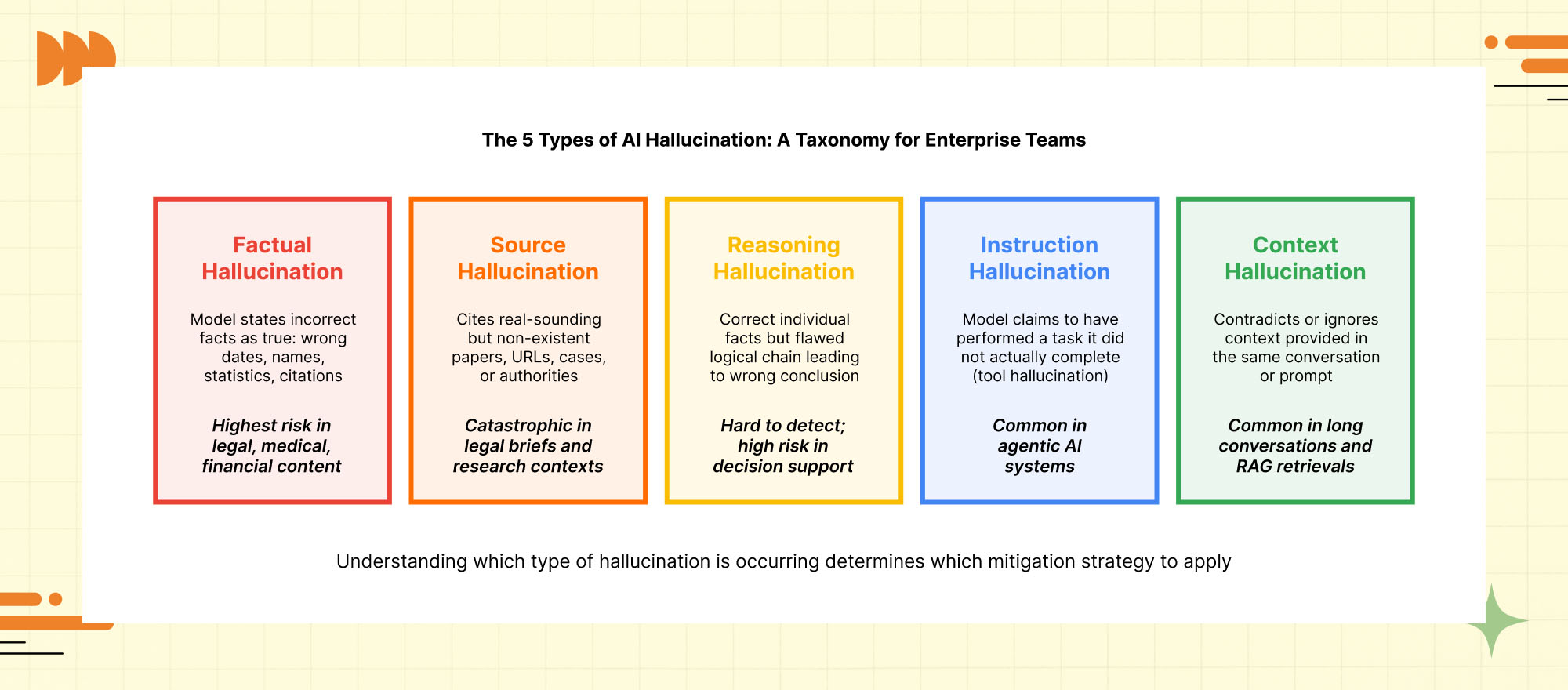
Five types of AI hallucinations including factual, source, reasoning, instruction and context hallucinations explained

1. Factual Hallucination

The model states an incorrect fact as true. Examples include wrong dates, incorrect statistics, wrong executive names, inaccurate product specifications, or fabricated historical events. This is the most commonly cited type of AI hallucination and the easiest to detect with structured fact-checking. A financial services AI assistant that states an incorrect interest rate or a product detail that differs from the actual offering is producing a factual hallucination.

2. Source Hallucination

The model cites a real-sounding but non-existent source: a paper, a legal case, a regulatory document, a news article, or a URL that does not exist. This is particularly dangerous in legal, academic, and compliance contexts. The 2023 Mata v. Avianca legal case, where attorneys submitted a brief with ChatGPT-hallucinated case citations, is the most publicized example of source hallucination causing direct harm, resulting in sanctions against the attorneys involved.

3. Reasoning Hallucination

The individual facts cited may be correct, but the logical chain connecting them to a conclusion is flawed, producing a wrong conclusion that appears to be well-reasoned. This is the most dangerous and hardest to detect type of AI hallucination, because fact-checking the inputs does not reveal the error. A risk analysis AI that correctly identifies all inputs but reasons incorrectly to a wrong risk conclusion is producing a reasoning hallucination.

4. Instruction Hallucination

The model claims to have performed a task it did not actually complete, or reports performing a tool call with a result that is fabricated. This type of AI hallucination is particularly prevalent in agentic AI systems where the model controls tool use. An AI agent that reports “I have sent the email” when no email was sent, or “the database query returned 47 records” when no query was executed, is producing an instruction hallucination.

5. Context Hallucination

The model contradicts or ignores context that was explicitly provided in the same prompt, conversation, or retrieved document. A RAG-powered system that retrieves an accurate document and then generates a response that contradicts the document it just read is producing a context hallucination. This type is particularly insidious because it undermines the very grounding strategy that RAG is designed to provide.

Real AI Hallucination Examples from Enterprise Deployments

The following examples are documented AI hallucination incidents drawn from public reporting, regulatory filings, and enterprise AI research. They are organized by industry to make the risk concrete for the specific operational contexts where Trantor clients deploy AI systems.

Legal: Mata v. Avianca (2023, New York Federal Court)

What happened: Attorneys used ChatGPT to research case citations for a brief. The model hallucinated the names, dates, and outcomes of multiple court cases that did not exist. The attorneys submitted the brief with these fabricated citations without independent verification.

Consequence: Federal judge sanctioned the attorneys. The case became the most widely cited public example of AI hallucination causing direct legal and professional harm. The attorneys faced disciplinary proceedings.

Lesson for enterprise teams: AI output in legal contexts requires verification against primary sources before submission. Source hallucination is particularly common when LLMs are asked to recall specific citations. Even a model that accurately summarizes general legal principles may fabricate specific citations.

Healthcare: Medication Dosage Hallucinations in Clinical AI Pilots

What happened: Multiple healthcare organizations piloting AI assistants for clinical documentation and support have documented cases where the AI generated medication dosages, drug interaction warnings, or protocol steps that did not correspond to approved guidelines. In some cases the dosages were plausible but incorrect for the specific medication or patient weight class.

Consequence: Most incidents were caught by clinical staff during review before reaching patients, but the catch rate depended entirely on the vigilance of individual clinicians rather than a systematic detection layer. The FDA and HHS have issued guidance requiring human oversight for AI in clinical decision support specifically because of this failure mode.

Lesson for enterprise teams: Healthcare AI deployments require clinical validation layers that compare outputs against structured drug databases and treatment protocols, not just general LLM accuracy benchmarks. Human-in-the-loop review is mandatory for any AI output that influences a clinical decision.

Financial Services: AI Research Assistant Fabricated Analyst Reports

What happened: A financial services firm deployed an internal AI assistant for market research. The assistant hallucinated analyst consensus estimates, invented references to earnings calls that had not occurred, and in one case fabricated a merger rumor attributed to a real publication that had not reported it.

Consequence: The firm identified the incidents through a routine audit before any fabricated information reached clients. Internal review found the assistant had produced hallucinated financial data in approximately 12 percent of research synthesis requests when asked about specific numerical analyst estimates.

Lesson for enterprise teams: Financial AI systems should never rely solely on an LLM to retrieve or generate numerical data. Structured data retrieval with RAG grounding against verified financial data sources, combined with output validation that checks generated numbers against retrieved source values, is the minimum standard for any financial research AI application.

Enterprise Software: AI Code Generator Hallucinated API Methods

What happened: Multiple enterprise development teams deploying AI coding assistants have documented the model generating code that calls API methods that do not exist in the referenced library, references internal functions from training data that have been deprecated or renamed, or constructs database queries using syntax valid in a different version of the software than what is deployed.

Consequence: Code compiles but fails at runtime, sometimes silently. In one documented case, an AI-generated database query ran without errors but returned incorrect results because the AI hallucinated a valid but semantically wrong field name that happened to exist in the schema.

Lesson for enterprise teams: AI code generation requires integration testing, not just code review. An LLM that generates syntactically valid code with semantically wrong API calls is producing a hallucination that static review may not catch. Automated test execution against the actual deployed environment is the primary mitigation.

Customer Service: AI Support Bot Invented Product Features

What happened: A consumer electronics manufacturer deployed an AI-powered customer support chatbot trained on product documentation. The bot began confidently describing product features that did not exist, including connectivity options, battery specifications, and software capabilities that were either from an older product generation or entirely fabricated.

Consequence: Customer complaints increased when customers discovered features the chatbot described were not available. Some customers had made purchase decisions based on AI-described capabilities. The company disabled the chatbot feature and reverted to human-only support while redesigning the system.

Lesson for enterprise teams: Customer-facing AI that describes product capabilities must be grounded in current, version-specific product documentation with retrieval validation. RAG against a well-maintained product knowledge base, with output validation that cross-checks described features against structured product data, is the standard architecture for this use case.

Why AI Hallucination Happens: Root Causes

Understanding why AI hallucination happens is necessary for choosing the right mitigation. Teams that treat hallucination as a single phenomenon often apply the wrong fix, better prompting when the real problem is missing retrieval, or more context when the real problem is reasoning errors.
AI hallucination detection framework with six-layer validation process for enterprise AI and LLM applications

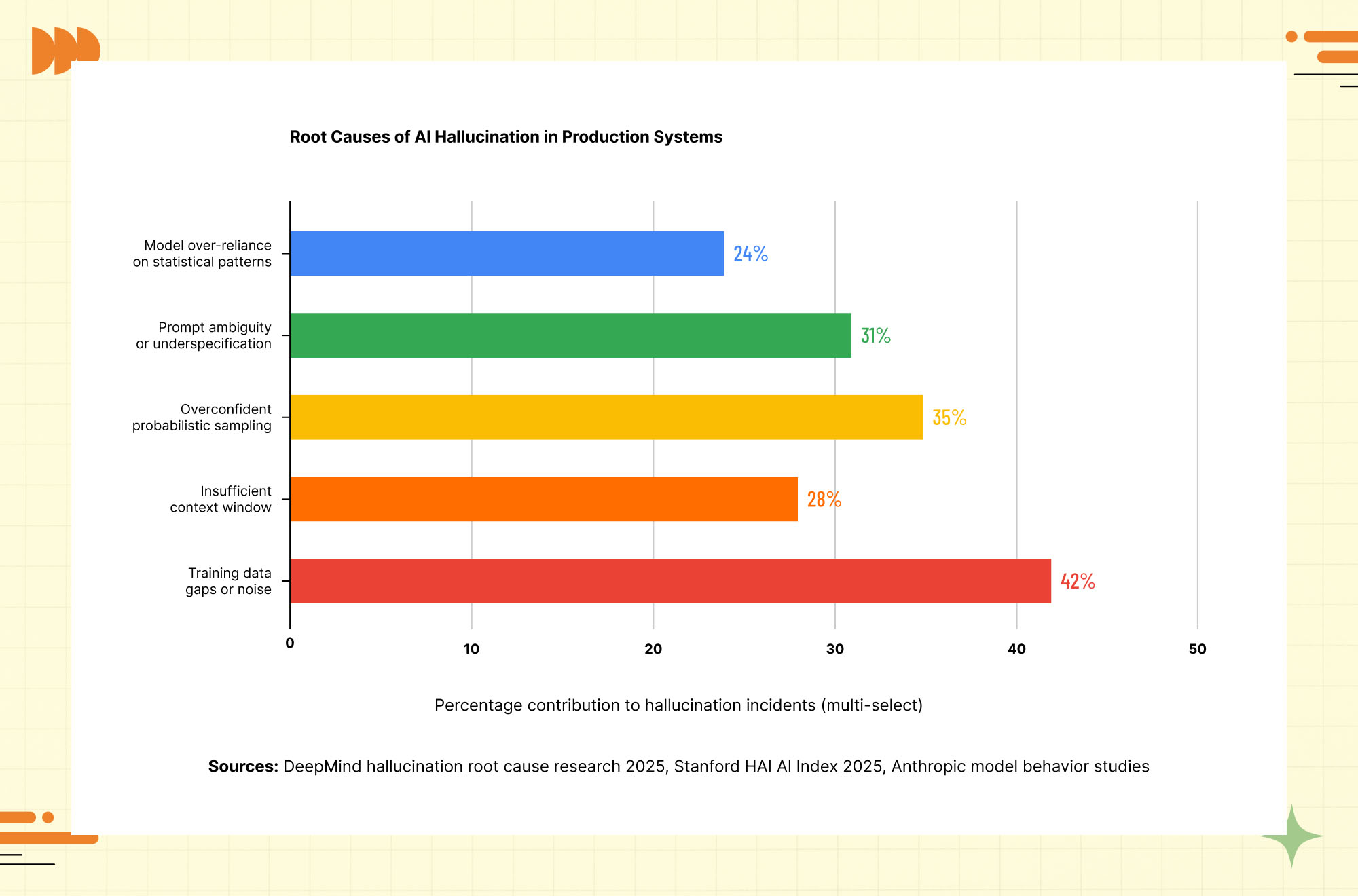
Training data gaps and noise (42% of incidents): the model was trained on data that either did not cover the specific domain being queried, contained incorrect information about that domain, or represented an older state of the world that has since changed. When an LLM is asked about something at the edge of its training distribution, it generates statistically plausible text from adjacent knowledge rather than admitting it does not know.

Overconfident probabilistic sampling (35%): LLM text generation involves sampling from a probability distribution over possible next tokens. When sampling parameters encourage confident, decisive responses (low temperature settings in the wrong context), the model produces authoritative-sounding text even when the underlying probability distribution is actually spread across many plausible options, none of which corresponds to a clearly correct answer.

Prompt ambiguity or underspecification (31%): vague, ambiguous, or underspecified prompts leave the model with too much latitude to fill in gaps. When a system prompt does not define what “I don’t know” looks like or how to handle questions outside the intended domain, the model defaults to generating a helpful-sounding response rather than declining to answer.

Insufficient or mis-retrieved context (28%): even RAG-powered systems hallucinate when the retrieved context is insufficient, irrelevant, or contradictory. A model that retrieves documents that partially match the query but do not contain the specific information needed will often fill the gap with hallucinated content rather than indicating the limitation of the retrieved context.

Model over-reliance on statistical patterns (24%): LLMs learn associations between concepts from co-occurrence patterns in training data. When asked about a specific entity (a company, a person, a product), the model may generate attributes that statistically co-occur with similar entities in its training data, even when those attributes do not apply to the specific entity in question. This is how a model confidently attributes a quote to the wrong person or describes a company’s leadership that reflects the typical pattern for that type of company rather than the actual leadership.

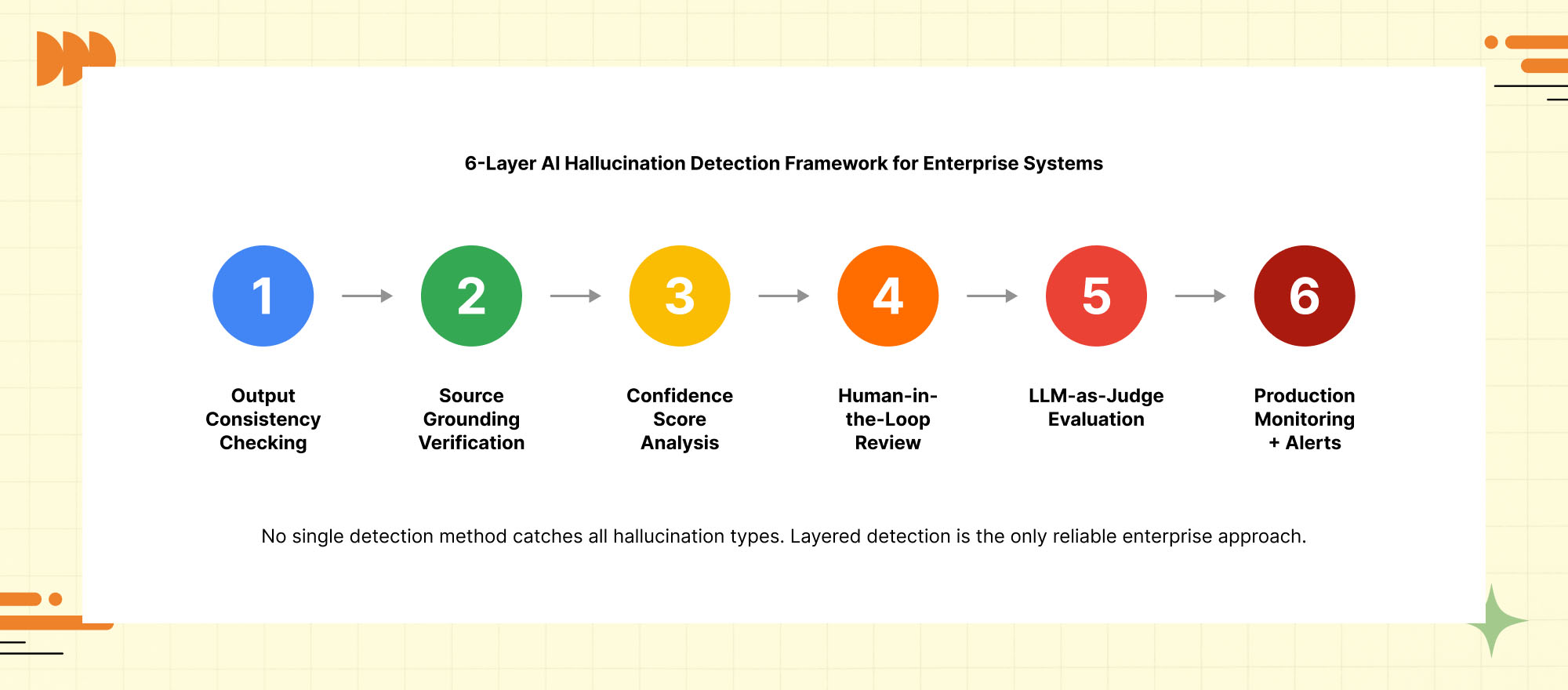
How to Reduce AI Hallucination: A 6-Layer Mitigation Framework

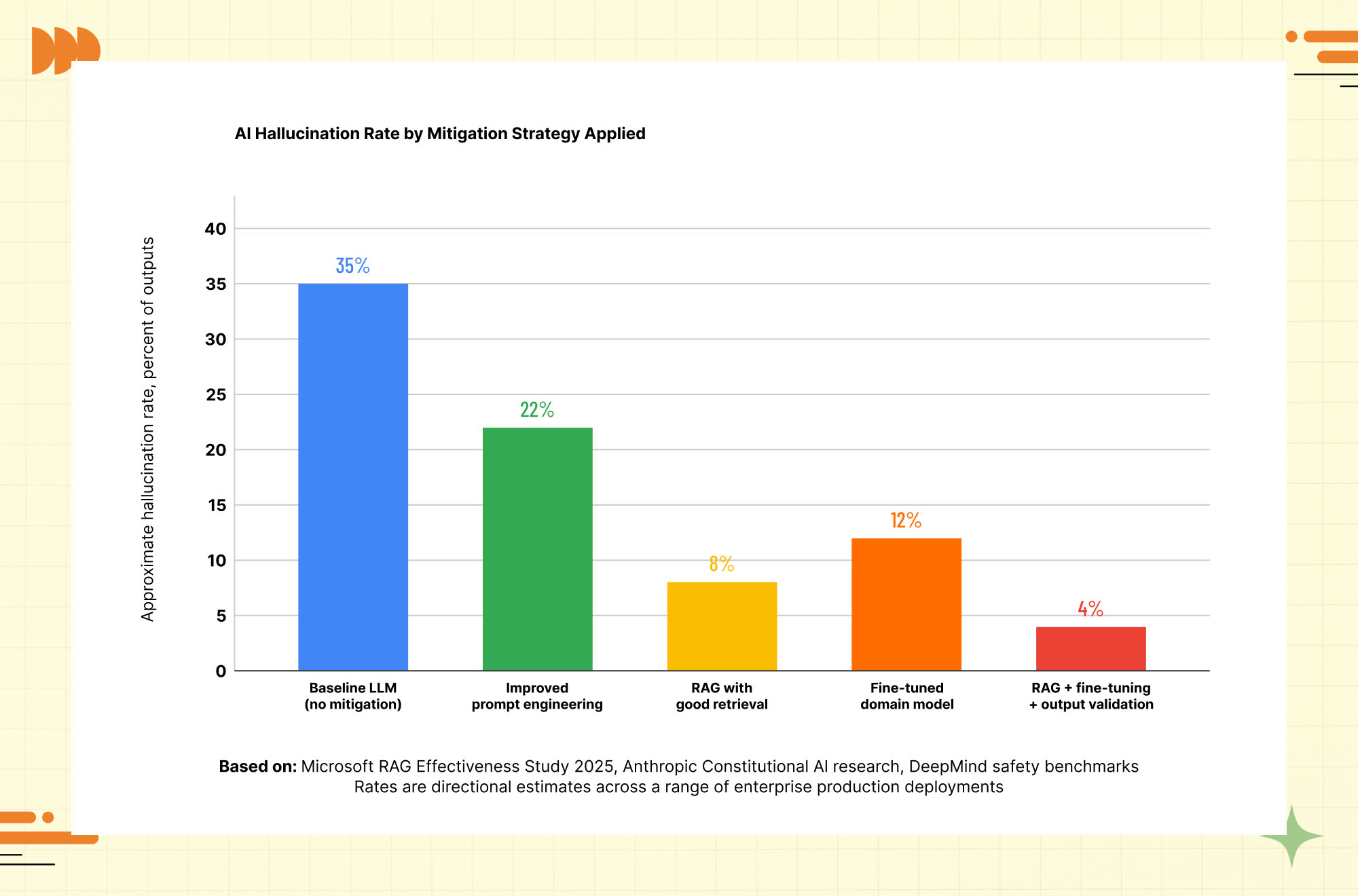
No single mitigation eliminates AI hallucination entirely. The enterprise standard is a layered architecture where multiple overlapping detection and prevention mechanisms work together to reduce hallucination to an acceptable rate for the specific risk tolerance of the deployment context.
Root causes of AI hallucinations chart showing training data issues, prompt ambiguity, context limits and model overconfidence AI hallucination mitigation comparison showing baseline LLM, prompt engineering, RAG, fine-tuning and output validation effectiveness
1 Retrieval Augmented Generation (RAG) — Prevent at the Source

RAG is the highest-impact single mitigation for factual and source hallucination. Instead of relying on the model’s parametric knowledge (what it learned during training), RAG retrieves relevant documents from a verified, current knowledge base and includes them in the prompt as grounding context. The model is instructed to answer only from the provided context and to indicate when the context does not contain sufficient information.

Microsoft’s RAG effectiveness research found an 82 percent reduction in hallucination rate when RAG is properly implemented versus a baseline LLM without retrieval. The key word is “properly”: RAG implementations that retrieve irrelevant documents, retrieve too few documents, or fail to explicitly instruct the model to stay grounded in retrieved context do not achieve this reduction.

RAG IMPLEMENTATION NOTE: RAG reduces factual and source hallucination significantly. It does not eliminate reasoning hallucination (the model can still reason incorrectly from correct retrieved facts) or instruction hallucination in agentic systems (the model can still fabricate tool call results). A complete hallucination mitigation strategy requires layers beyond RAG alone.

2 Output Consistency Checking
Run the same query multiple times with slight temperature variation and compare outputs for consistency. Factual answers from a well-grounded model are consistent across runs. Hallucinated answers tend to vary because they are generated from a diffuse probability distribution rather than retrieved fact. This technique, called self-consistency checking, identifies low-confidence outputs that warrant human review before delivery.
3 Confidence Score Analysis and Calibrated Uncertainty
Instruct the model to express uncertainty explicitly rather than generating confident text for all outputs. A prompt that defines what “I don’t know” looks like and rewards the model for expressing uncertainty (through examples in the system prompt) produces outputs that are more calibrated to actual model confidence. Flag outputs containing explicit uncertainty for human review rather than passing them directly to users.
4 Structured Output Validation
For outputs that contain specific factual claims (numerical values, named entities, dates, citations), implement automated validation that cross-checks generated values against authoritative structured data sources. A generated medication dosage can be validated against a drug database. A generated statistic can be validated against the retrieved source document. A cited URL can be validated by attempting to retrieve it. These mechanical checks catch factual and source hallucinations without requiring human review of every output.
5 LLM-as-Judge Evaluation
Use a separate LLM call to evaluate the primary output for hallucination risk. The evaluating model is given the original query, the retrieved context (if any), and the generated output, and asked to identify claims in the output that are not supported by or contradict the retrieved context. LLM-as-Judge evaluation is particularly effective at catching context hallucination in RAG systems and reasoning hallucination where the stated logic is flawed.
6 Production Monitoring and Human Escalation Routing

Deploy production monitoring that tracks hallucination-risk signals: outputs that contradict retrieved context, outputs that contain claims with low consistency across runs, outputs in domains identified as high-risk for the specific deployment. Route flagged outputs to human review rather than direct delivery. Track hallucination incident rates over time as a key production metric alongside latency and throughput.

GOVERNANCE NOTE: Under the EU AI Act, high-risk AI systems used in healthcare, financial services, employment, and similar domains are required to have human oversight mechanisms specifically because of hallucination and other failure risks. The 6-layer framework above maps directly to the technical robustness requirements in EU AI Act Article 15. Building this framework is not just best practice for reducing hallucination risk. For regulated enterprises, it is a compliance requirement.

AI Hallucination by Risk Level: What Requires What Level of Mitigation

The appropriate level of hallucination mitigation investment depends on the consequences of a hallucination reaching a user or a downstream process. Not all hallucination risks are equal.

🔴 Critical Risk
Any AI application where a hallucination could cause direct physical harm, legal liability, or financial harm to a third party. Healthcare clinical decision support, legal document drafting, financial advice, and regulated compliance applications fall here. All 6 mitigation layers are appropriate, including mandatory human review for high-confidence flagged outputs.
🟠 High Risk
Customer-facing applications where a hallucination damages customer trust, causes a purchase decision based on incorrect information, or creates a contractual misrepresentation. Customer service AI, product recommendation systems, and customer-facing chatbots fall here. Layers 1 through 4 are the minimum standard.
🟡 Medium Risk
Internal productivity applications where a hallucination causes wasted work or internal miscommunication but does not escape to external parties. Internal knowledge bases, meeting summarizers, and internal research assistants fall here. RAG grounding, output consistency checking, and user-facing uncertainty disclosure are the baseline.
🟢 Lower Risk
Creative and generative applications where factual precision is not the primary value. Content brainstorming, draft generation for human editing, and ideation tools fall here. Basic prompt engineering and user awareness training are sufficient.

RISK CLASSIFICATION WARNING: Many enterprises underestimate the risk level of their AI deployments because they focus on intended use rather than possible failure consequences. An internal AI assistant intended for employee productivity becomes a high-risk application the moment employees start relying on it for decisions that affect customers, finances, or compliance. Classify risk based on the worst-case realistic failure consequence, not the intended nominal use case.

Frequently Asked Questions About AI Hallucination

Q: What is AI hallucination?
AI hallucination is when a large language model generates output that is factually incorrect, fabricated, or contradictory, stated with apparent confidence and without indicating any uncertainty. The term describes the model producing text that is statistically plausible given its training but does not correspond to reality. AI hallucination is not a bug in a specific model that can be patched. It is a fundamental property of how LLMs generate text: by predicting probable next tokens rather than retrieving verified facts from a structured knowledge base.
Q: What are the most common examples of AI hallucination?
The most widely documented AI hallucination examples include: attorneys submitting legal briefs with AI-hallucinated case citations that did not exist (Mata v. Avianca, 2023), financial AI assistants generating incorrect analyst estimates or inventing references to earnings calls, customer service chatbots describing product features that do not exist, healthcare AI pilots generating medication dosages that do not correspond to approved protocols, and AI coding assistants generating calls to API methods that do not exist in the referenced library. In each case the hallucination was presented with the same apparent confidence as accurate information.
Q: Why do AI models hallucinate?
AI models hallucinate for several distinct reasons: training data gaps where the model lacks sufficient accurate information about a specific domain or recent event, overconfident sampling where the generation process produces decisive-sounding text even when no clearly correct answer exists in the probability distribution, prompt ambiguity that leaves the model without guidance on how to handle questions outside its competence, insufficient or mis-retrieved context in RAG systems, and over-reliance on statistical co-occurrence patterns that associate attributes with entity types rather than with specific entities.
Q: How can enterprises reduce AI hallucination?
The most effective single mitigation is Retrieval Augmented Generation (RAG), which grounds model outputs in verified, current documents rather than parametric knowledge and reduces hallucination rates by up to 82 percent when properly implemented. A complete enterprise framework layers RAG with output consistency checking (running queries multiple times and comparing), structured output validation against authoritative data sources, LLM-as-Judge evaluation that uses a second model to check the first, production monitoring that flags risky outputs, and human escalation routing for high-confidence risk signals. No single layer eliminates hallucination entirely; overlapping layers are required.
Q: Is AI hallucination getting better with newer models?
Newer frontier models (GPT-4o, Claude Opus, Gemini Ultra) demonstrate lower hallucination rates on benchmark evaluations than earlier generations. However, IBM’s 2025 enterprise survey found that 76 percent of enterprise AI deployments still experienced hallucination issues in production, even with newer models. This gap between benchmark performance and production behavior exists because benchmarks test general accuracy while enterprise production environments involve highly specific domain questions, edge cases, and user queries that fall at the periphery of the model’s training distribution. Model improvement reduces the baseline hallucination rate but does not eliminate the need for architectural mitigation.
Q: What is the difference between AI hallucination and AI bias?
AI hallucination refers specifically to a model generating false or fabricated information stated as fact. AI bias refers to a model producing outputs that systematically favor or disadvantage certain groups, perspectives, or outcomes in ways that reflect biases in training data or model design. Both are AI failure modes, but they require different detection and mitigation strategies. Hallucination is detected by checking factual accuracy and source grounding. Bias is detected by analyzing output distributions across demographic groups, protected categories, and different framing of equivalent queries. An AI system can hallucinate without being biased and can be biased without technically hallucinating.

AI Hallucination Is Not a Reason to Avoid AI. It Is a Reason to Deploy It Correctly.

The statistics in this guide are not arguments against deploying AI in enterprise contexts. They are arguments for deploying it with the architectural rigor that the specific risks demand. The 13 percent of AI deployments that do not experience hallucination issues in production are not using better models. They are using layered mitigation frameworks, grounded architectures, and structured detection systems that the 76 percent majority has not yet implemented.

The cost of AI hallucination in enterprise contexts, estimated at over $1.2 million per high-stakes incident by Gartner, is dramatically higher than the cost of building the mitigation infrastructure in the first place. RAG grounding, output validation, and production monitoring are well-understood engineering problems with well-understood solutions. The organizations that treat hallucination risk as a fundamental design constraint rather than an edge-case footnote are the ones that capture AI’s productivity and competitive advantages without the liability exposure that comes from deploying LLMs without adequate safeguards.

At Trantor, we build enterprise AI systems with hallucination mitigation built in from the architecture stage, not retrofitted after an incident. Our work spans RAG pipeline design and optimization, structured output validation frameworks, LLMOps monitoring for production hallucination detection, and the governance frameworks required by the EU AI Act and US regulatory guidance. Whether you are designing an enterprise AI system for the first time, auditing an existing deployment for hallucination risk, or responding to a hallucination incident that has already occurred, we are ready to help.

Explore Trantor’s Enterprise AI Services: Artificial Intelligence
Enterprise AI hallucination mitigation services for RAG pipelines, LLMOps monitoring, output validation and AI governance