Artificial Intelligence, zBlog
What Is AI Reasoning? How o1, o3, and Thinking Models Actually Work
trantorindia | Updated: August 14, 2026
What is AI reasoning?
AI reasoning refers to a class of large language models that generate internal chains of thought before producing a final answer, spending additional compute time to check, revise, and verify their reasoning before responding. Models like OpenAI o1, o3, and Anthropic’s Claude with Extended Thinking use this approach to dramatically improve accuracy on complex multi-step problems where standard LLMs fail.
When OpenAI released o1 in September 2024, it scored 83 percent on the AIME 2024 mathematics benchmark, a competition-level test where GPT-4o had scored 13 percent. That 70-point gap on the same underlying benchmark is the most concrete way to understand what AI reasoning models actually do differently, and why they represent a genuine architectural shift rather than an incremental improvement.
AI reasoning models like o1, o3, and Claude Extended Thinking do not simply generate a faster or more sophisticated response to a prompt. They allocate time to think before responding, using a technique called chain-of-thought reasoning at the model level to explore multiple approaches, check their own work, identify errors, and revise their reasoning before producing a final answer. The thinking happens internally, in what the model generates before its visible response, and it is this internal deliberation that produces the dramatic accuracy improvements on complex reasoning tasks.
This guide explains how AI reasoning models work mechanically, what the benchmark numbers actually mean for practical enterprise use cases, which models are available and what differentiates them, when a reasoning model genuinely improves outcomes versus when it adds cost and latency without benefit, and what AI reasoning models still cannot do that their benchmark scores might suggest they can.
The most important practical point about AI reasoning models: they are not universally better than standard LLMs. They are dramatically better on specific task types and provide no benefit or negative cost-to-value ratios on others. Understanding when to use AI reasoning is as important as understanding how it works.
What Is AI Reasoning? The Mechanical Explanation
Standard large language models generate text one token at a time, each token predicted from all preceding tokens in a single forward pass through the model’s parameters. This works remarkably well for most tasks: writing, summarizing, extracting information, answering factual questions, and generating code for straightforward problems. Where it breaks down is on tasks that require holding multiple constraints in mind simultaneously, checking whether a proposed solution actually satisfies all those constraints, and backtracking when the current approach is not working.
AI reasoning models address this limitation through a technique called extended chain-of-thought reasoning, trained at the model level rather than imposed through prompting. During training, these models learn to generate lengthy internal reasoning sequences, checking and revising their own thinking, before producing a final answer. At inference time, when you submit a query to o1, o3, or Claude with Extended Thinking, the model generates a stream of internal “thinking tokens” that are not shown to the user, then produces the visible response only after that internal deliberation is complete.
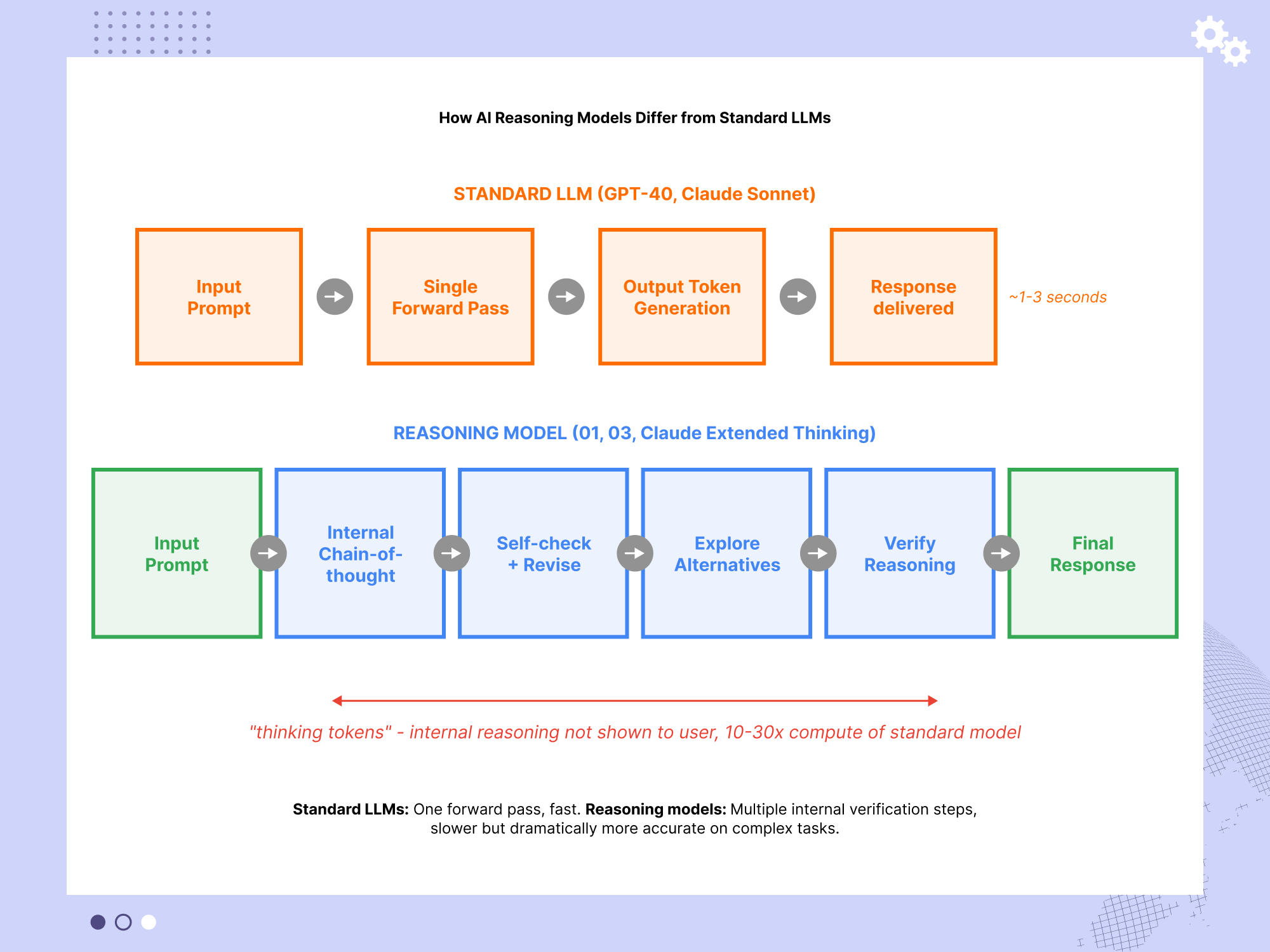
The “thinking tokens” are the key. When o3 scores 84 percent on ARC-AGI while GPT-4o scores 53 percent, the difference is not a larger or better-trained base model in the conventional sense. It is the compute allocated to internal reasoning before the response. This approach, called test-time compute scaling, means the model invests more computation at inference time rather than only during training, which is why reasoning models are significantly slower and more expensive per query than standard models on the same provider.
Why this matters for enterprise deployments: AI reasoning models are billed differently from standard models because they consume significantly more tokens, including the internal thinking tokens, to generate a single response. A query that costs $0.002 on GPT-4o might cost $0.04 to $0.20 on o1 or o3 depending on the complexity and the thinking budget. For high-volume applications, this cost difference requires careful use-case analysis before defaulting to a reasoning model.
The AI Reasoning Model Timeline: From o1 to the Present
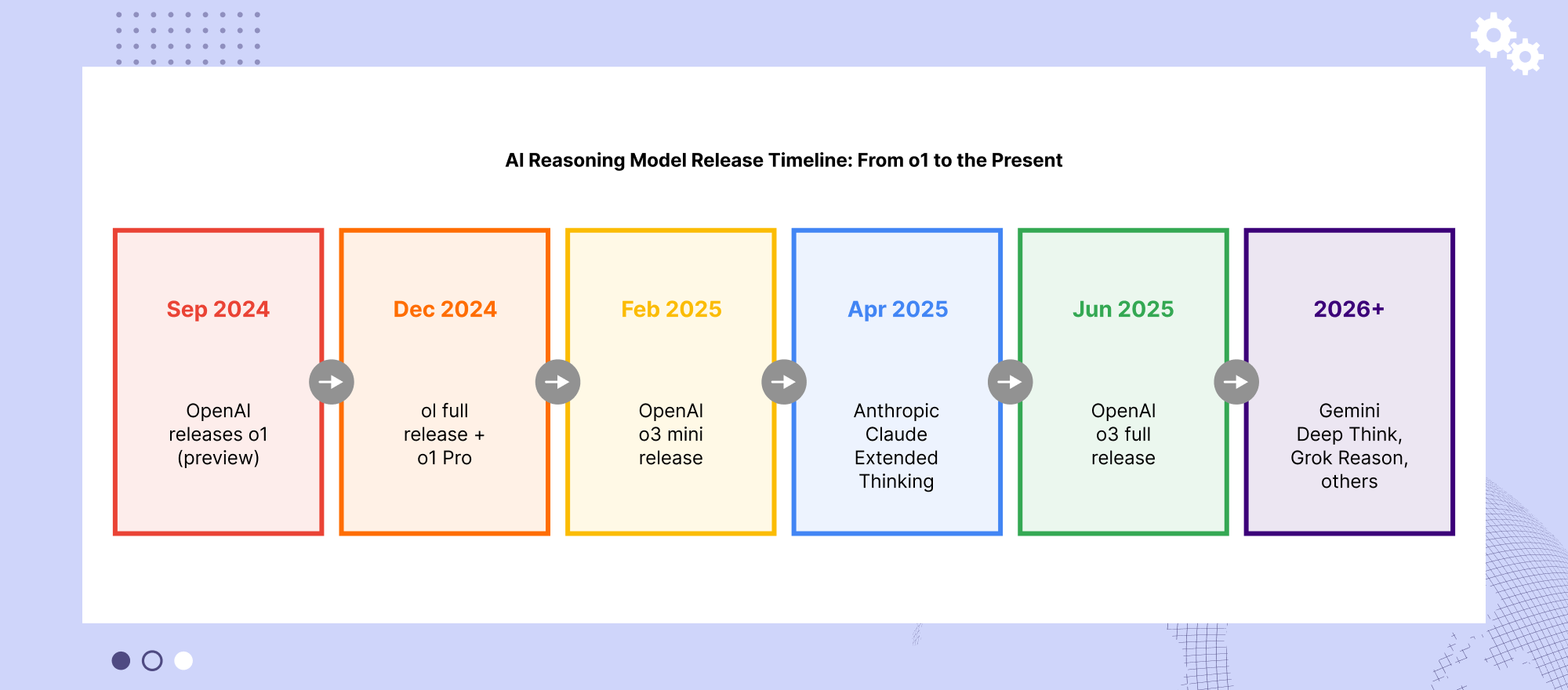
AI reasoning as a publicly available capability began with OpenAI’s release of o1 in preview in September 2024. The release was significant not only for the benchmark scores but because OpenAI explicitly described it as a different paradigm from GPT-4: instead of just training a larger model on more data, o1 was trained to spend time reasoning before responding, using a process the company called “thinking” that happens internally before the visible output.
OpenAI followed the o1 preview with the full o1 release and o1 Pro in December 2024, then o3 mini in February 2025, and the full o3 release in April 2025. o3 significantly exceeded o1 on nearly every benchmark, most dramatically on ARC-AGI where o1 had scored 32 percent and o3 reached 84.3 percent. Anthropic released Claude with Extended Thinking in April 2025, making Claude’s chain-of-thought reasoning available through its API. By mid-2026, nearly every major LLM provider has released or announced reasoning model capabilities, including Google with Gemini Deep Think and xAI with Grok reasoning variants.
AI Reasoning Model Benchmark Performance: What the Numbers Actually Mean
Benchmark scores for AI reasoning models are frequently cited without context about what the benchmarks actually measure and where the improvement is most practically relevant. Here is the full picture.
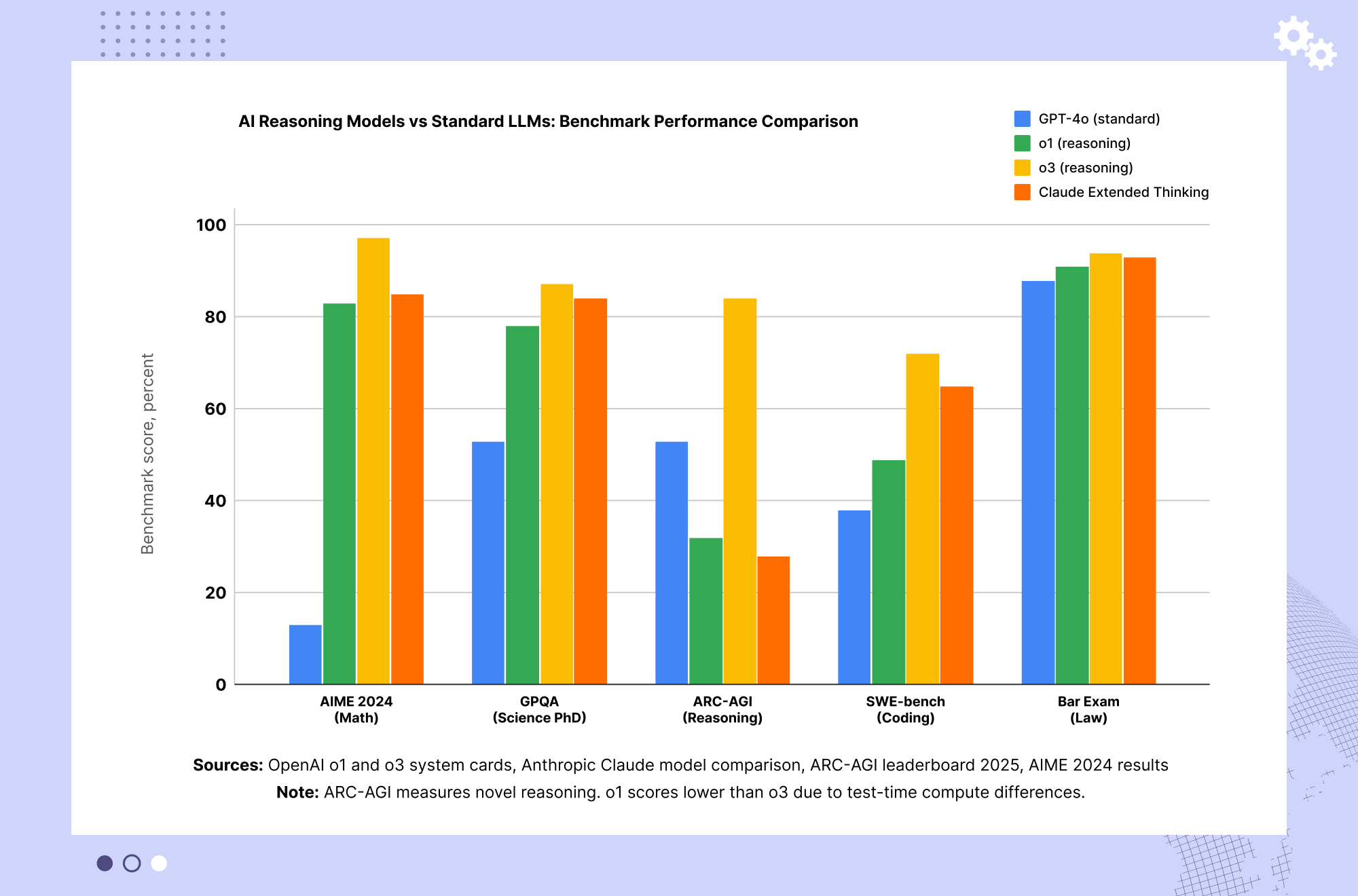
AIME 2024 (Competition Mathematics): AIME is the American Invitational Mathematics Examination, a competition that tests advanced problem-solving in mathematics. GPT-4o scored 13 percent. o1 scored 83 percent. o3 scored 96.7 percent. This benchmark directly measures the multi-step mathematical reasoning where chain-of-thought thinking provides the largest advantage: problems that require maintaining and checking multiple algebraic constraints across many steps, where a single error in step three invalidates everything that follows.
GPQA (Graduate-Level Science Questions): GPQA tests PhD-level questions in chemistry, biology, and physics written by domain experts specifically to require genuine scientific reasoning rather than factual recall. GPT-4o scored 53 percent. o1 scored 78 percent. o3 scored 87 percent. Claude Extended Thinking reached 84 percent. For enterprise teams using AI on scientific or technical research, this benchmark is more directly relevant than mathematics competitions.
ARC-AGI (Abstract Reasoning): ARC-AGI was designed specifically to test novel reasoning that cannot be solved by pattern-matching against training data, making it a particularly revealing benchmark for genuine reasoning capability. GPT-4o scored 53 percent. o1 scored 32 percent, a counterintuitive result explained by the fact that o1 was an earlier model with less test-time compute budget. o3 with high compute settings reached 84.3 percent, which was particularly significant because the benchmark had been designed to be very difficult for LLMs.
SWE-bench (Real-World Software Engineering): SWE-bench tests an AI’s ability to resolve actual GitHub issues from real open-source software repositories. GPT-4o resolved 38 percent. o3 resolved 72 percent. This benchmark is the most directly relevant for enterprise software development use cases, because it measures coding tasks that mirror what a developer actually encounters rather than algorithmic puzzles.
BENCHMARK HONESTY NOTE: Benchmark scores measure what they measure. An o3 score of 84 percent on ARC-AGI does not mean the model solves 84 percent of all reasoning problems you might throw at it in production. ARC-AGI is specifically designed to test abstract pattern recognition. Your enterprise use case may or may not share characteristics with that benchmark. The practical question is whether your specific task type shows the same performance gap between standard and reasoning models that the benchmarks show. For mathematical and logical reasoning tasks, that gap is very real. For writing tasks, summarization, and conversational AI, the gap largely disappears.
The Main AI Reasoning Models Available in 2026
OpenAI o1 and o3
The models that defined the AI reasoning category, with o3 representing the current frontier of publicly available reasoning performance.
o1 vs o3: o1 was released first (September 2024) and established the category. o3 (released April 2025) significantly exceeds o1 on most benchmarks, particularly ARC-AGI (32% for o1 versus 84.3% for o3) and SWE-bench (49% for o1 versus 72% for o3). For most new deployments, o3 is the appropriate choice unless API cost constraints favor o1
o3 mini: A smaller, faster, and cheaper variant of o3 optimized for cost-sensitive deployments that still need reasoning capability. o3 mini trades some peak accuracy for significantly lower inference cost and latency, making it more suitable for higher-volume reasoning tasks where o3 full would be cost-prohibitive
Thinking budget: Both o1 and o3 can be configured with a “thinking budget” via the reasoning_effort parameter in the API, allowing developers to trade accuracy for speed and cost on a per-request basis
Limitations: Reasoning models do not support streaming in the same way as standard GPT models. The extended internal reasoning time means responses are not available for streaming until the thinking phase is complete, which affects real-time user-facing applications
Best for: Complex code generation, mathematical analysis, multi-step logical reasoning, scientific research synthesis, and any task where GPT-4o produces inconsistent or incorrect results on complex instances
Anthropic Claude with Extended Thinking
Anthropic’s reasoning-capable variant of Claude, which makes the internal chain-of-thought available to developers for inspection rather than hiding it completely.
Extended Thinking: When Extended Thinking is enabled through the API, Claude generates a visible thinking block in its response that shows the actual internal reasoning process. This distinguishes it from o1 and o3, which keep internal thinking hidden from the API response
Benchmark performance: Claude Extended Thinking scores 85 percent on AIME, 84 percent on GPQA, and 65 percent on SWE-bench, competitive with o1 and approaching o3 on most benchmarks while often providing more transparent reasoning output
Context window advantage: Claude maintains its 200,000 token context window even when Extended Thinking is enabled, which matters for reasoning tasks that require analyzing long documents alongside complex problem-solving
Budget tokens parameter: The thinking budget for Claude is controlled via the budget_tokens parameter, which sets the maximum number of tokens to allocate to internal thinking. Higher budgets improve accuracy on harder problems at the cost of latency and token consumption
Best for: Tasks where seeing the reasoning chain is valuable for audit, verification, or explanation purposes. Legal analysis, financial modeling verification, and any regulated context where the reasoning must be inspectable
Google Gemini Deep Think (Gemini 2.0 Flash Thinking)
Google’s reasoning model variant, tightly integrated with Google Workspace and Google Cloud infrastructure.
Current status: Gemini 2.0 Flash Thinking is available through Google AI Studio and the Gemini API as of early 2026. Full Deep Think capabilities are rolling out progressively across the Gemini model family
Integration advantage: Gemini reasoning models have native access to Google Search and Google Workspace data, which makes them uniquely capable for research tasks that combine extended reasoning with real-time web retrieval
Context window: Gemini 2.0 Flash Thinking maintains up to 1 million token context during thinking, the largest context window of any reasoning model available
Best for: Enterprise teams on Google Cloud, applications requiring both extended reasoning and real-time information retrieval, and multimodal reasoning tasks combining images and text
AI Reasoning vs Standard LLMs: When Reasoning Actually Helps
The most actionable question about AI reasoning models is not how they work but when to use them. The answer requires being specific about task type, because the performance gap varies from enormous to negligible depending on what you are asking the model to do.
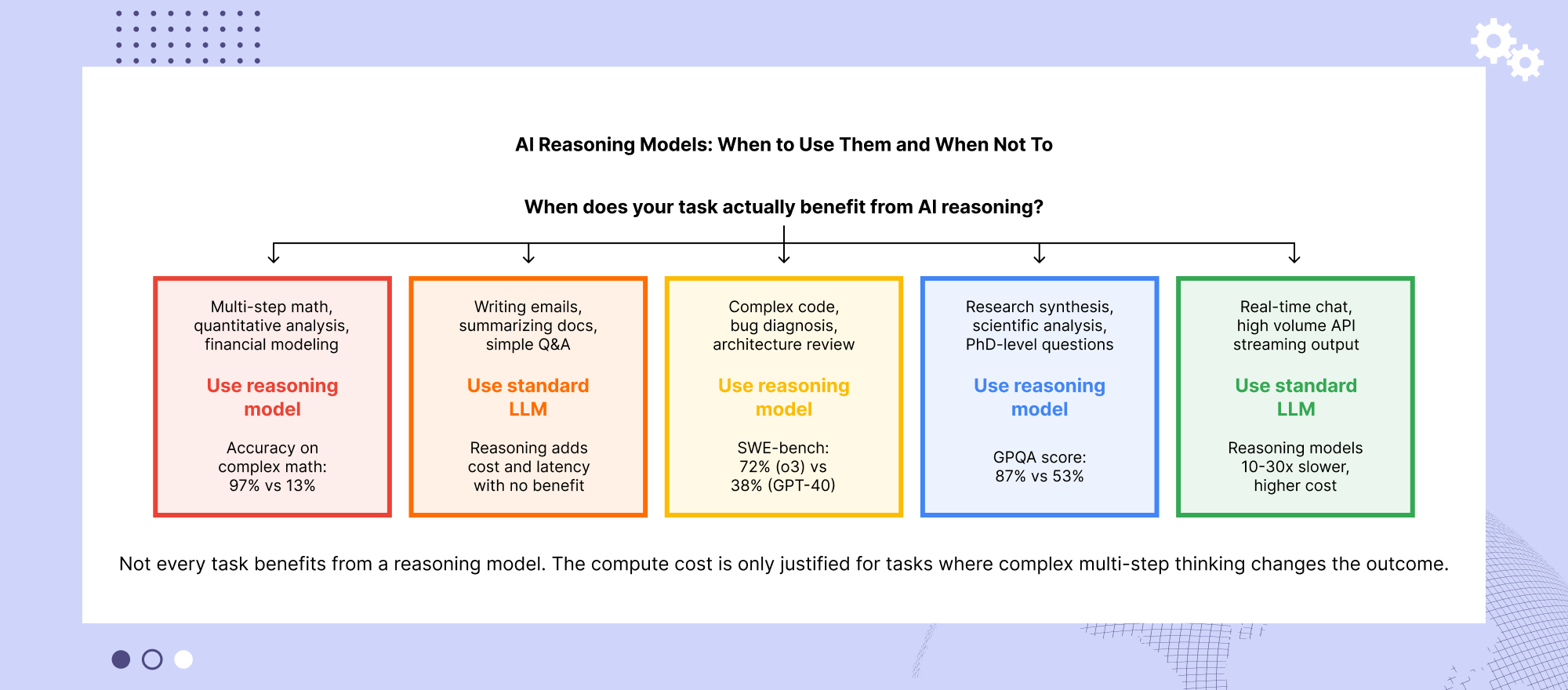
Tasks where AI reasoning provides large, measurable gains: complex mathematics and quantitative analysis, multi-step logical deduction, code debugging for hard bugs that require understanding a complex call chain, scientific literature synthesis requiring cross-domain reasoning, legal analysis requiring checking for internal consistency and exception handling, and any task where a standard LLM consistently produces subtly wrong results on complex instances.
Tasks where AI reasoning provides minimal or no benefit: writing and editing (Claude Sonnet and GPT-4o produce writing quality that reasoning models do not measurably improve), simple factual questions, summarization, translation, creative generation, customer service conversations, and classification tasks. These tasks do not benefit from extended chain-of-thought because they do not require the multi-step verification that thinking provides.
Tasks where AI reasoning may actually be harmful: real-time user-facing applications where the 10 to 30x latency increase is user-perceptible, high-volume API applications where the cost increase is economically prohibitive, and creative writing tasks where the deliberate, structured thinking of reasoning models produces less natural-sounding output than standard models.
PRACTICAL HEURISTIC FOR ENTERPRISE TEAMS: A reliable indicator that a task will benefit from AI reasoning is whether a smart human expert would benefit from being given more time to think before answering. If a financial analyst would produce a meaningfully better analysis with an extra hour of careful reasoning versus one minute, an AI reasoning model will likely outperform a standard LLM on the same task. If a skilled writer would produce essentially the same email draft after five minutes of careful thinking as after thirty seconds, a reasoning model will not meaningfully outperform a standard model on that writing task.
AI Reasoning in Enterprise Workflows: Real Use Cases
Financial modeling and analysis: AI reasoning models handle multi-variable financial models significantly better than standard LLMs. A query asking a model to evaluate whether a proposed acquisition meets 12 specific financial criteria, identify which criteria are not met, and estimate the gap requires exactly the kind of multi-constraint verification that reasoning models provide. Standard LLMs on complex financial queries frequently miss constraints or make arithmetic errors that compound across steps.
Legal document analysis: reviewing contracts for consistency, identifying clauses that conflict with each other or with governing law, and checking that defined terms are used consistently throughout a lengthy document are all tasks where AI reasoning models show large performance gains. The ability to maintain a complex logical model of a document across many pages and check new clauses against earlier definitions is where extended thinking provides concrete value.
Complex software debugging: when a bug requires understanding a multi-file call chain, reasoning about race conditions, or tracing memory management across a complex system, AI reasoning models can work through the problem more systematically than standard models. The SWE-bench improvement from 38 percent (GPT-4o) to 72 percent (o3) reflects exactly this capability on real-world software engineering problems.
Scientific research synthesis: reasoning models handle questions that require synthesizing information across multiple papers or domains, resolving apparent contradictions between findings, and reaching a defensible conclusion while acknowledging uncertainty. The 84 percent GPQA score for o3 on PhD-level science questions reflects genuine capability for this type of research support work.
Compliance checking: checking whether a proposed action, contract, or process satisfies a complex set of regulatory requirements requires the same multi-constraint verification that AI reasoning excels at. An AI reasoning model that can simultaneously check a data processing agreement against GDPR Article 28, the CCPA requirements, and a company’s internal data policy and produce a gap analysis is providing genuine value that standard models handle less reliably.
DEPLOYMENT RISK: One of the more subtle risks with AI reasoning models in enterprise deployments is over-trust. Because the model produces detailed, internally consistent reasoning, outputs can feel more authoritative than those of standard models. A well-reasoned but incorrect analysis is more dangerous than an obviously uncertain response because it is more likely to be accepted without verification. Apply the same human review and output validation standards to reasoning model outputs that you apply to standard LLM outputs.
What AI Reasoning Models Still Cannot Do
The benchmark improvements from AI reasoning models are real, but they are frequently overstated in popular coverage. Understanding the genuine limits is essential for deploying these models appropriately in enterprise contexts.
They still hallucinate: AI reasoning models reduce hallucination on factual questions but do not eliminate it. A reasoning model that works through a complex problem carefully can still reach a confidently wrong conclusion if the premises it starts from are incorrect. Hallucination mitigation strategies, including RAG grounding and output validation, remain necessary with reasoning models.
They cannot access real-time information: like standard LLMs, reasoning models have a training data cutoff and do not know about events after that cutoff unless augmented with retrieval. The reasoning capability does not compensate for missing information.
They are significantly slower: the 10 to 30x increase in response time for complex reasoning queries is not an artifact that will be optimized away. It reflects genuine additional computation being performed. Applications that require sub-second responses should not use reasoning models for those latency-sensitive paths.
They are more expensive: o3 costs significantly more per output token than GPT-4o, reflecting the additional compute consumed by internal reasoning. At scale, this cost difference is material and requires careful cost modeling before committing to reasoning models in production.
Reasoning does not substitute for domain knowledge: a reasoning model asked about a highly specialized domain where its training data was sparse will still produce low-quality output, regardless of how carefully it reasons. Careful wrong reasoning is still wrong. Domain-specific retrieval and grounding remain important even for reasoning-capable models.
Frequently Asked Questions About AI Reasoning Models
Q: What is an AI reasoning model?
An AI reasoning model is a large language model trained to generate internal chains of thought before producing a final answer. Models like OpenAI o1, o3, and Anthropic Claude with Extended Thinking allocate additional compute time to internal deliberation, checking and revising their reasoning before responding. This approach, called test-time compute scaling or extended chain-of-thought reasoning, dramatically improves accuracy on complex multi-step problems including mathematics, logical reasoning, scientific analysis, and complex software engineering tasks.
Q: What is the difference between o1 and o3?
o1 was OpenAI’s first publicly released reasoning model, released in September 2024. o3 is a significantly more capable successor released in April 2025. On AIME 2024 mathematics, o1 scored 83 percent and o3 scored 96.7 percent. On ARC-AGI abstract reasoning, o1 scored 32 percent and o3 scored 84.3 percent. On SWE-bench software engineering, o1 scored 49 percent and o3 scored 72 percent. o3 also costs more than o1 per query. OpenAI also offers o3 mini as a faster, cheaper variant that sacrifices some peak accuracy for better cost efficiency on high-volume reasoning tasks.
Q: How do AI reasoning models work?
AI reasoning models generate internal “thinking tokens” before producing their visible response. These thinking tokens represent the model’s chain-of-thought: exploring multiple approaches, checking intermediate results, identifying errors in its own reasoning, and revising its approach before committing to a final answer. This internal deliberation is not visible to users by default (in o1 and o3) but can be made visible (in Claude Extended Thinking). The amount of thinking is controlled by a “thinking budget” or “reasoning effort” parameter that allows developers to trade accuracy against speed and cost per query.
Q: When should I use a reasoning model versus a standard LLM?
Use a reasoning model when the task requires multi-step logical or mathematical reasoning, when a standard LLM consistently produces incorrect results on complex instances of the task, or when the accuracy improvement justifies the 10 to 30x increase in latency and significant increase in cost. Specific use cases where reasoning models consistently outperform standard LLMs include complex financial modeling, legal document consistency checking, hard software debugging, scientific research synthesis, and compliance gap analysis. Do not use reasoning models for writing, summarization, customer service conversations, classification, or any real-time application where sub-second response times are required.
Q: Do AI reasoning models still hallucinate?
Yes. AI reasoning models reduce hallucination rates on factual and logical tasks compared to standard LLMs, but they do not eliminate hallucination. A reasoning model that carefully works through incorrect premises will produce a confidently wrong, well-reasoned answer that may be more dangerous than an obviously uncertain response from a standard model because it is more likely to be accepted without verification. The same hallucination mitigation strategies that apply to standard LLMs, including retrieval augmented generation, output validation, and human review for high-stakes decisions, remain necessary with reasoning models.
Q: What is chain-of-thought reasoning in AI?
Chain-of-thought reasoning is a technique where a language model generates intermediate reasoning steps rather than jumping directly from a problem to an answer. When applied through prompting of standard models, it is called chain-of-thought prompting. In reasoning models like o1 and o3, it happens internally at the model level during training and inference rather than being imposed through prompts. The result is that the model checks its own work, explores alternative approaches, and identifies errors in its reasoning before committing to a final answer, which is why reasoning models show such large accuracy improvements on tasks that require multiple verified steps to solve correctly.
AI Reasoning Is a Tool, Not a Universal Upgrade
AI reasoning models represent a genuine architectural advance in large language model capabilities. The benchmark improvements on mathematics, scientific reasoning, and complex software engineering are real, reproducible, and large enough to matter for enterprise applications in those domains. o3 scoring 84.3 percent on ARC-AGI, a benchmark specifically designed to resist pattern-matching approaches, is a meaningful result.
What they are not is a universal upgrade that should replace standard LLMs across all enterprise AI workloads. The 10 to 30x compute increase is real, the cost implications are material at scale, and the latency increase is user-perceptible in real-time applications. The correct enterprise strategy is to maintain a portfolio of models, routing tasks to standard LLMs where they are adequate and reserving AI reasoning model capacity for the specific task types where the accuracy improvement justifies the cost and latency premium.
At Trantor, we help enterprise teams design AI architectures that use reasoning models where they genuinely improve outcomes and standard models where they do not, rather than applying reasoning models uniformly at unnecessary cost. Whether you are evaluating o1, o3, or Claude Extended Thinking for a specific workflow, building a routing layer that selects the right model for each query type, or integrating reasoning model capabilities into an existing LLM application, we bring the implementation experience to make those decisions with real data rather than benchmark marketing.
Explore Trantor’s Enterprise AI Services: Artificial Intelligence