Artificial Intelligence, zBlog
Generative AI in Retail — The Complete 2026 Guide: Use Cases, ROI, and Real Brand Examples
trantorindia | Updated: June 15, 2026
Generative AI in retail went from a forecast to a revenue line item during the 2025 holiday season. AI and AI agents drove $262 billion in global retail revenue — roughly 20% of total holiday sales. Traffic to US retail websites from generative AI platforms grew 4,700% year over year. Shoppers arriving from AI platforms converted 31% higher than standard traffic and spent 45% more time on retailer sites.
These are not projected benefits. They are documented outcomes from a single season — and they represent the early phase of a transformation that McKinsey estimates will add $400 to $660 billion in annual value to the global retail sector.
Yet most retailers are still in the early stages of figuring out where generative AI fits into their specific operations. The use case options are broad — personalization, product content, demand forecasting, customer service, supply chain, marketing, visual search, employee enablement — and the temptation to try everything simultaneously is exactly what turns AI investments into expensive disappointments. This guide is designed to fix that. It covers every major use case with real brand examples, an honest ROI assessment, a function-by-function priority framework, and a practical implementation roadmap for retailers at any stage of AI adoption.
The most important shift in retail AI in 2026 is not generative AI itself — it is the emergence of agentic commerce. By 2025, consumers began adopting general-purpose AI tools like ChatGPT as external shopping advisors that could synthesize and compare information across retailers, trends, reviews, and price points. AI systems began anticipating needs, planning multi-step tasks, and supporting users end-to-end from discovery through checkout. The retailers winning in the agentic commerce era are the ones that have ensured their products, data, and content are optimized for AI discovery — not just Google discovery.
Why 2026 Is the Year Generative AI Becomes a Retail Necessity
Retailers have been running some form of AI for years — recommendation engines, demand-forecasting algorithms, fraud-detection models. What changed with generative AI is not the presence of AI in the retail stack. It is the type of value AI can now create, and the speed at which consumer behavior is shifting to expect it.
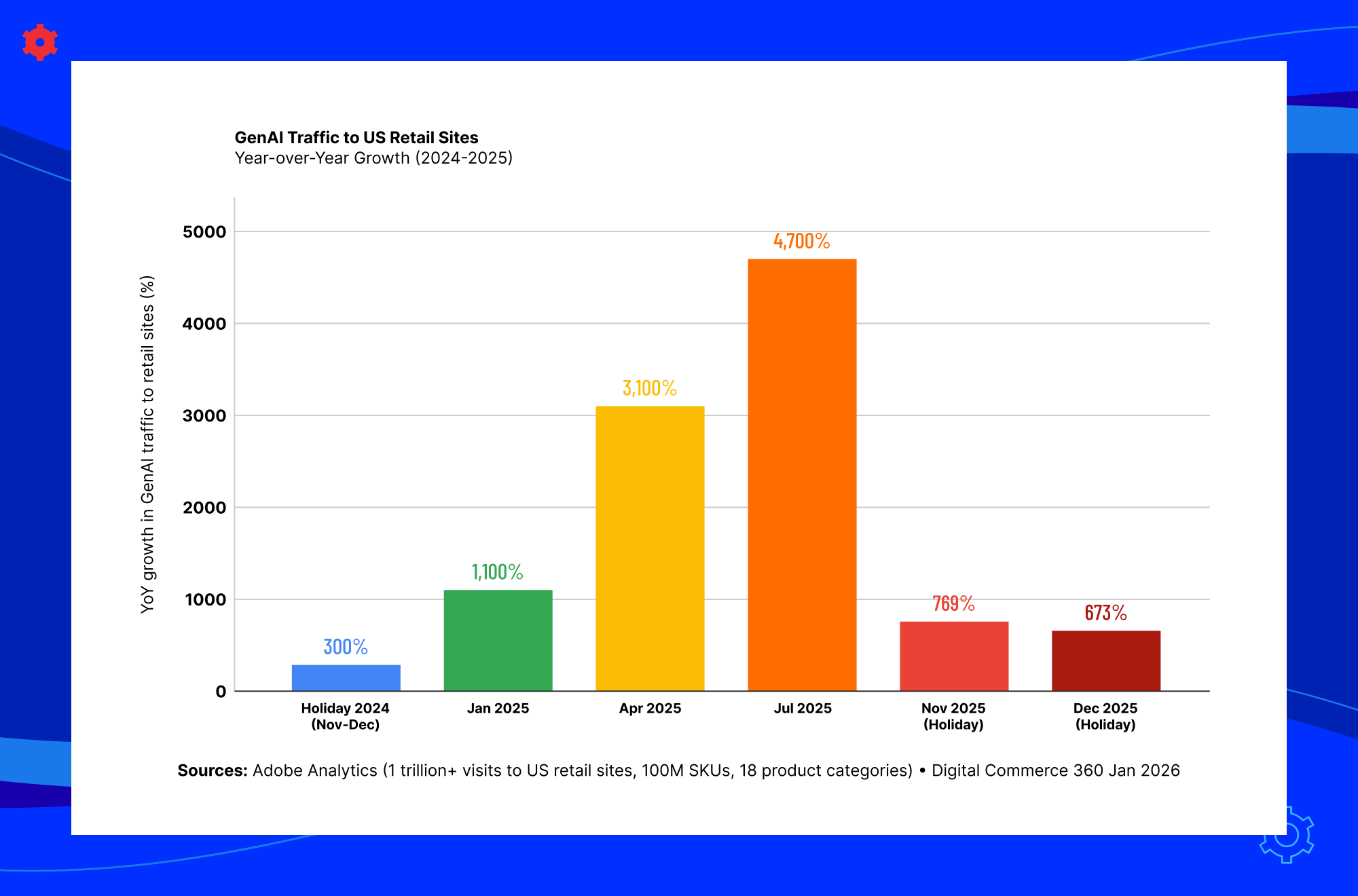
The Adobe data is the clearest signal. Traffic to retail sites from generative AI platforms grew 4,700% year over year by July 2025. During the holiday season, referrals from generative AI platforms were up 769% in November and 673% in December versus the prior year. These are not edge-case numbers from a single retailer — they represent Adobe’s tracking of over a trillion US retail site visits. The shift in consumer behavior is structural and accelerating.
On the supply side, the content production crisis is just as urgent. Almost two-thirds of marketers expect content needs to increase fivefold by 2026, according to industry research. The number of product pages, personalized emails, localized campaigns, social posts, and customer service conversations a retail organization needs to produce at competitive speed has already exceeded what human teams can create manually. Generative AI is not a productivity enhancer for content production in retail — it is the only way the math works.
KEY DATA:
51% of US consumers used generative AI for online shopping in 2025, up from 38% in 2024 — a 34% year-over-year increase. 52% plan to use AI for shopping this year. 83% say they are more likely to use AI for larger or more complex purchases. 84% of e-commerce businesses now consider AI their top strategic priority.
Generative AI in Retail — What US Consumers Are Actually Doing
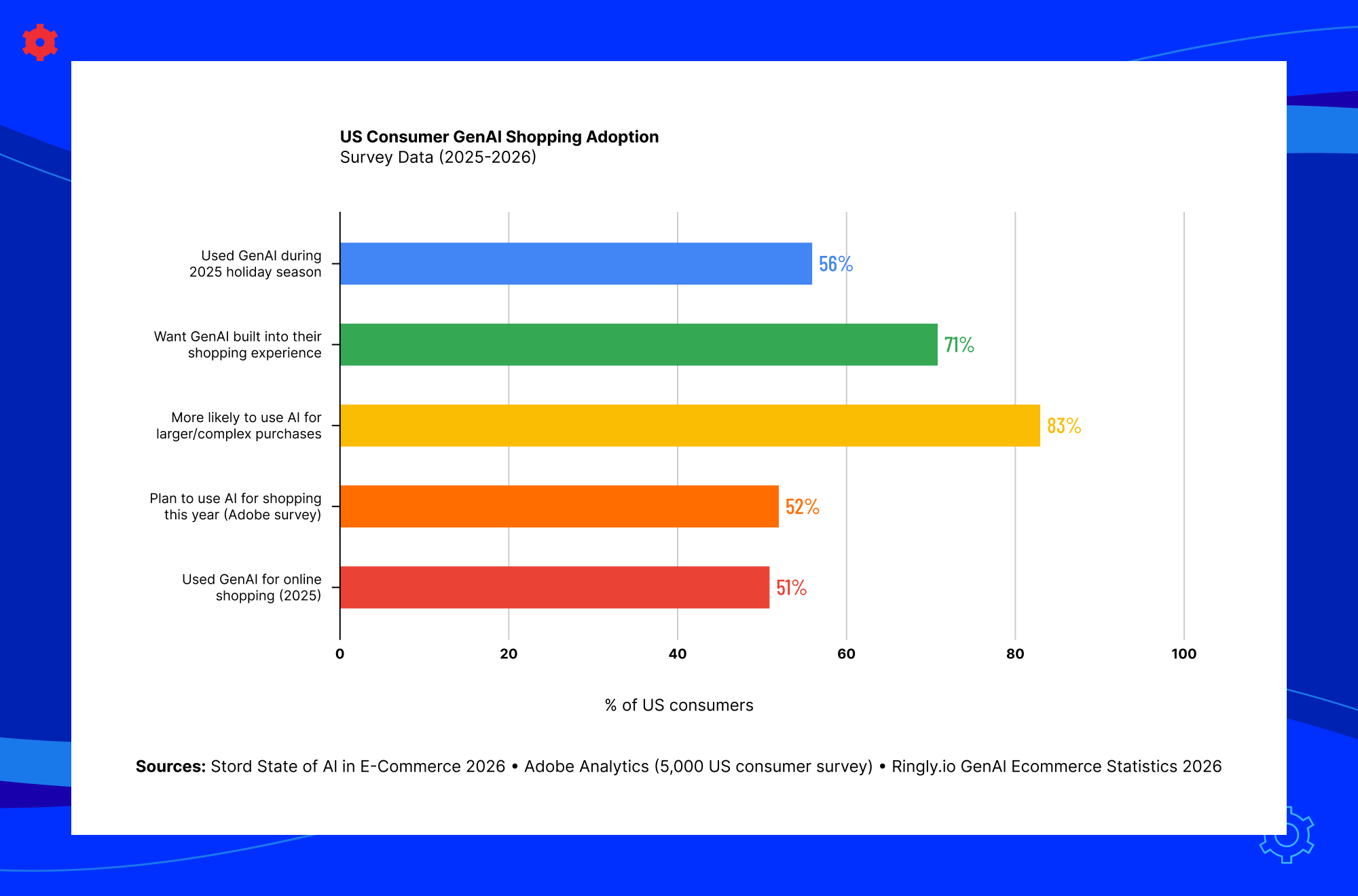
Understanding what consumers are doing with generative AI right now — not what they might do in three years — is the essential foundation for any retail AI strategy. The Stord State of AI in E-Commerce 2026 report and Adobe’s survey of 5,000 consumers provide the clearest current picture.
Consumers are using generative AI primarily as a research and discovery tool. They ask AI platforms to compare products across retailers, explain technical specifications in plain language, identify the best option for their specific situation, find the best price, and shortlist vendors before they ever visit a retailer’s own website. This is the agentic commerce pattern — the AI agent doing the consideration-stage work that previously happened on the retailer’s own site.
The implication is significant: the purchase journey is shifting outside the retailer’s owned properties in the consideration phase. The retailers that appear in AI platform recommendations — because their product content is accurate, structured, and AI-accessible — will win consideration-stage traffic. Those whose product data is poorly structured or buried behind JavaScript-heavy rendering will not. This is the 2026 version of SEO — and it requires the same strategic investment.
AGENTIC COMMERCE ALERT:
AI-referred shoppers convert 31% higher and spend 45% more time on retailer sites than average traffic — suggesting that AI platforms are doing effective pre-qualification before sending shoppers to retail sites. But these shoppers will only arrive if your product data and content are optimized for AI discovery. Product descriptions with rich attributes, structured data markup, accurate inventory information, and comprehensive specifications are now table stakes for AI-era retail discoverability.
Generative AI in Retail — Use Cases by Business Function
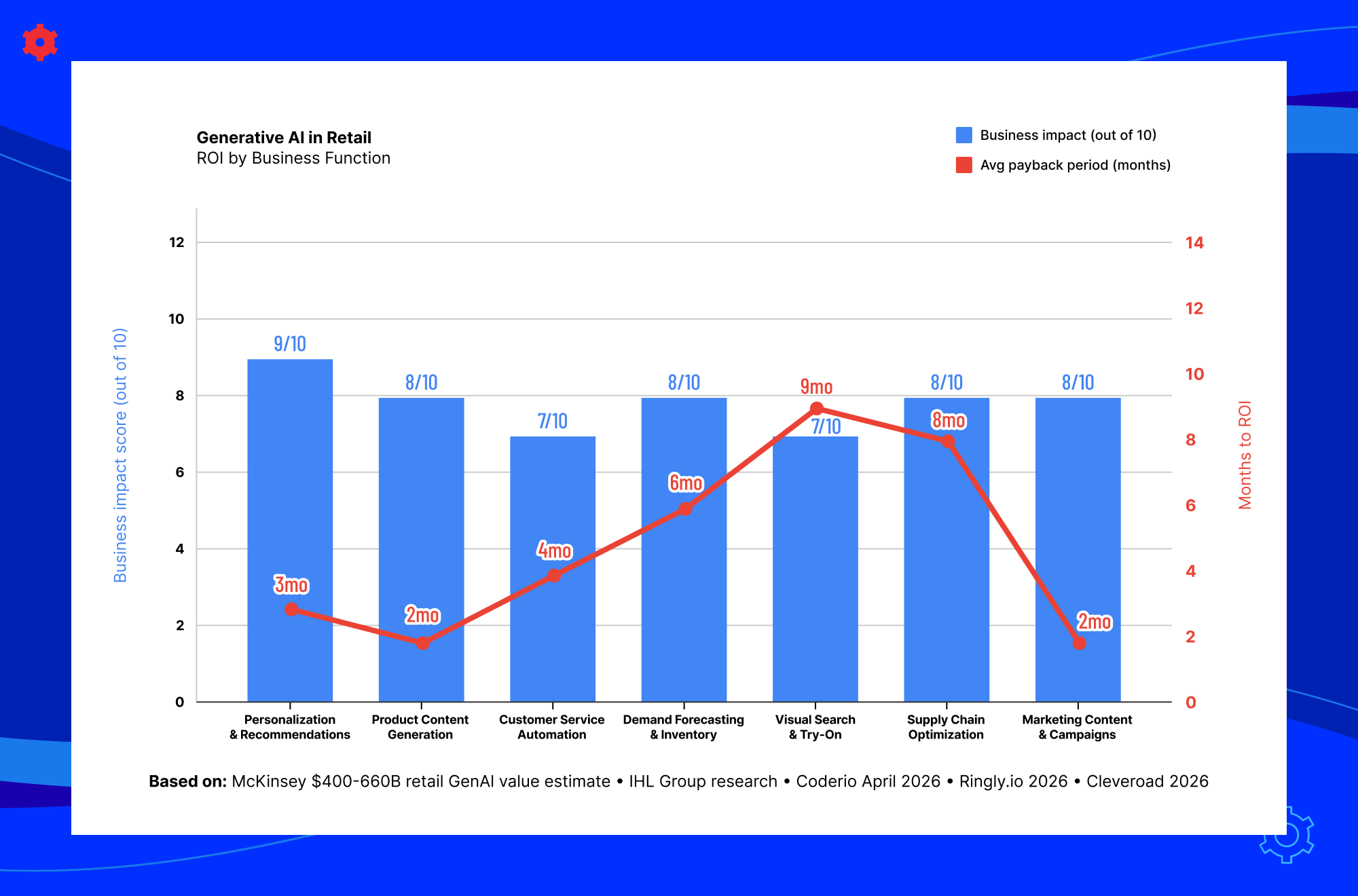
The most useful frame for retail generative AI is not the technology — it is the business function. Retailers make better AI investment decisions when they evaluate use cases by where they operate in the business, what data they require, and the realistic payback timeline. The ROI analysis below is organized by function rather than by technology type.
Generative AI in Retail — ROI by Business Function
| Use Case | What GenAI Does | ROI Impact | Payback |
|---|---|---|---|
| Personalization | Hyper-personalized product recommendations, emails, and offers based on behavior + real-time context | High | 2–3 months |
| Product Content | AI generates descriptions, specs, titles, and SEO copy across millions of SKUs | Very High | 1–2 months |
| Customer Service | AI chatbots resolve 35%+ of queries; call time is reduced by 30–90 seconds | High | 3–4 months |
| Demand Forecasting | AI analyzes buying patterns, weather, and events to reduce stockouts and overstock | Very High | 4–6 months |
| Visual Search & Try-On | Shoppers upload photos; AI finds matches — ASOS saw 23% fewer returns | High | 6–9 months |
| Supply Chain | Route optimization, supplier risk detection, logistics AI | Very High | 6–8 months |
| Marketing Content | Campaign copy, localized ads, social content at scale | High | 1–2 months |
| Employee Enablement | Associate AI tools (Magic Apron model) for in-store expert guidance | Medium | 4–6 months |
| Dynamic Pricing | AI adjusts prices based on demand signals, competitor data, and margin targets | High | 3–5 months |
1. Personalization and Recommendations — The Highest-Revenue Use Case
Amazon’s recommendation engine drives 35% of its total revenue. That is the ceiling this use case is playing for — not a productivity gain, but a revenue multiplier that affects every interaction a shopper has with the retailer’s catalog. Traditional recommendation engines use collaborative filtering: people who bought X also bought Y. Generative AI personalizes in a fundamentally different way: it understands the shopper’s current context, expressed intent, and conversation history to generate recommendations that feel individually crafted rather than statistically averaged.
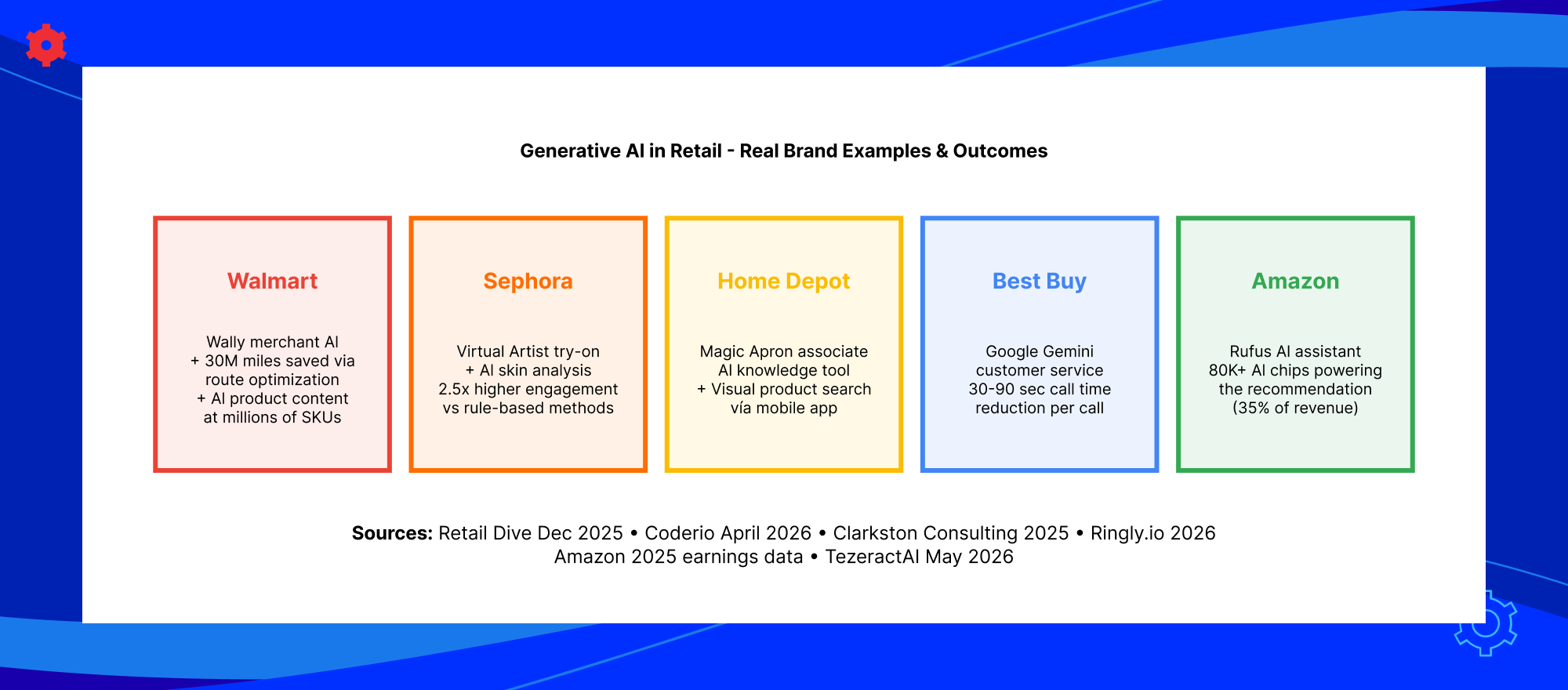
Sephora’s Virtual Artist is the most widely cited example. The system uses AI skin analysis and product data to recommend makeup not based on what similar users bought, but on what will actually look good on the specific person in front of the camera — resulting in 2.5x higher engagement than rule-based recommendation methods. Personalized marketing campaigns and dynamic pricing strategies contribute to higher sales and improved customer satisfaction and loyalty.
2. Product Content Generation — The Fastest ROI Use Case
Walmart manages millions of product SKUs. Writing accurate, compelling, SEO-optimized product descriptions for millions of items — and keeping them updated as products change — is an enormous content production challenge that manual teams cannot solve at the required scale. Generative AI changes the economics entirely: a model trained on Walmart’s product data and brand voice can generate accurate product content at the speed of publishing, not the speed of writing.
Estée Lauder used Adobe’s GenAI platform for creative production across 30+ brands, generating localized campaign content automatically and reducing manual hours by hundreds per campaign launch. The content production use case has the fastest payback period of any retail AI investment — typically 1–2 months — because the cost savings from reduced manual content creation are immediate and measurable against a baseline that every marketing team already tracks.
3. Customer Service Automation — The Highest-Volume Use Case
Walmart’s chatbot independently answers more than 35% of customer questions without human escalation. Best Buy integrated Google Gemini into customer service operations, cutting handling time by 30–90 seconds per call — a significant efficiency gain when multiplied across millions of annual customer interactions. Generative AI resolves the customer service quality problem that traditional chatbots created: rule-based chatbots frustrated customers with scripted, unhelpful responses. GenAI customer service systems understand natural language, maintain context across a conversation, and generate responses that actually address the customer’s question rather than navigating them through a decision tree.
Research found that GenAI can reduce issue resolution time from an average of 38 hours to 5.4 minutes. The customer experience impact compounds: faster resolution means fewer repeat contacts, fewer escalations to expensive human agents, and higher customer satisfaction scores that drive repeat purchases.
4. Demand Forecasting and Inventory — The Highest-Margin Use Case
For retailers, every percentage point of inventory accuracy is worth real margin. Stockouts mean lost sales. Overstock means markdown costs. The traditional demand forecasting approaches — historical sales curves, seasonal adjustments, category manager judgment — consistently underperform against the actual complexity of demand signals: weather, social trends, local events, price changes, competitive promotions, and economic shifts.
Generative AI demand forecasting analyzes these signals simultaneously and continuously. Walmart’s supply chain AI saved 30 million unnecessary miles annually through route optimization alone — a direct cost reduction that scales with network size. IHL Group projects that generative AI will reduce retailers’ selling and administrative costs by 29% between 2023 and 2029, with supply chain and inventory optimization as the primary driver.
5. Visual Search and Virtual Try-On — The Return-Reduction Use Case
The return rate problem in e-commerce is significant: apparel returns average 20–30% of orders, and the cost of processing returns frequently exceeds the margin on the original sale. Virtual try-on and visual search directly attack this problem by helping shoppers make better decisions before purchase.
ASOS implemented virtual try-on for clothing and observed a 23% decrease in returns — one of the most direct ROI calculations in retail AI. Sephora’s Virtual Artist reduces return rates by 30% while increasing sales conversion rates by 30%. Home Depot’s mobile app allows customers to take pictures of items and find exact matches or comparable items in seconds — replacing the frustrating experience of trying to describe a product verbally. The virtual try-on market is growing rapidly as the underlying computer vision and generative AI models improve, and retailers investing in this capability now are building a differentiated experience that will define the category.
6. Marketing Content at Scale — Solving the Content 5x Problem
Almost two-thirds of marketers expect their content needs to increase fivefold by 2026. The channels have multiplied — social, email, SMS, paid search, display, connected TV, voice — and each requires variant content tailored to format, audience, and moment. Manual content production at this scale is not economically viable.
Generative AI makes the content math work. Estée Lauder’s implementation of Adobe’s GenAI platform produced localized campaign content automatically across 30+ brands, reducing launch preparation time from weeks to days and the number of manual hours per launch by hundreds. The quality threshold is real — AI-generated marketing content requires creative direction, brand guidelines, and human review — but the production throughput advantage is not marginal. It is the difference between content operations that can keep pace with channel growth and those that cannot.
Generative AI in Retail — Real Brand Examples with Outcomes
EMERGING EXAMPLE:
Zara is using AI-generated fabric patterns and virtual clothing designs based on customer preferences, sales data, and trending styles — applying generative AI to the design process itself, not just the selling process. This represents the next frontier of retail AI: using customer demand signals to inform product creation, not just product recommendation.
The Long-Term Business Impact of Generative AI in Retail
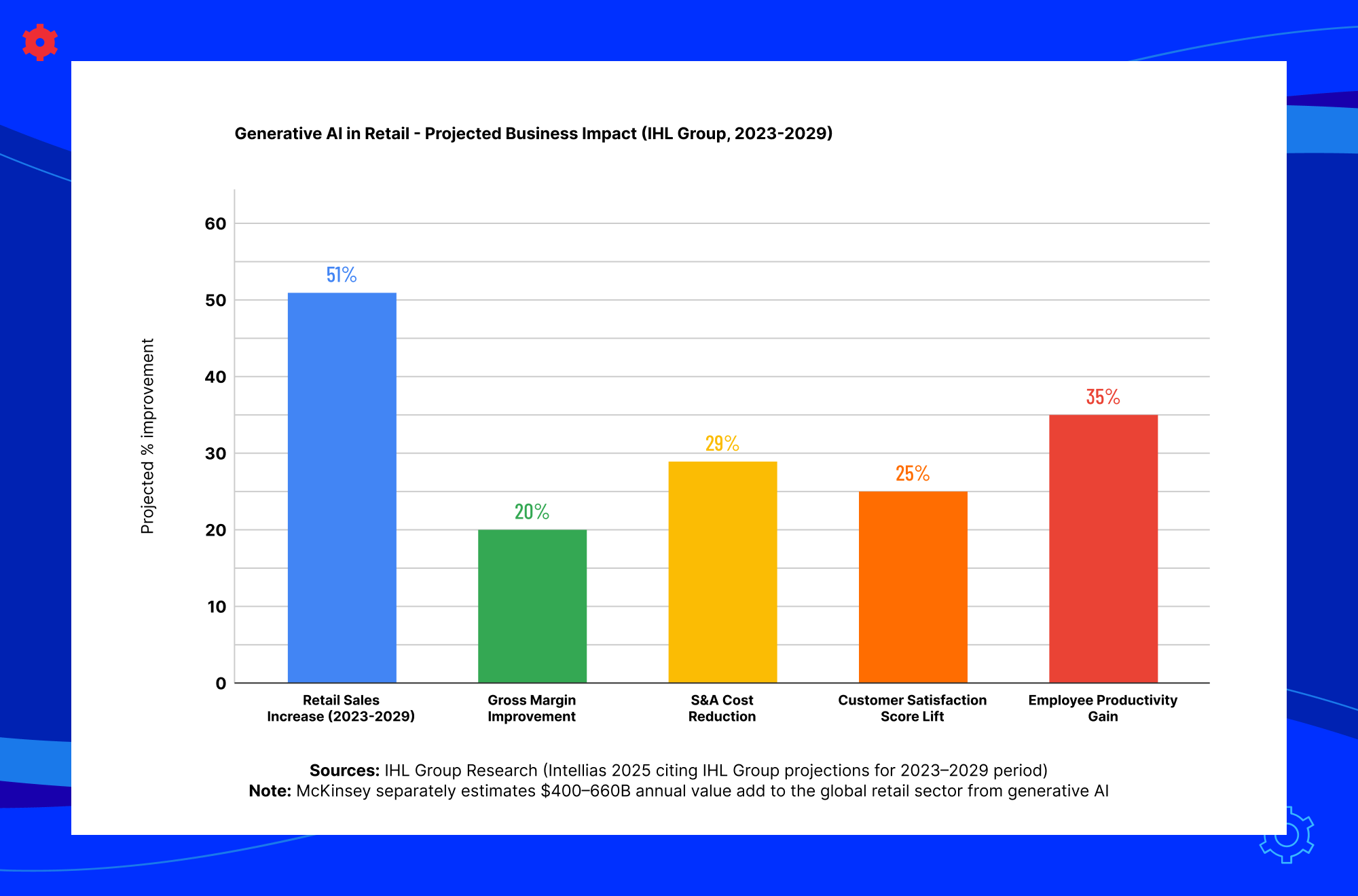
IHL Group’s research on generative AI in retail projects’ outcomes across the 2023–2029 period represents the most comprehensive quantification of the long-term opportunity available. The projections: a 51% increase in retail sales, a 20% improvement in gross margin, and a 29% reduction in S&A costs. These are not aggregate market projections — they are per-retailer operational improvements for organizations that successfully deploy generative AI at enterprise scale.
McKinsey’s separate analysis estimates that generative AI could add $400 to $660 billion in annual value to the global retail and consumer goods sector. The range reflects implementation variance: retailers that deploy AI strategically across the highest-value functions will capture the top end; those that deploy experimentally without strategic prioritization will capture significantly less.
The most important long-term trend in retail generative AI is not any individual use case — it is the compounding advantage that retailers building AI capabilities now will have over those who wait. The training data, customer preference models, organizational AI literacy, and internal AI infrastructure developed in 2026 will be meaningfully harder to replicate in 2028 than they are to build now. AI creates a durable advantage in retail precisely because learning compounds: models improve as they see more data, and retailers with the most data in the right format will always have the advantage.
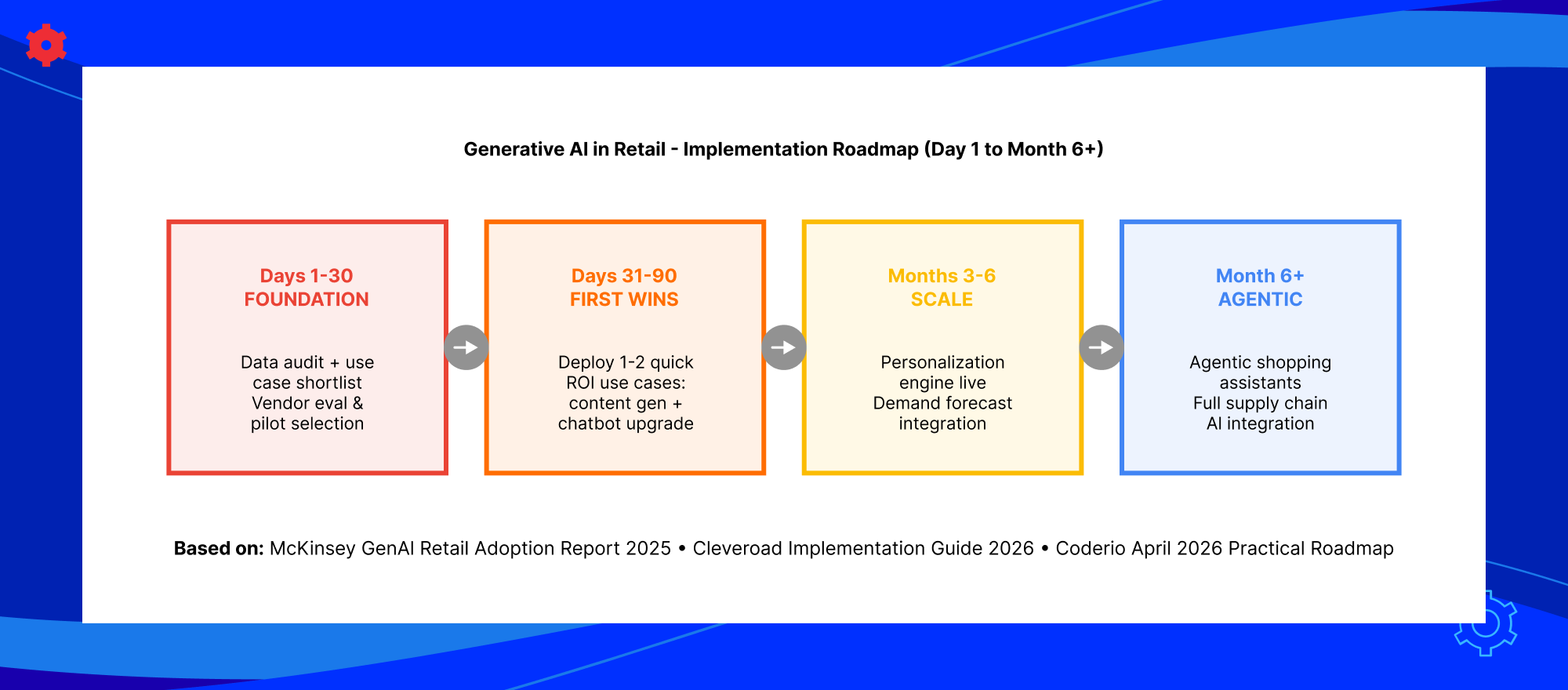
How to Implement Generative AI in Your Retail Business — The 2026 Roadmap
IMPLEMENTATION CAUTION:
95% of enterprise AI pilots fail to scale, with the primary constraint being operational fit — the ability to integrate AI into fragmented enterprise workflows shaped by legacy systems, approval layers, and siloed data. The most common retail AI implementation failure is choosing the wrong first use case: one that requires data the organization does not have, changes too many workflows simultaneously, or requires organizational change management that was not budgeted for. Start with the use case that fits your current data state, not the one that would theoretically deliver the most value if everything went perfectly.
Frequently Asked Questions About Generative AI in Retail
Conclusion: Generative AI in Retail Is Already Here — The Question Is Whether You Are
Retail organizations that wait for generative AI to mature before investing are misreading the moment. Generative AI drove $262 billion in retail revenue during a single holiday season. Traffic from AI platforms to retail sites grew 4,700% in a single year. More than half of US consumers have already used AI for shopping, and 83% say they are more likely to use it for major purchases. The technology is not approaching — it is operating, at scale, in the companies whose names you know.
What separates the retailers building durable AI advantage from those running one-off experiments is not budget size or technical sophistication. It is strategic clarity: knowing which use case to start with, having the data infrastructure to support it, measuring outcomes honestly, and building on a foundation of proven ROI rather than accumulated pilots.
The IHL Group projection — a 51% increase in retail sales, a 20% improvement in gross margin, and a 29% reduction in S&A costs from generative AI between 2023 and 2029 — is not a guarantee. It is the outcome available to retailers that deploy AI strategically. The gap between the retailers that capture this value and those that do not will be determined by decisions made in 2026, not 2029.
At Trantor (trantorinc.com), we help retail and ecommerce organizations design and deploy generative AI programs that deliver measurable business outcomes — not technology demonstrations. Still, production systems that improve revenue, reduce costs, and build the customer experience advantage that sustains competitive position. We work across the full retail AI stack: personalization engines, product content automation, AI customer service infrastructure, demand forecasting integration, and the agentic commerce capabilities that represent the frontier of retail AI in 2026. Whether you are making your first generative AI investment, scaling a successful pilot to enterprise deployment, or designing the AI infrastructure that will power your retail business for the next five years — that is the work we are built for.