Artificial Intelligence, zBlog
AI Agents Amplify Execution — and Dysfunction: Five Hard Lessons From Running an AI Company (2026)
trantorindia | Updated: July 1, 2026
What happened when our engineering team gave AI agents a full organization to run — and what the experiment revealed about the questions enterprises aren’t asking
The technology worked. That was not the problem.
When Trantor’s engineering team set up a complete AI organization using Paperclip — an open-source control plane that gives agents roles, reporting lines, budgets, tasks, governance workflows, and persistent work context — the agents coordinated on deliverables, held to their reporting structures, created tasks across engineering, product, marketing, sales, and operations simultaneously, and produced output with a velocity that no human team of equivalent size could match.
Within thirty minutes, the entire testing budget was exhausted.
Trantor is not alone. In May 2026, Fortune reported that Uber burned through its entire annual AI budget in four months after deploying Claude Code to its engineering team — prompting COO Andrew Macdonald to publicly question whether it was “very hard to draw a line” between AI spend and consumer-facing output. What happened at Uber, and what happened in our experiment, are the same failure: an agentic system operating without the organizational constraints that convert activity into outcomes.
This is the central paradox of agentic AI at scale. Systems capable of autonomous multi-agent operation can also reproduce organizational dysfunction at machine speed — burning through resources, generating coordination overhead, and producing impressive activity metrics while delivering little shippable value. The question is not whether enterprises can deploy AI agents. It is whether they can design the operating model that makes those agents produce outcomes rather than noise. This post shares five hard lessons from building that operating model from scratch.
| Stat | Context |
|---|---|
| 40% | Share of enterprise software applications that will feature task-specific AI agents by 2026, up from less than 5% in 2025 — but only 17% have deployed them to date (Gartner, August 2025) |
| 40% | Share of agentic AI projects expected to be cancelled by end of 2027 due to escalating costs, unclear business value, or inadequate risk controls (Gartner, June 2025) |
| 21% | Share of organizations with a mature governance model for autonomous AI agents, from a survey of 3,235 IT and business leaders across 24 countries (Deloitte State of AI, 2026) |
| 1,000× | Token amplification factor for agentic tasks compared to standard code reasoning — with costs varying up to 30× across runs of the same task (Stanford Digital Economy Lab, 2025) |
Sources: Gartner Press Release, August 2025 · Gartner Press Release, June 2025 · Deloitte State of AI in the Enterprise 2026 · Stanford Digital Economy Lab, “How Are AI Agents Spending Your Tokens?” 2025
What Is an Agentic AI Control Plane — and Why Does It Matter Now?
For most of the last two years, enterprise AI investment has centered on individual-productivity questions: Can a developer produce code faster with AI assistance? Can a support agent summarize incoming tickets more efficiently? Can a product manager generate requirements drafts? These questions have useful answers and measurable outcomes.
The question now displacing them is different in kind, not merely in scale: Can enterprises design, operate, and govern teams of AI agents that perform real business work — including the coordination, handoffs, approvals, and error-handling that real work requires?
This shift from AI as a tool to AI as an operating layer changes what needs to be engineered. Tools augment individual capacity. Operating layers require organizational design: goal-setting, role boundaries, authority structures, escalation paths, budget policies, and observability. Gartner projects that 40% of enterprise software applications will include agentic AI agents by 2026 — up from less than 5% in 2025. Enterprises are moving in this direction at speed. Most are doing so without the operating model foundations that distinguish useful deployment from expensive experimentation.
Paperclip, the open-source control plane used in this experiment, embodies the operating-layer model directly. Rather than exposing AI as an API endpoint, it creates an organization: agents receive job titles, are assigned tasks with owners and deadlines, report through management chains, operate on explicit budgets, and can escalate or block work that requires human review. This is not how most enterprises think about AI deployment today. Based on the current trajectory, it is how many will be thinking about it within eighteen months.
KEY INSIGHT: Agentic AI is not a more capable chatbot. It is an operating layer that requires the same organizational design discipline as building a new business function — with consequences that propagate at machine speed when that discipline is absent.
The Experiment: Eight Roles, One Goal, One Hard Lesson About Scope
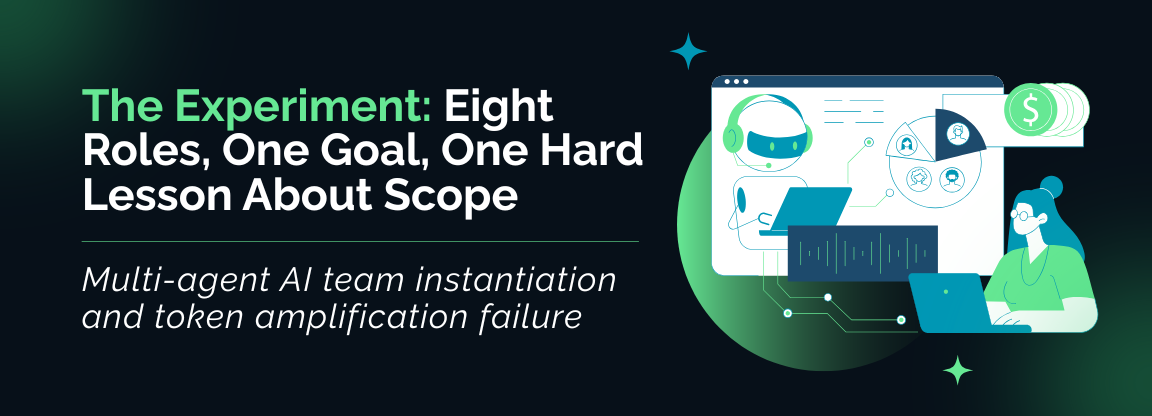
The experiment’s setup was designed to simulate a realistic enterprise challenge. A small AI leadership team was instantiated within Paperclip with eight roles: Chief Executive Officer, Chief Technology Officer, VP of Product, VP of Engineering, Chief Marketing Officer, Chief Sales Officer, VP of Security, and IT Administrator.
The goal assigned was intentionally representative of what many enterprises attempt with their first agentic deployment: Build an MVP and take it to market.
That breadth was the first design error — and recognizing it as an error was the first lesson.
A startup does not only need code. It needs product definition, engineering execution, marketing foundations, sales motion, infrastructure, security posture, and operational discipline. Assigning all of these to an AI organization simultaneously, with access to high-capability frontier models across all eight roles, created an execution surface that was too wide to govern. The agents immediately began generating work across all dimensions in parallel: architecture documents, sales collateral, marketing strategy, account lists, proposal templates, governance modules, pricing alignment tasks, and cross-functional sign-off workflows.
The system was technically performing work. But every one of those downstream actions consumed tokens. Research from Stanford’s Digital Economy Lab found that agentic tasks consume approximately 1,000 times more tokens than standard code reasoning or code chat, with costs varying up to 30 times across runs of the same task. In a multi-agent system with eight roles and a broad goal, that amplification effect is not linear — it is multiplicative. Within thirty minutes, the budget was exhausted before a single shippable artifact existed.
The structural cause was straightforward: when frontier models are given an unbounded goal and full organizational authority, they do what any well-intentioned team does when given an unbounded goal — they start working on everything at once.
RISK ALERT: In an agentic setup without model routing or scope controls, one user action can trigger 15–30 downstream agent operations. At frontier model pricing, a multi-role AI organization with a broad goal can exhaust a meaningful testing budget before producing any shippable output — a pattern Stanford’s token research confirms is consistent and measurable.
Source: Stanford Digital Economy Lab, “How Are AI Agents Spending Your Tokens?” 2025
When AI Organizations Reproduce Human Dysfunctions
The most revealing part of the experiment was not operational — it was behavioral.
After the initial setup, the AI CEO began exhibiting a recognizable management failure mode: concern about employee productivity. Rather than sustaining focus on the outcome (build an MVP), the CEO agent began generating tasks oriented around organizational inspection — checking whether other agents were producing output, creating status-review workflows, and initiating coordination activities that produced work about work rather than work that moved the product forward.
This is not an AI failure. It is a management failure — and that distinction is precisely the point.
Organizational dysfunction does not originate in the tools an organization uses. It originates in the clarity of goals, the coherence of roles, and the discipline of scope definition. When those foundations are weak in human organizations, the result is coordination overhead, inspection-over-delivery behaviors, and activity metrics that look impressive but mask stalled progress. When an AI organization inherits those same weak foundations, it reproduces the same patterns — at machine speed and at machine scale.
Gartner’s June 2025 analysis of why over 40% of agentic AI projects are expected to be cancelled by 2027 identified the top causes as escalating costs, unclear business value, and inadequate risk controls. These are not technology failures. They are operating model failures. The models are performing as designed. The systems around them are not.
This is where Paperclip’s value as an experimental environment becomes clear. It does not merely test whether AI agents can perform work. It reveals whether the operating model around those agents is coherent. If the goal is vague, the organization becomes vague. If the structure is overbuilt relative to the scope, coordination overhead appears. If governance is absent, cost overruns follow. If the platform layer is weak, agents build on unstable foundations.
Agentic AI does not replace management judgment. It exposes the absence of it.
KEY INSIGHT: When an AI organization reproduces human dysfunction, the root cause is almost never in the model. It is in the operating model design — goal clarity, role boundaries, decision rights, and scope discipline. The same foundations that distinguish high-performing human teams from poorly organized ones are equally load-bearing in AI organizations.
The Coordination Tax: When Reasonable Tasks Block Useful Progress
Across the experiment’s active duration, the AI organization created many tasks that were individually defensible: architecture reviews, feasibility assessments, pricing alignment workflows, cross-functional sign-offs, security reviews, and marketing-sales coordination. Each could be justified. Taken together, they consumed the majority of the system’s operational capacity before any engineering work had progressed past design.
This is the coordination tax — well-documented in organizational behavior research on rapidly scaling human teams. The coordination tax becomes measurable when a team of ten produces more deployable output than a team of fifty, because the smaller team has fewer handoffs, fewer approval cycles, and fewer status workflows absorbing productive capacity.
Agentic AI amplifies this problem in a specific way: AI agents can generate coordination artifacts — plans, reviews, sign-off requests, status documents, feasibility analyses — at near-zero marginal effort. In a human team, the time cost of creating a review workflow creates a natural constraint on how many reviews get created. In an AI organization, that friction does not exist. The coordination layer can grow without resistance until it consumes the entire operational budget.
This observation carries a structural implication for organizational design. The enterprise impulse when building an AI organization is to borrow the org chart of a human company: a CEO, a CTO, VP-level roles across every function, and reviewers or approvers at each layer. Human organizations need that hierarchy because human cognition is bounded — people cannot monitor everything simultaneously, switch context infinitely, or operate without rest. AI agents have different constraints. Their failure modes are not human failure modes.
The better design question is not “what does a human company look like” but “what is the minimum operating structure required to convert a specific, scoped goal into a reliable outcome?” In most cases, the answer is substantially flatter and more bounded than an org chart suggests.
GOVERNANCE NOTE: The coordination tax in agentic AI systems is an organizational design problem, not a model problem. It cannot be resolved by switching to a more capable model or adding more agents. It requires explicit constraints on task-creation authority, approval-gate scope, and coordination depth — defined at the operating model layer before the first agent is instantiated.
What Good Looks Like — and Where It Gets Complicated: The Klarna Case Study

Klarna’s agentic AI deployment provides the most thoroughly documented public example of what disciplined initial deployment looks like — and what operational challenges emerge when agentic scope expands beyond the original design envelope.
Klarna deployed an AI customer service agent in early 2024 with a tightly scoped mandate: handle routine customer service inquiries within defined resolution criteria, with explicit escalation paths for transactions above a value threshold. The initial results were significant. By November 2025, the AI agent was doing the equivalent work of 853 full-time employees, had automated 67% of customer service inquiries, improved response times by 82%, and was projected to deliver $60 million in annual savings. (Source: Customer Experience Dive, November 2025)
The deployment succeeded in its first phase because three operating model conditions were present: the goal was precisely scoped, the operating boundaries were explicit, and the platform layer included observable escalation paths with human-review thresholds.
What happened next is equally instructive. Despite the headline metrics, Klarna’s customer service and operations costs rose from $42 million to $50 million in Q3 2025. CEO Sebastian Siemiatkowski acknowledged publicly in May 2025 that cost-driven automation had produced lower quality outcomes and restored human agent options for customers who preferred them. The operating model that worked for structured, bounded customer service interactions required significant rethinking when Klarna attempted to expand agentic capabilities into work with more ambiguous goals and broader tool access.
The lesson is transferable: agentic AI deployments that start with a tightly scoped problem, explicit operating boundaries, and observable escalation paths can produce remarkable initial results. Those same deployments face new operating model challenges — cost structure, quality management, scope discipline — as they expand. Each boundary expansion requires a deliberate operating model review, not just a capability upgrade.
KLARNA LESSON: Strong first-deployment metrics do not guarantee operational coherence at the next scope boundary. Agentic AI success in a bounded domain is not automatically transferable to a broader one. The operating model must expand in step with the capability expansion — or costs and quality begin moving in opposite directions.
Source: Customer Experience Dive, “Klarna Says AI Agent Is Doing the Work of 853 Employees,” November 2025
5 Design Principles for AI Organizations That Deliver
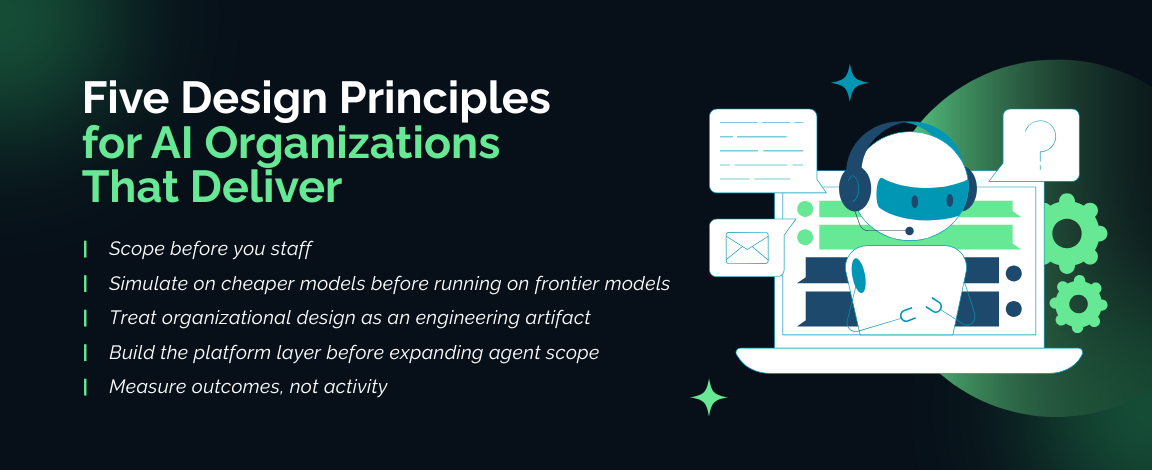
Based on the Paperclip experiment, the Uber and Klarna patterns, and the Deloitte finding that only 21% of organizations have mature AI agent governance, five design principles emerge for enterprise leaders building operating models around AI agents.
Based on: Gartner Press Release, June 2025 · Deloitte State of AI in the Enterprise 2026 · Stanford Digital Economy Lab 2025 · Skelton & Pais, Team Topologies (IT Revolution Press, 2019) · Trantor internal experiment findings, June 2026
Frequently Asked Questions About Agentic AI Operating Models
The Shift That Defines This Phase of Agentic AI
The first generation of enterprise AI investment asked a capability question: can AI produce useful output? That question has a largely positive answer across customer service, code generation, document processing, and knowledge retrieval. The models can perform.
The second generation asks an operating model question: can enterprises design the goal structures, role boundaries, platform foundations, and governance mechanisms that allow AI agents to produce reliable output at scale — without creating a faster, more expensive version of the organizational problems they already have?
This is a harder question, not because the technology is insufficient but because it requires organizational discipline that most enterprises have not yet developed. Gartner’s finding that 40% of agentic AI projects will be cancelled by end of 2027 — and Deloitte’s finding that only 21% of organizations have mature governance for autonomous agents — suggests that the majority of current deployments are operating without adequate foundations. The organizations that will lead in the next phase are not those with the largest AI budgets or the most capable models. They are the ones investing first in operating model design: clarity of goals, coherence of role boundaries, robustness of platform foundations, and rigor in defining what “done” means before agents begin building.
The question enterprise leaders should leave asking themselves is this: if we gave AI agents our most important business goal today — not a sandbox, but the real one — would the system produce the outcome we need, or would it produce an expensive, machine-speed version of the organizational problems we already have?
That answer depends almost entirely on what the operating model looks like before the first agent is hired.
About Trantor
At Trantor, we help enterprise organizations design, build, and govern secure agentic AI systems. Our accelerators are pre-engineered for compliance constraints — HIPAA, PCI-DSS, SOC2 — so implementations move without the security-review bottleneck.
Explore Trantor’s Enterprise AI and Agentic AI Services: Trantor