
Artificial Intelligence, zBlog
Pinecone Vector Database: Pricing, Performance, and an Honest 2026 Comparison

Pinecone created the managed vector database category, and in many ways it still defines it. But the question most people actually ask before adopting Pinecone is not whether vector databases matter. It is whether Pinecone specifically is worth the cost and the lock in, compared to Weaviate, Qdrant, Milvus, or simply running pgvector on Postgres you already operate.
That is the question this guide on the Pinecone vector database answers directly, with real 2026 pricing, real benchmarks, and an honest accounting of where Pinecone wins and where it loses. We are not going to pretend Pinecone exists without competition, because in 2026 it clearly does not. The vector database market has matured into a genuine multi-way decision, and treating Pinecone as the only option does a disservice to anyone trying to choose the right vector database for their actual workload.
Here is the short version before the detail. Pinecone, the fully managed vector database, remains the fastest path to production for teams that want zero infrastructure overhead, particularly under 50 million vectors. Above that scale, the economics shift hard toward self-hosted alternatives like Qdrant or Milvus. Pinecone also has no self-hosting option at all, which matters if your data cannot leave a specific region or must stay on-premises. The rest of this guide walks through exactly why, with numbers.
Pinecone is a fully managed vector database built for storing, indexing, and querying high dimensional vector embeddings at scale. In 2025, Pinecone completed its transition to a serverless architecture as the default deployment model, which decouples storage from compute and changes how the platform is priced. Understanding that pricing model is the first real decision point for anyone evaluating the Pinecone vector database in 2026.
What Is Pinecone and How Does the Pinecone Vector Database Actually Work?
Pinecone is a vector database, a type of database purpose built to store and search high dimensional vectors rather than the rows and columns of a traditional relational database. These vectors are typically produced by embedding models, the same models used to convert text, images, or audio into numerical representations that capture semantic meaning. A vector database like Pinecone lets you find the most similar vectors to a given query vector, which is the core operation behind semantic search, recommendation systems, and retrieval augmented generation for large language models.
Where Pinecone differs from open source vector databases is in its deployment model. Pinecone is a fully managed service only. There is no version of Pinecone you can download and run on your own servers. In 2025, Pinecone moved to serverless as its default architecture, which means the platform automatically separates storage from compute and bills you for what you actually use rather than for pre-provisioned capacity. This was a meaningful shift from Pinecone’s earlier pod based pricing, which required you to provision and pay for fixed capacity regardless of usage.
What this means in practice: you pay for Pinecone vector database storage at $0.33 per GB per month, plus separate charges for read units and write units based on actual query and ingestion volume. There is no idle cost with the serverless Pinecone model, which is a genuine improvement over the old pod based system for workloads with variable or unpredictable traffic.
Pinecone Pricing in 2026: What It Actually Costs at Different Scales
This is the section most existing guides to the Pinecone vector database skip entirely, and it is the single most important factor in deciding whether Pinecone is the right choice for your project.
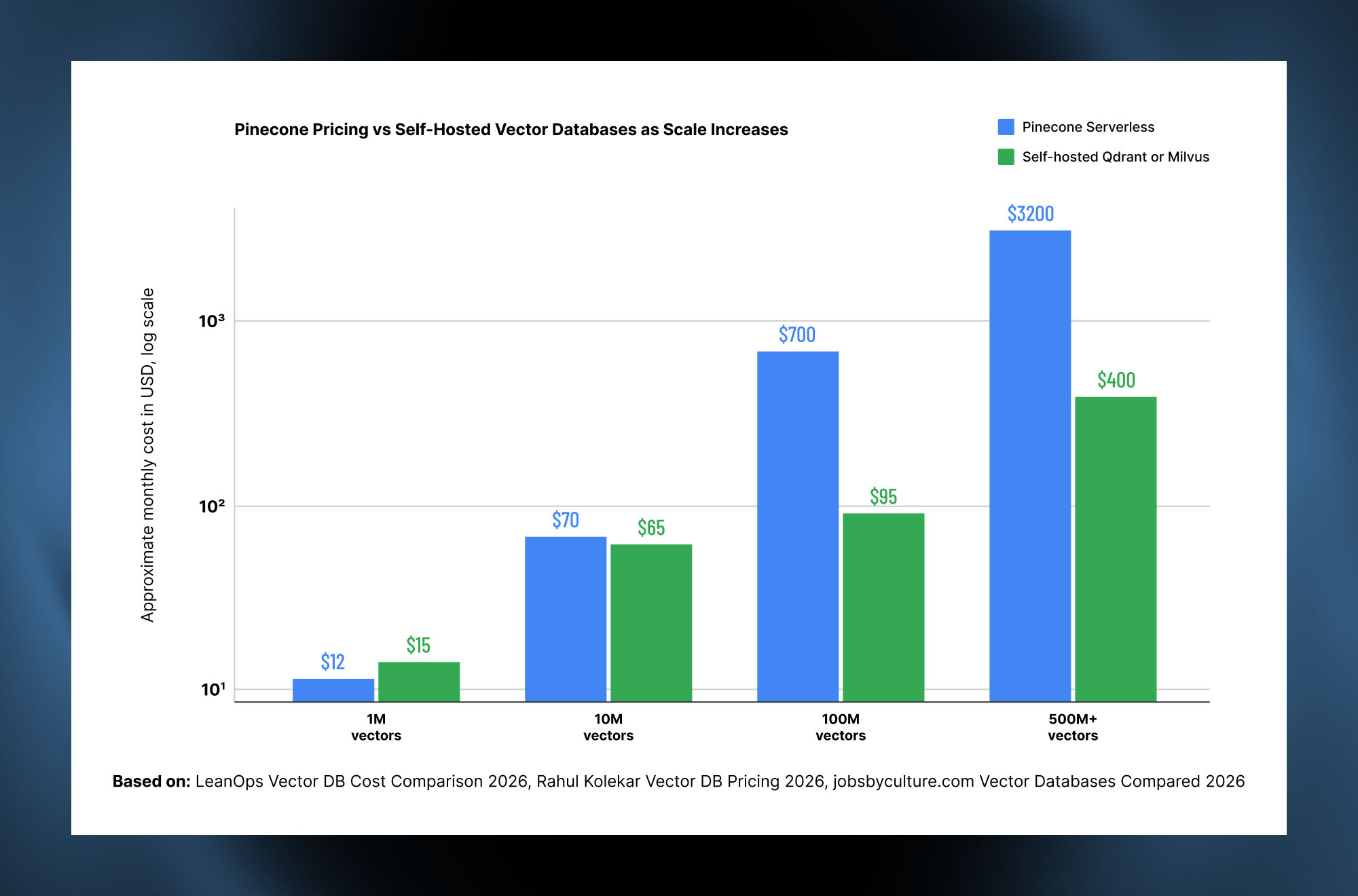
At small scale, under 10 million vectors, Pinecone is genuinely competitive. Multiple independent 2026 cost comparisons put Pinecone serverless at roughly $70 per month for 10 million vectors with moderate query volume, which is in line with or cheaper than managed alternatives like Weaviate Cloud, and not far behind self-hosted options once you account for the engineering hours saved.
The picture changes sharply at scale. At 100 million vectors, Pinecone can reach $700 or more per month, while self-hosted Qdrant or Milvus typically stays under $100 to $150 per month for equivalent capacity, before accounting for engineering and operations time. At 500 million vectors and above, the gap widens further, with some enterprise Pinecone deployments running several thousand dollars a month while a well operated self-hosted cluster handles the same load for a few hundred.
PRICING CAUTION:
Independent analysis from LeanOps found that the average gap between a vector database vendor pricing page estimate and the actual production bill runs 2.5 to 4 times higher than budgeted, and Pinecone is not exempt from this pattern. Read unit costs in particular scale with query volume in ways that are easy to underestimate during a pricing exercise. If you are evaluating the Pinecone vector database for a high query volume application, model your actual expected read and write unit consumption before committing, not just storage size.
Pinecone vs Weaviate vs Qdrant vs Milvus vs Chroma: How the Vector Database Options Actually Compare
No single vector database wins every dimension, and any guide that claims otherwise is not being honest about the current state of the market. Here is how Pinecone stacks up against the four vector databases it gets compared to most often in 2026.
| Pinecone | Weaviate | Qdrant | Milvus | Chroma | |
|---|---|---|---|---|---|
| Deployment | Managed only | Managed + self-host | Managed + self-host | Managed + self-host | Local + server |
| Self-hosting | Not available | Yes, Apache 2.0 | Yes, open source | Yes, open source | Yes, open source |
| Hybrid search | Limited | Strongest in market | Good, with filters | Sparse vector support | Basic |
| Best for scale | Under 50M vectors | Mid scale, multimodal | High throughput, Rust | Billions of vectors | Prototyping |
| Ops overhead | Zero | Low to moderate | Low to moderate | High at scale | Near zero |
| Pinecone | |
|---|---|
| Deployment | Managed only |
| Self-hosting | Not available |
| Hybrid search | Limited |
| Best for scale | Under 50M vectors |
| Ops overhead | Zero |
| Weaviate | |
|---|---|
| Deployment | Managed + self-host |
| Self-hosting | Yes, Apache 2.0 |
| Hybrid search | Strongest in market |
| Best for scale | Mid scale, multimodal |
| Ops overhead | Low to moderate |
| Qdrant | |
|---|---|
| Deployment | Managed + self-host |
| Self-hosting | Yes, open source |
| Hybrid search | Good, with filters |
| Best for scale | High throughput, Rust |
| Ops overhead | Low to moderate |
| Milvus | |
|---|---|
| Deployment | Managed + self-host |
| Self-hosting | Yes, open source |
| Hybrid search | Sparse vector support |
| Best for scale | Billions of vectors |
| Ops overhead | High at scale |
| Chroma | |
|---|---|
| Deployment | Local + server |
| Self-hosting | Yes, open source |
| Hybrid search | Basic |
| Best for scale | Prototyping |
| Ops overhead | Near zero |
When Pinecone Is the Right Vector Database, and When It Is Not
The honest answer to which vector database you should use is that it depends on your scale, your operations capacity, and what kind of search your application actually needs. Here is a practical decision framework.
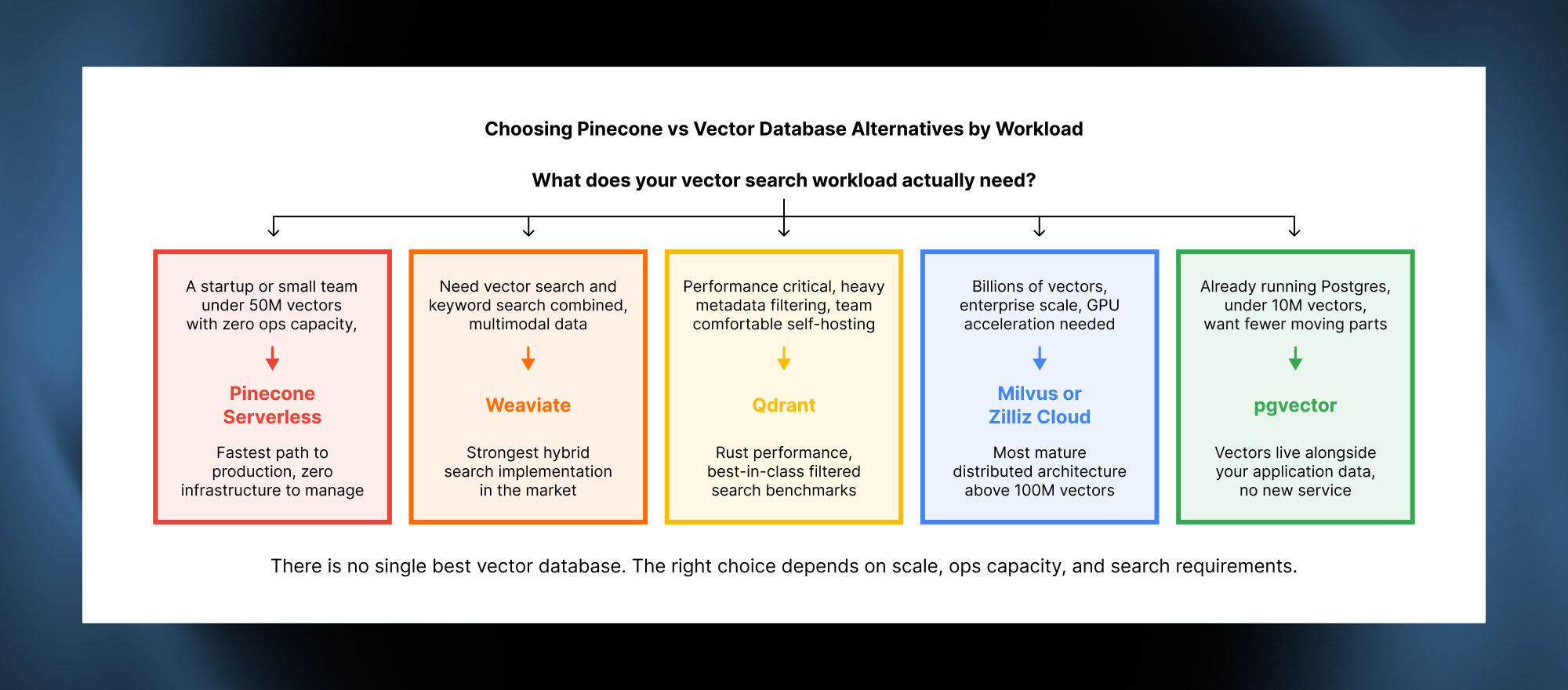
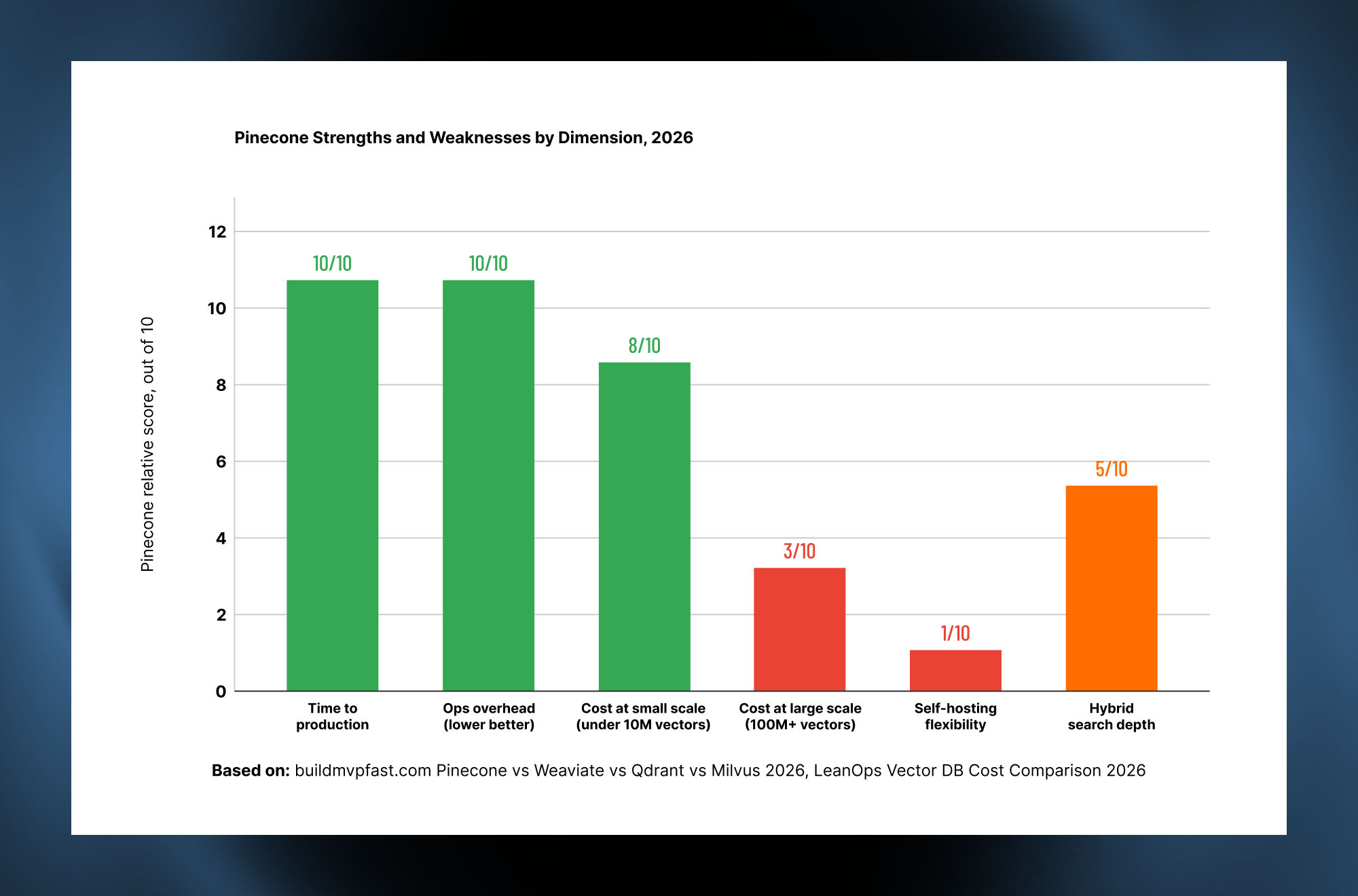
Choose Pinecone when: you are a startup or small team with limited operations capacity, your dataset is under roughly 50 million vectors, and you want to ship a working semantic search or retrieval augmented generation feature as fast as possible without managing infrastructure. Pinecone genuinely excels here, and several 2026 comparisons that are otherwise critical of Pinecone’s cost at scale still recommend it as the best starting point for exactly this profile.
Look elsewhere when: your data cannot leave a specific cloud region or must be air-gapped on-premises, since Pinecone offers no self-hosting at all. Also look elsewhere if you expect to scale past 100 million vectors, where the cost gap against self-hosted Qdrant or Milvus becomes difficult to justify, or if hybrid search combining keywords and vectors is central to your application, where Weaviate has built the more complete implementation.
A PRACTICAL NOTE ON SWITCHING LATER:
If you start with Pinecone and later need to move to a self-hosted vector database at scale, store your source embeddings in cold storage such as S3 or Parquet files from day one, separate from the vector database itself. This lets you rebuild a new index on a different platform without paying egress fees or re-running expensive embedding jobs, and it is one of the most useful practices we recommend to clients regardless of which vector database they start with.
What the Pinecone Vector Database Is Actually Used For
Despite the cost and deployment tradeoffs covered above, Pinecone remains a strong fit for several categories of application, and these have not changed much since the platform’s earlier years.
Retrieval augmented generation: Pinecone is widely used as the retrieval layer behind large language model applications, storing document embeddings so an LLM can pull relevant context at query time rather than relying solely on its training data.
Semantic search: organizations use the Pinecone vector database to power search that understands meaning and context rather than exact keyword matches, useful for documentation search, enterprise knowledge bases, and customer support tools.
Recommendation systems: by representing users and items as vectors, Pinecone can power recommendation engines that match people to relevant products or content based on learned similarity rather than simple rule-based logic.
Anomaly detection: representing normal behavior as vectors and measuring distance from new data points is a practical way to flag unusual transactions, network activity, or sensor readings, and several Pinecone customers use it for exactly this.
Frequently Asked Questions About the Pinecone Vector Database
The Bottom Line on the Pinecone Vector Database
Pinecone earned its position as the category-defining vector database by making it genuinely easy to go from zero to a working semantic search or retrieval augmented generation application, and that ease of use has not disappeared in 2026. For startups and small teams operating under roughly 50 million vectors, Pinecone remains a sound, low-risk choice.
What has changed is that Pinecone is no longer evaluated in isolation. Weaviate, Qdrant, Milvus, Chroma, and pgvector are all real, mature options in 2026, each with a clear case for when it beats Pinecone on cost, self-hosting flexibility, or hybrid search depth. Choosing the right vector database in 2026 means being honest about your actual scale, your operations capacity, and what kind of search your application needs, rather than defaulting to whichever vector database has the most name recognition.
At Trantor, we help organizations choose and implement the right vector database for their actual workload, whether that is Pinecone, Weaviate, Qdrant, Milvus, or a combination evaluated against real cost and performance data rather than a vendor pricing page. We have built retrieval augmented generation systems, semantic search, and recommendation engines on multiple vector database platforms, and we bring that implementation experience to help you make this decision with real numbers rather than guesswork. If you are weighing Pinecone against the alternatives for your own project, we are ready to help.