Artificial Intelligence, zBlog
AI Red-Teaming — The Practitioner’s Complete Guide (2026)
trantorindia | Updated: June 19, 2026
“Testing AI systems requires a fundamentally different mindset than traditional security testing. You are not looking for a specific vulnerability. You are looking for all the ways the system can be made to behave in ways it was not designed to.”
— OWASP GenAI Security Project, April 2026
INCIDENT: Financial Services Firm — Internal FAQ Leaked in Production
Deployment: Customer-facing LLM without adversarial pre-testing
Attack: Indirect prompt injection via crafted user input
Outcome: Internal FAQ content leaked within weeks of go-live
Remediation cost: $3,000,000 + regulatory scrutiny
INCIDENT: Enterprise Software Company — Salary Database Extracted
Deployment: Executives used LLM for financial modeling on internal data
Attack: Context manipulation causing sensitive data exfiltration
Outcome: Entire salary database exposed via AI output
Remediation cost: Undisclosed + reputational impact
These are not hypothetical scenarios from a security conference. They happened in 2025, in production, at organizations that believed their AI deployments were adequately secured. They were not secured. They were tested for functionality. They were not tested adversarially.
That distinction — between functional testing and adversarial testing — is what AI red-teaming is about. And it is the gap that 78% of enterprises have not yet closed, according to Gartner’s 2026 AI security research.
What AI Red-Teaming Actually Is — And the One Thing Most People Get Wrong
The most common mistake when security teams first approach AI red-teaming is applying the wrong mental model. They treat it like penetration testing. It is not penetration testing.
Traditional penetration testing checks expected behavior. You write a test case, run it against a known vulnerability class, get a binary result — vulnerable or not vulnerable. The vulnerability either exists or it does not. The pass/fail is clean.
AI red-teaming tests for unexpected behavior. There is no exhaustive list of known vulnerabilities. The attack surface is the model’s entire probability space — every possible input, every possible conversation sequence, every possible context manipulation that could cause the model to produce outputs it was not designed to produce. You are not looking for a specific bug. You are probing the frontier of what the system can be made to do.
AI Red Teaming vs Traditional Penetration Testing — Key Differences
| Dimension | Traditional Pen Testing | AI Red Teaming |
|---|---|---|
| What you test | Known CVEs, misconfigs, exposed endpoints | Unexpected AI behavior, jailbreaks, hallucinations |
| Testing methodology | Scripted exploits, defined attack paths | Adversarial prompts, context manipulation |
| Pass/fail criteria | Binary: vulnerable or not vulnerable | Probabilistic: risk thresholds, not binary |
| Primary tools | Metasploit, Nessus, Burp Suite | PyRIT, Garak, PromptBench, DeepTeam, Promptfoo |
| Skill requirement | Network/app security expertise | AI/ML security + red team expertise |
| Frequency | Quarterly or annual | Continuous (per model update/deployment) |
| Scope | Infrastructure, APIs, web applications | LLMs, agents, RAG pipelines, fine-tuned models |
Based on: General Analysis AI Red Teaming Guide 2026 · VentureBeat Dec 2025 · RedTeam Partners · Confident AI 2026
The practical difference shows up immediately in methodology. A pen tester runs known exploits against defined targets. An AI red teamer crafts novel prompts, manipulates context over multi-turn conversations, exploits the model’s inherent tendency to be helpful, and tests whether external inputs can hijack the system’s instructions. The skill set is different. The tooling is different. The success criteria are different.
What AI red-teaming tests: Model jailbreaks. Policy bypasses. Prompt injection via user input. Indirect prompt injection via documents, web pages, or tool outputs the model processes. System prompt extraction. Training data leakage. RAG pipeline poisoning. Tool call manipulation in agentic systems. Multi-turn context attacks. Harmful content generation. Misinformation production. Data exfiltration through model outputs.
What traditional pen testing tests: Known CVEs. Exposed endpoints. Authentication weaknesses. Insecure configurations. API authorization flaws. The normal application security attack surface.
What AI red-teaming does NOT replace: Traditional pen testing. Your AI application still has an API, an authentication layer, and infrastructure that needs conventional security testing. AI red-teaming is additive, not a replacement.
AI red-teaming is the practice of adversarially probing AI systems — especially LLMs, AI agents, RAG pipelines, and multi-model orchestration systems — to discover unexpected, harmful, or policy-violating behavior before attackers discover it in production. It requires simulating the mindset of someone trying to manipulate the system, not the mindset of someone trying to use it correctly.
The OWASP LLM Top 10 2025 — What Changed and Why It Matters for Your Testing
OWASP’s Top 10 for LLM Applications is the closest thing the AI security field has to a standardized threat taxonomy. It is imperfect — the categories are broad and the real-world attack surface changes faster than any framework can track — but it is the reference that enterprise procurement checklists, regulatory frameworks, and security programs align on. The 2025 edition made significant changes that most organizations have not yet incorporated into their testing programs.
OWASP LLM Top 10 2025 — What Changed and What the 5 New Categories Mean
| #1 | Prompt Injection Direct + indirect attack paths | STAYED #1 (2nd consecutive year) | ▲ CRITICAL |
| #2 | Sensitive Info Disclosure Data leakage from prompts + training | JUMPED from #6 | ▲ HIGH |
| #3 | Supply Chain Vulnerabilities Poisoned models, plugins, datasets | CLIMBED from #5 | ▲ HIGH |
| #4 | Data & Model Poisoning Training / fine-tuning data attacks | STABLE | ▲ HIGH |
| #5 | Improper Output Handling Downstream injection via LLM output | NEW position | ▲ MED |
Five vulnerability categories appeared for the first time in the 2025 list. They are not theoretical additions based on research papers. They reflect production incidents.
Excessive Agency (#6, new): When an AI agent is given more permissions, tools, or autonomy than its task requires, and an attacker exploits this over-privilege to cause unintended actions. This is the agentic AI vulnerability that enterprise security teams are least prepared for. If your agent can write files, call APIs, and send emails — and an attacker can manipulate its instructions — they have access to everything the agent has access to.
System Prompt Leakage (#7, new): Extraction of confidential system prompts through adversarial queries. System prompts frequently contain business logic, proprietary processes, and security instructions that organizations treat as confidential. Attackers who extract the system prompt understand the system’s constraints — and know exactly how to circumvent them. NeuralTrust’s January 2026 survey found this vulnerability in a significant fraction of tested production systems.
Vector and Embedding Weaknesses (#8, new): Attack techniques targeting RAG pipelines by poisoning the vector database or manipulating embedding retrieval. If an attacker can inject content into the document corpus your RAG system searches, they can influence every response the system generates on topics adjacent to that content. This attack is particularly dangerous because it is invisible to conventional security monitoring.
Misinformation (#9, new): AI systems generating factually incorrect, misleading, or harmful content — not through external attack, but through inherent model limitations or adversarial manipulation of the generation process. In regulated industries (financial services, healthcare, legal), AI-generated misinformation carries direct compliance and liability exposure.
Unbounded Consumption (#10, new): Resource exhaustion attacks that exploit the computational cost of LLM inference. Adversarially crafted inputs that maximize token consumption can serve as denial-of-service attacks against AI services or generate costs that exceed business projections by orders of magnitude.
FRAMEWORK NOTE:
The OWASP LLM Top 10 2025 list reflects production incidents, not academic research. Every category on this list has been exploited in real enterprise deployments. The five new categories in 2025 represent threat classes that barely existed at enterprise scale in 2024 — the agentic AI deployment wave created them. If your red-teaming program was designed against the 2023/2024 list, it needs updating.
The Attack Surface Expands With Every Layer You Add
One of the most important mental models in AI security is that attack surface scales with capability. Every feature you add to an AI system — every tool, every data source, every memory layer, every agent — expands the attack surface in ways that are not always obvious before deployment.
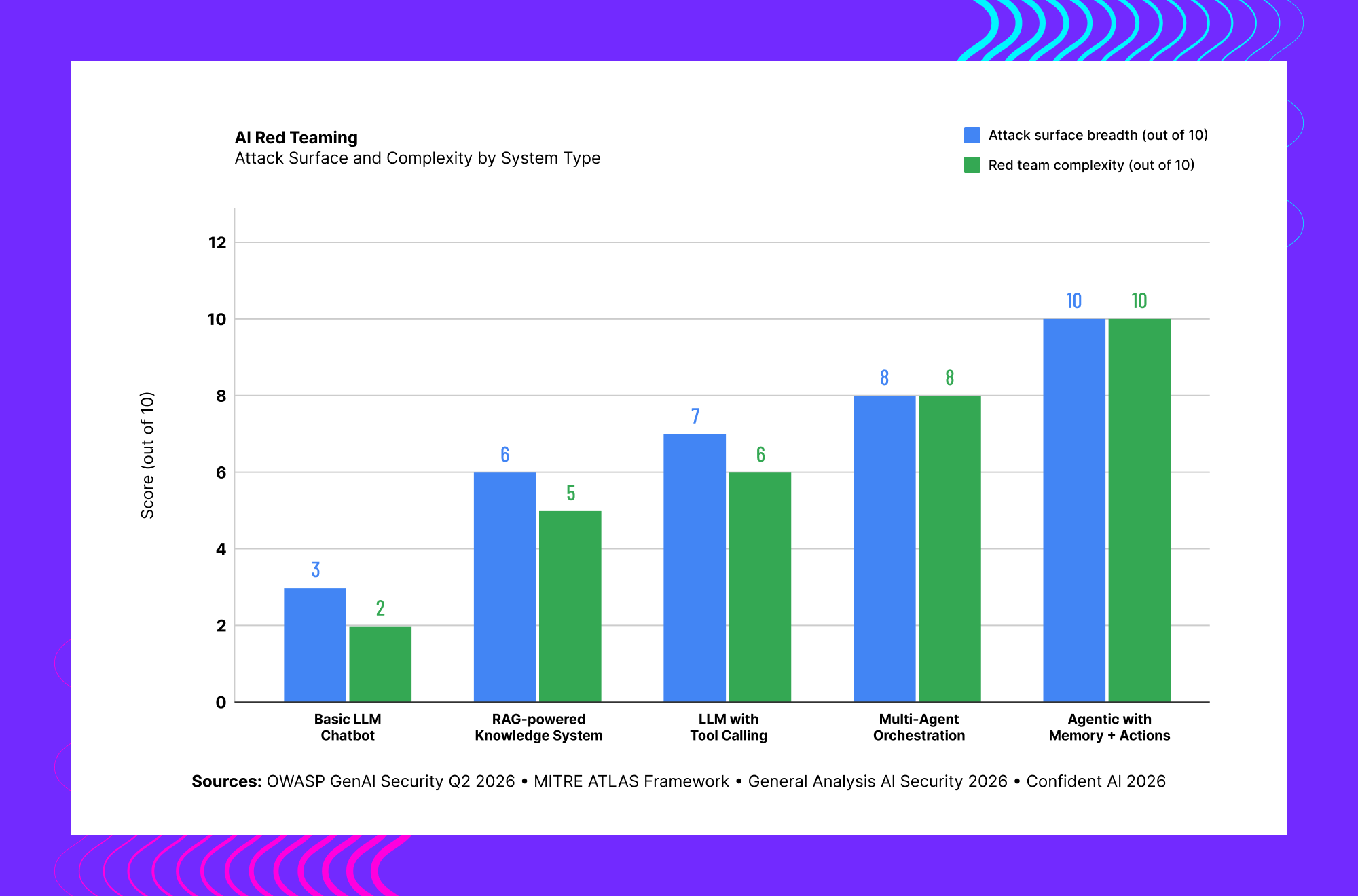
A basic LLM chatbot has a relatively contained attack surface: the input and output of a single model. A RAG-powered knowledge system adds the document corpus as an attack vector. An LLM with tool calling adds every tool API as a potential exploitation path. Multi-agent orchestration adds the inter-agent communication layer and the trust relationships between agents. An agentic system with persistent memory and real-world action capabilities has the broadest attack surface in the current enterprise AI deployment landscape.
The red-teaming scope must expand accordingly. Treating a multi-agent agentic system the same way you test a basic chatbot will miss the majority of the exploitable attack surface. OWASP explicitly acknowledged this in their April 2026 AI Security Solutions Landscape publication: traditional application security practices are no longer sufficient for organizations deploying generative AI and autonomous agents into business-critical workflows.
The Attack Playbook — 8 Techniques Your Red Team Needs to Test
This section covers the attack techniques that produce real results in production AI systems. Not theoretical vulnerabilities from research papers — documented techniques that enterprise red teams are finding in live deployments right now.
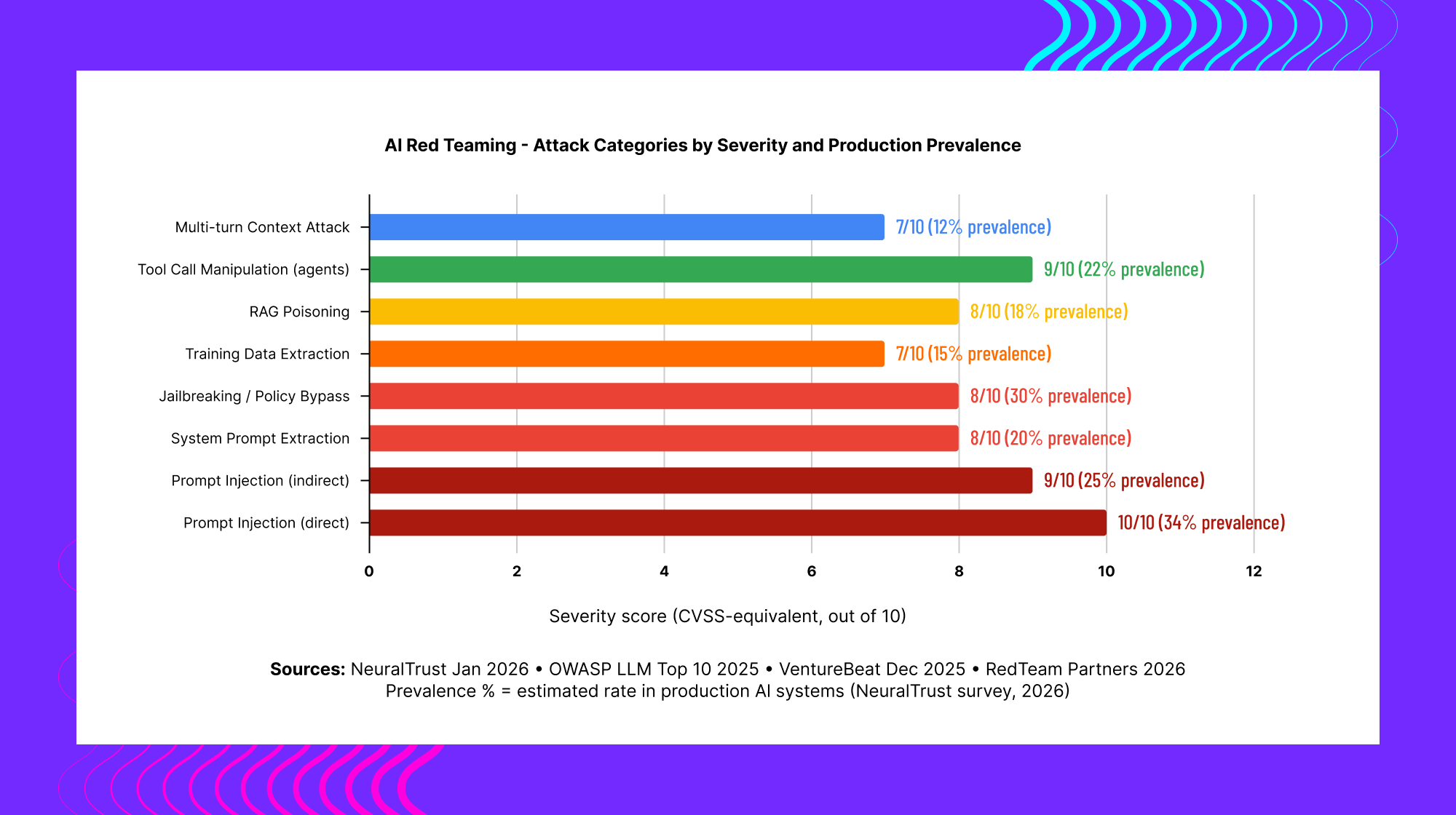
Agentic AI Red-Teaming — Where the Real Frontier Is in 2026
Agentic AI systems — AI that takes actions, calls tools, maintains memory, and executes multi-step workflows — represent a fundamentally different security challenge from static LLMs. The attack surface is not just the model’s outputs. It is every action the agent can take, every system it can access, and every decision it can make autonomously.
The security implications compound quickly. A customer service agent with access to a CRM, an email system, and an ordering database does not just have language risks — it has operational risks. An attacker who can manipulate the agent’s instructions through indirect prompt injection in a customer email can potentially trigger CRM updates, send emails as the company, or modify customer orders. The model’s language generates the actions. The actions have real-world consequences.
RISK ALERT:
OWASP GenAI Security Q2 2026 explicitly states: as organizations increasingly deploy generative AI and autonomous agents into business-critical workflows, traditional application security practices are no longer sufficient. Agentic systems require red-teaming that tests not just the model’s outputs but the consequences of every action the agent can take. A standard LLM red-team engagement covers approximately 30% of the attack surface of an equivalent agentic system. The remaining 70% — tool misuse, orchestration attacks, memory poisoning, inter-agent trust exploitation — requires agentic-specific methodology.
What Agentic Red-Teaming Tests That Standard LLM Testing Misses
Tool call authorization: Can an adversary manipulate the agent into calling tools it should not call, with parameters it should not use? Test every tool in the agent’s toolkit as an independent attack vector.
Memory poisoning: If the agent has persistent memory across sessions, can an attacker inject content into the memory store that influences future agent behavior? This is the agentic equivalent of RAG pipeline poisoning.
Orchestration trust: In multi-agent systems, can a compromised or simulated agent send instructions to other agents that bypass their individual safety controls? Test the trust model between every agent in the system.
Action reversibility: For every action the agent can take, what is the blast radius if that action is triggered by adversarial manipulation? High-consequence irreversible actions require the most rigorous pre-deployment red-teaming.
Identity and authorization: Does the agent correctly distinguish between instructions from legitimate system sources and instructions injected through user input or external content? Test the boundary between system and user trust.
Building an Enterprise AI Red-Teaming Program — Not a One-Time Test
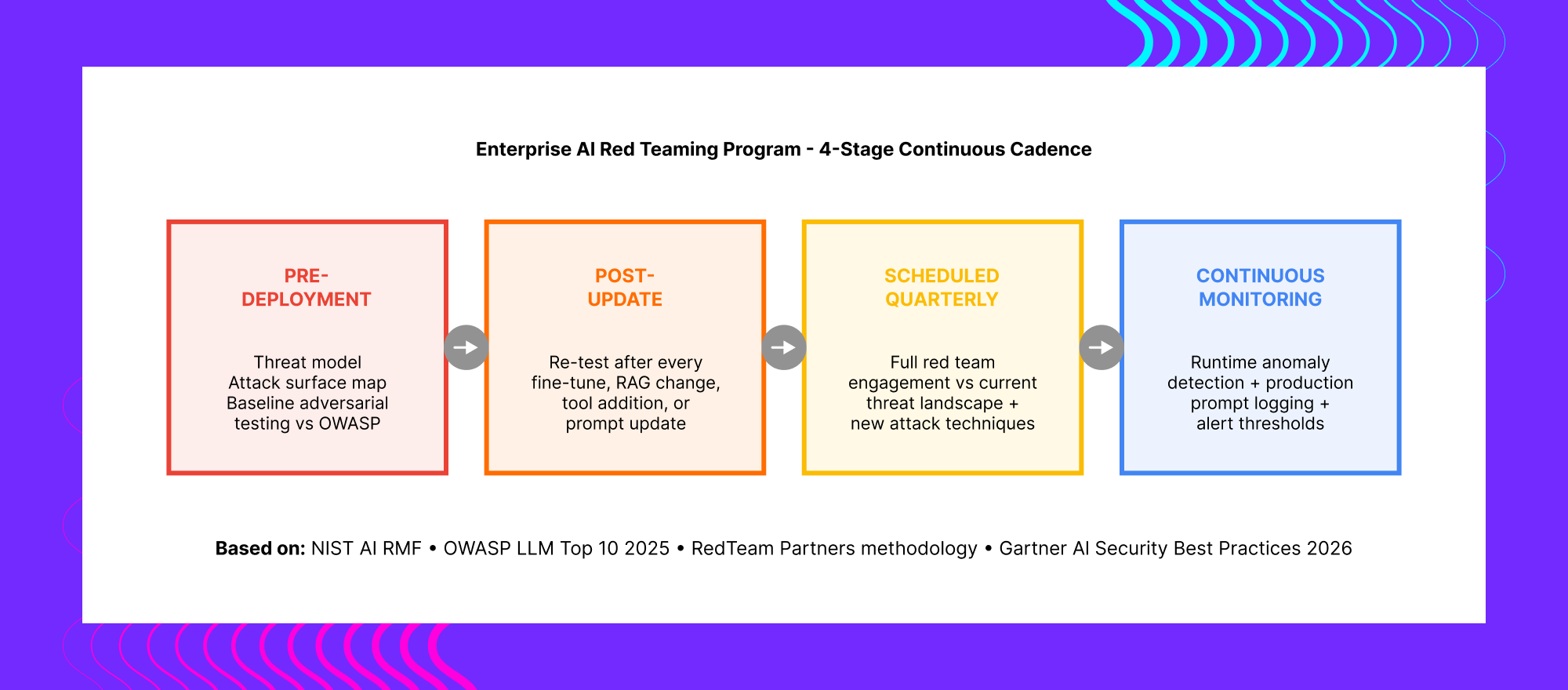
AI red-teaming is not an event. It is a program. A single pre-deployment red team engagement before go-live is necessary but not sufficient. The threat landscape evolves. The model updates. The RAG corpus grows. The tools available to agents change. Any of these changes can introduce new vulnerabilities that were not present in the original deployment.
The 2026 AI Red-Teaming Tool Landscape
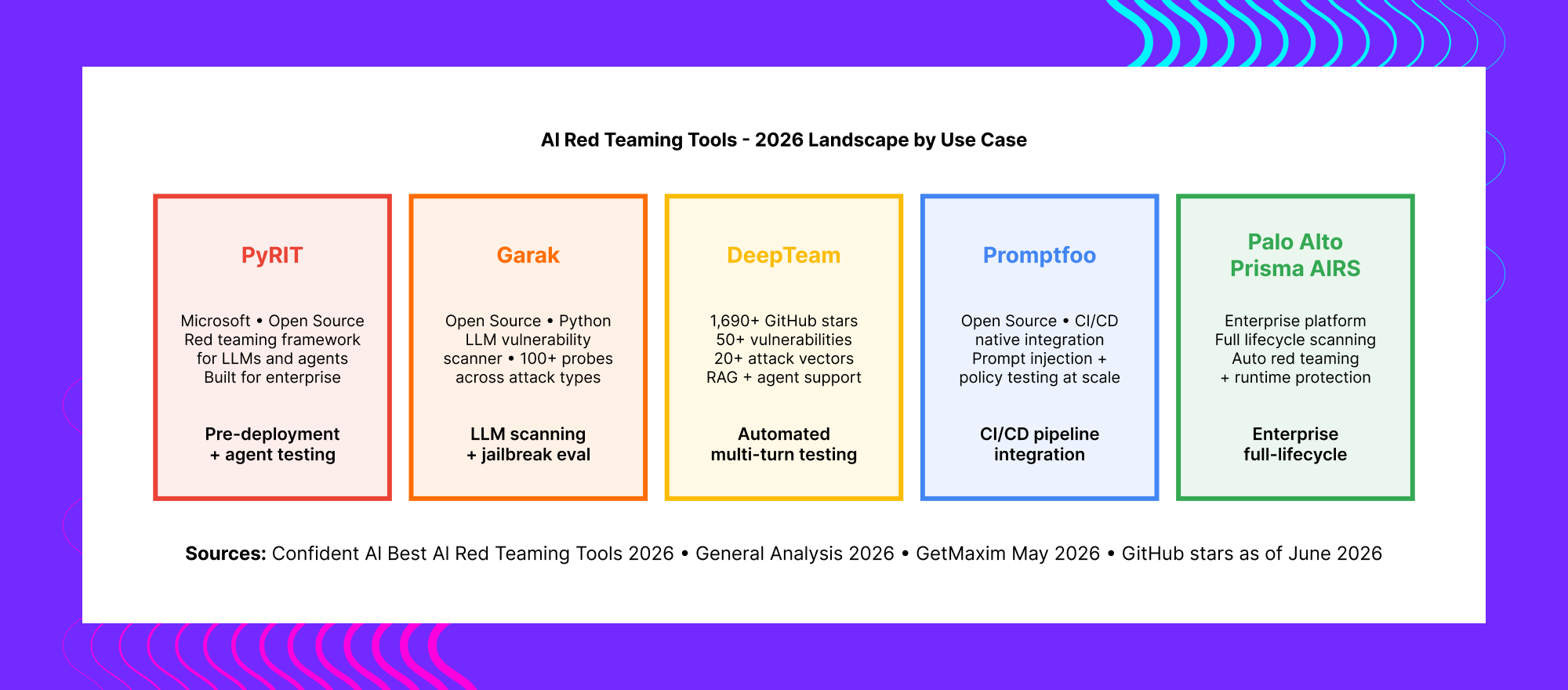
TOOL SELECTION NOTE:
The right tool depends on what phase of the lifecycle you are testing and what type of AI system you are securing. For pre-deployment scanning: PyRIT or DeepTeam for comprehensive coverage. For CI/CD integration: Promptfoo. For enterprise full-lifecycle with runtime monitoring: Prisma AIRS or Lakera Guard. For visual testing in browsers: PromptBench. Most mature enterprise programs use two or three tools across different lifecycle stages rather than choosing one platform.
What Regulations Actually Require From AI Red-Teaming in 2026
The regulatory environment for enterprise AI security is consolidating around a small number of frameworks that red-teaming programs need to address. Knowing which framework applies to your organization and what it actually requires — rather than what the marketing materials say it requires — determines how your red-teaming program needs to be documented and structured.
NIST AI RMF: The most widely referenced framework in US enterprise AI governance. The RMF’s GOVERN, MAP, MEASURE, and MANAGE functions create the governance structure that connects red-teaming to organizational risk management. NIST does not mandate specific testing techniques but requires documented, systematic adversarial testing as part of the MEASURE function for high-risk AI systems. Your red-teaming program needs to produce outputs — test results, remediation tracking, residual risk documentation — that feed into the NIST RMF process.
EU AI Act (effective August 2026): Classifies AI systems used in regulated decisions as high-risk, requiring conformity assessments, human oversight mechanisms, audit trails, and robustness testing against adversarial inputs. Robustness against adversarial inputs is a specific legal requirement — making red-teaming not just good security practice but compliance obligation for organizations with EU market exposure. The Act requires that high-risk AI systems be tested for adversarial vulnerabilities before deployment and that testing documentation be maintained.
OWASP LLM Top 10 2025: Not a regulatory requirement, but the de facto enterprise procurement standard. Most enterprise security teams now include OWASP LLM Top 10 coverage as a requirement in AI system procurement. Documenting red-teaming coverage against the 2025 list — including the five new categories — is increasingly necessary for enterprise sales cycles in regulated industries.
The Only Way to Know Is to Try to Break It
The $3 million remediation cost in the financial services incident. The salary database exposure. The regulatory scrutiny. None of those outcomes were inevitable. They were the consequence of deploying AI systems without systematically trying to break them before attackers did.
AI red-teaming is not a compliance checkbox and it is not a one-time pen test. It is the ongoing practice of putting your AI systems under the same adversarial scrutiny that a determined attacker would apply — and finding what they would find, in a controlled environment, before they find it in production. The threat landscape evolves fast enough that quarterly is the minimum cadence for a serious program. Agentic AI deployment is expanding the attack surface fast enough that tools and methodology from 2024 are already insufficient for 2026 systems.
78% of enterprises are still using traditional testing only for AI systems (Gartner 2026). That is both a risk statistic and an opportunity: the organizations that build serious AI red-teaming programs now are building a security capability that the majority of their competitors have not yet started.
At Trantor (trantorinc.com), we help enterprise organizations design and implement AI security programs that cover the full threat landscape — from pre-deployment adversarial testing against the OWASP LLM Top 10 2025 through continuous production monitoring and governance frameworks that satisfy NIST AI RMF and EU AI Act requirements. Our security work covers LLM red-teaming, agentic AI security assessment, RAG pipeline security review, and the organizational governance that makes AI security sustainable rather than a periodic event. Whether you are building an AI red-teaming program from scratch, assessing the security posture of existing AI deployments, or designing the governance infrastructure that connects security testing to regulatory compliance — that is the work we are built for.