Artificial Intelligence, zBlog
Knowledge Graphs for Enterprise AI — Replacing RAG with Structured Reasoning
trantorindia | Updated: May 29, 2026
Retrieval-Augmented Generation was the answer enterprise AI needed in 2023 and 2024. When LLMs needed access to private, proprietary, and domain-specific knowledge without retraining, RAG delivered: retrieve relevant document chunks from a vector store, inject them into the LLM’s context, generate a grounded response. It worked. It reduced hallucinations compared to ungrounded LLMs. It enabled AI systems to answer questions about enterprise content. And it deployed quickly.
The problem is what happened when organizations pushed RAG past its design envelope. When they asked it to reason about relationships between entities across thousands of documents. When they asked it to answer multi-hop questions that required connecting signals from disparate data sources. When they needed to show an auditor not just an answer but the precise reasoning path that produced it. When they asked it to identify hidden connections — the kind that compliance, fraud detection, and strategic intelligence require.
Traditional vector RAG cannot do these things. And the gap is not a matter of better retrieval algorithms or larger context windows. It is a structural limitation. Vector RAG retrieves chunks that are semantically similar to a query. It cannot traverse relationships. It cannot reason across entity connections. It cannot answer “how is Customer A connected to Sanctioned Entity B across millions of transaction records?” — because that question requires graph traversal, not semantic similarity.
This is where knowledge graphs for enterprise AI change the equation. GraphRAG — the fusion of knowledge graph structure with LLM reasoning — represents a fundamental architectural shift from retrieval as similarity search to retrieval as structured reasoning. And the performance data is compelling: GraphRAG achieves 80% accuracy versus 51% for traditional vector RAG across enterprise domains, with a 3.4x improvement on enterprise benchmarks. But the headline numbers understate the real value. The reason knowledge graphs matter for enterprise AI is not just accuracy — it is the kind of questions an organization can suddenly answer that it could not before.
Where Traditional RAG Hits Its Ceiling — The Structural Limitations
71% of organizations report regular GenAI use as of 2025, according to McKinsey. But only 17% attribute more than 5% of EBIT to GenAI — underscoring the gap between demos and real production value. That gap is not a motivation problem or a capability problem. It is largely an architecture problem. Traditional RAG moves AI from impressive demos to production-grade enterprise value for a specific class of questions. For a different — and arguably more important — class of questions, it fails structurally.
Failure 1: The Multi-Hop Reasoning Wall
Consider the query: “How did the delay in Project Apollo affect Q3 APAC margins?” Traditional vector RAG will retrieve Project Apollo documents. It will retrieve APAC margin documents. It cannot reason about the causal relationship between them. That is a structural gap in pure vector retrieval — it finds semantically similar chunks; it cannot traverse the logical and relational connections that make the answer intelligible.
The mathematics are stark. GraphRAG achieves 90.63% accuracy on industry-domain multi-hop questions versus 46.88% for vector RAG — a gap so large it cannot be closed by better prompting or larger context windows. The gap exists because the architectures are answering fundamentally different types of questions. Vector RAG answers “what chunks are most similar to my query?” Knowledge graphs answer “what is the relationship structure around the entities in my query?”
Failure 2: The Explainability Gap in Regulated Industries
In 2024, real-world RAG deployment revealed a critical gap: the inability to explain answers to auditors. When a compliance officer asks an AI system why it flagged a transaction, “these chunks were semantically similar to your query” is not an acceptable answer. Regulated industries need traceable reasoning — healthcare and finance use knowledge graphs to ensure AI decisions can be explained to auditors with clear provenance chains. Vector RAG operates as black-box similarity matching. Knowledge graphs provide a “white box” approach where an auditor can see: “The model selected this answer because Entity A is linked to Entity B via Relationship C.”
Failure 3: The Holistic Synthesis Problem
Some enterprise questions require synthesizing understanding across an entire dataset — not retrieving the most relevant chunks. “What are the compliance risks across all our vendor contracts?” requires thematic understanding that cannot be assembled from the top-k most similar chunks. Microsoft’s GraphRAG addressed this with hierarchical community detection: the Leiden algorithm groups related entities into communities that can be summarized independently, enabling theme-level queries that pure vector search cannot answer.
The NStarX enterprise RAG evolution analysis captures this inflection point precisely: “The traditional view of RAG — ‘retrieve documents, stuff them into context, generate answer’ — is obsolete. By 2026–2030, successful enterprise deployments will treat RAG as a knowledge runtime: an orchestration layer that manages retrieval, verification, reasoning, access control, and audit trails as integrated operations.”
What Are Knowledge Graphs — And Why They Change the Retrieval Equation
A knowledge graph models information as nodes (entities) and edges (explicit relationships between those entities). Unlike traditional databases that require rigid schemas, and unlike vector stores that represent meaning as floating-point arrays, knowledge graphs represent the actual structure of how concepts, entities, and facts relate to each other in the real world.
In a financial knowledge graph, “Company A” is a node. “acquired” is an edge. “Company B” is another node. The graph captures not just that these entities exist, but how they are connected — and that connection can be traversed, queried, and reasoned over in ways that neither SQL nor vector similarity search can replicate. A question like “Which suppliers serve competitors who recently entered our market?” requires traversing multiple relationship hops — something graph databases handle natively and vector databases fundamentally cannot.
The Three-Layer Knowledge Architecture
Production enterprise AI systems in 2026 are increasingly built on a three-layer knowledge architecture, where each layer addresses limitations the others cannot:
The key insight from Atlan’s 2026 enterprise knowledge system analysis: “AI memory, RAG, and knowledge graphs are not alternatives to pick between — they are three distinct layers of the same context stack. Using only one leaves capability gaps the others would fill.”
The GraphRAG Knowledge Pipeline — From Raw Documents to Structured Reasoning
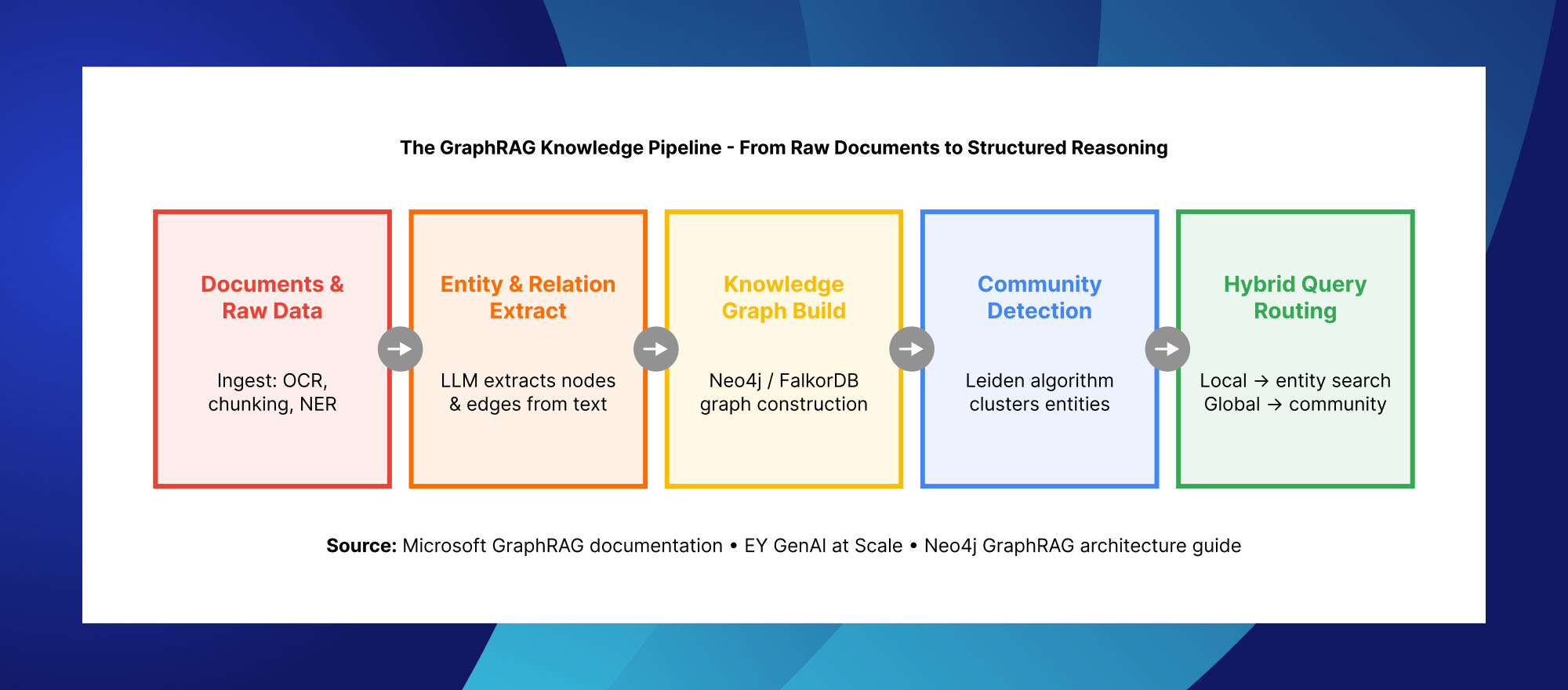
How GraphRAG Works — The Technical Architecture
GraphRAG — popularized by Microsoft’s open-source release in 2024 and reaching production maturity with version 1.0 in late 2024 — is a retrieval-augmented generation technique that uses knowledge graphs to organize and retrieve information for large language models. The core innovation is that instead of treating documents as flat text to be chunked and embedded, GraphRAG extracts the entities and relationships within documents and builds a structured graph that can be reasoned over.
Stage 1: Document Ingestion and Entity Extraction
The GraphRAG pipeline begins by ingesting source documents through OCR, text extraction, and chunking. LLMs are then used to extract entities (the nouns: people, organizations, products, locations, concepts) and relationships (how those entities connect) from each document chunk. This is where the most significant computational investment occurs — the entity extraction stage is what makes GraphRAG 3 to 5 times more expensive in LLM calls than baseline vector RAG at full implementation, though Microsoft’s LazyGraphRAG (released June 2025) reduces this indexing cost to just 0.1% of full GraphRAG while maintaining answer quality.
Stage 2: Knowledge Graph Construction
The extracted entities and relationships are stored as nodes and edges in a graph database — Neo4j being the de facto standard in production GraphRAG deployments, according to GraphRAG Publications July 2025 analysis. Neo4j’s combined graph and vector database capabilities — supporting both graph traversal and cosine similarity search — make it uniquely suited for hybrid GraphRAG architectures. The result of this stage is a structured knowledge graph that captures the organizational knowledge from the source documents as a traversable network of entities and connections.
Stage 3: Hierarchical Community Detection
Microsoft’s GraphRAG applies the Leiden algorithm to detect communities — clusters of closely related entities and relationships — within the constructed graph. These communities are summarized independently by the LLM, creating a hierarchical summary structure that enables both local search (within specific entity neighborhoods) and global search (across entire community summaries). This community hierarchy is what enables GraphRAG to answer thematic questions that require synthesizing understanding across an entire dataset.
Stage 4: Hybrid Query Routing
At query time, an incoming question is routed to the appropriate retrieval mechanism. Simple factual queries are directed to vector similarity search for speed and cost efficiency. Multi-hop queries requiring relationship traversal are directed to graph search. Global thematic queries are directed to community summary search. This hybrid routing is what makes production GraphRAG systems both powerful for complex queries and economically viable for the simple queries that should not invoke the full graph traversal pipeline.
Indexing Cost vs. Query Quality — RAG Architecture Trade-offs
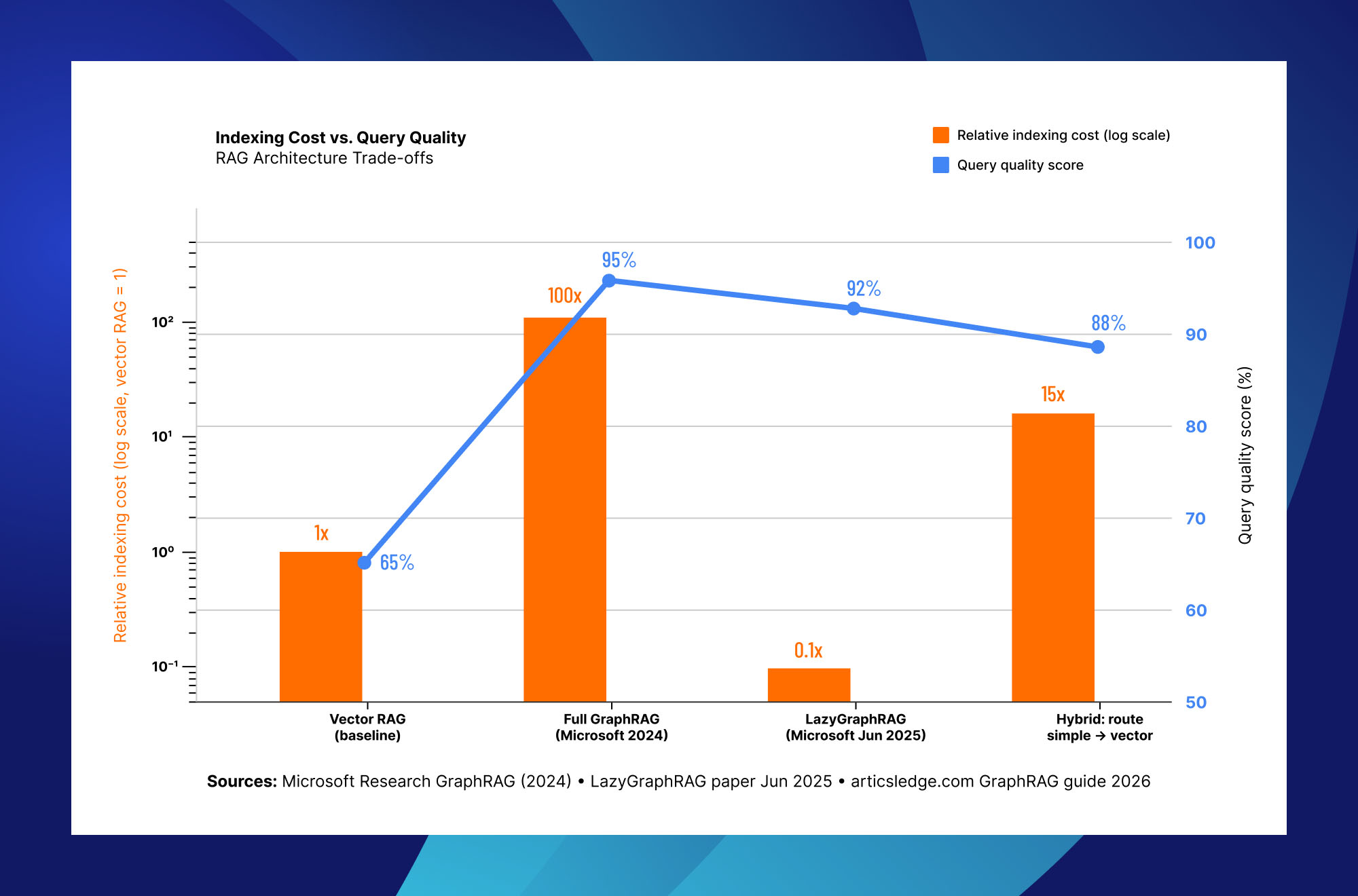
The Performance Data: What GraphRAG Actually Delivers in Enterprise Environments
The academic and industry benchmark data on GraphRAG performance is among the most consistent in enterprise AI research — significant improvements for the specific task categories where knowledge graph structure adds value, alongside important limitations for the task categories where it does not.
GraphRAG vs. Traditional Vector RAG — Accuracy by Domain
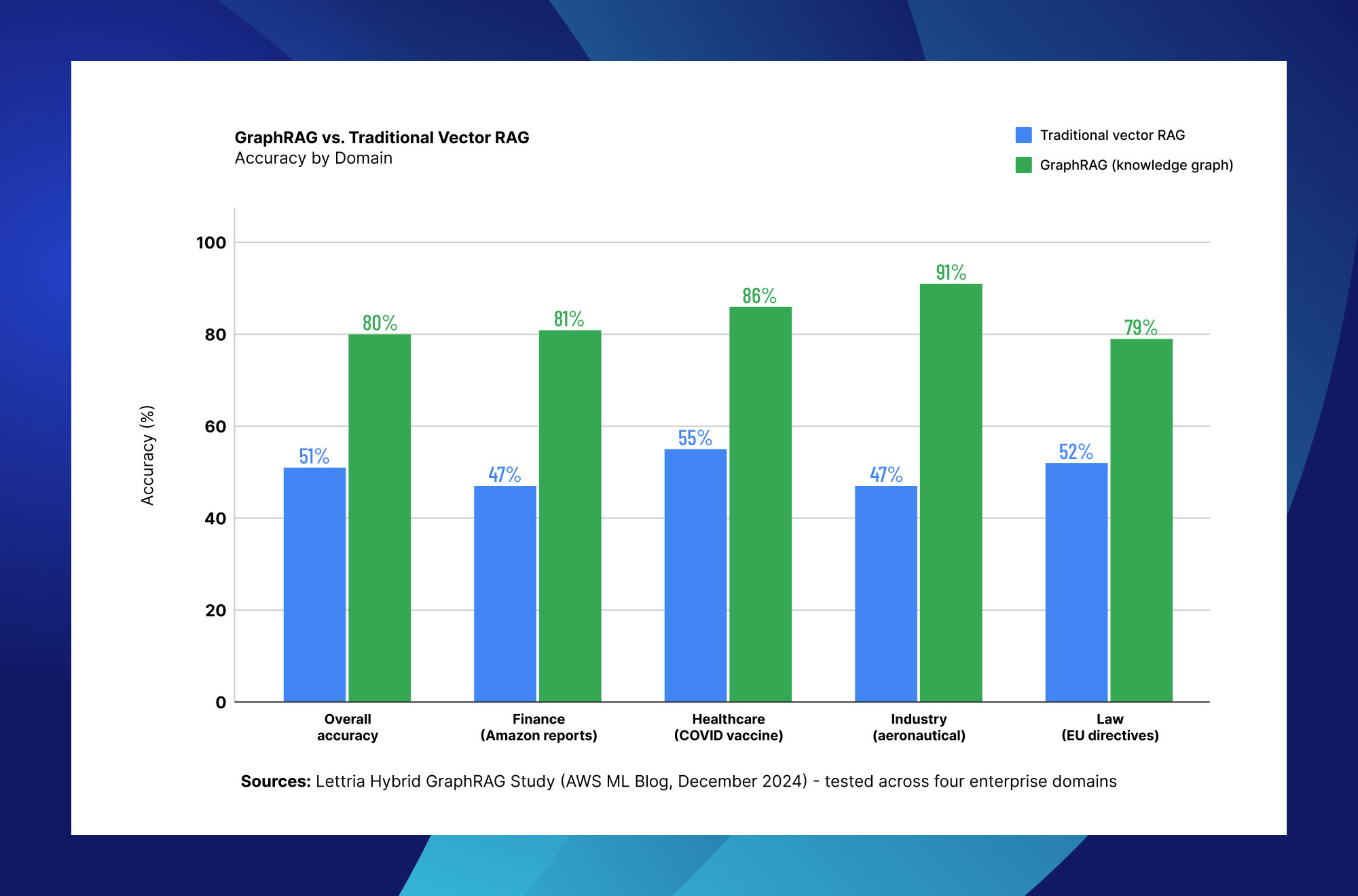
The Lettria Hybrid GraphRAG study, conducted across four enterprise domains and published on the AWS ML Blog in December 2024, provides some of the most comprehensive benchmarking data available. GraphRAG achieved 80% overall accuracy versus 51% for traditional vector RAG — a 29 percentage point improvement. In the industry domain (aeronautical specifications), GraphRAG reached 90.63% accuracy versus 46.88% for vector RAG — a nearly 2x improvement.
Microsoft’s own GraphRAG research found 72–83% comprehensiveness on global questions versus traditional RAG methods. The Diffbot KG-LM Benchmark (2023) documented a 3.4x accuracy improvement in enterprise scenarios. FalkorDB achieved a documented 90% hallucination reduction compared to traditional RAG while maintaining sub-50ms query latency. These are not marginal improvements — they are architectural capability differences.
The important counterpoint: GraphRAG does not outperform traditional RAG on all query types. A 2025 study found GraphRAG achieves 13.4% lower accuracy on Natural Questions compared to vanilla RAG, with a 16.6% accuracy drop for time-sensitive queries requiring real-time knowledge updates. The lesson is clear: GraphRAG excels on complex, relationship-intensive, multi-hop queries; traditional RAG remains competitive for simple factual lookups and real-time queries where graph re-indexing would be prohibitively slow.
Knowledge Graphs vs. RAG vs. GraphRAG — A Framework for Choosing
Capability Comparison — RAG vs. Knowledge Graph vs. GraphRAG
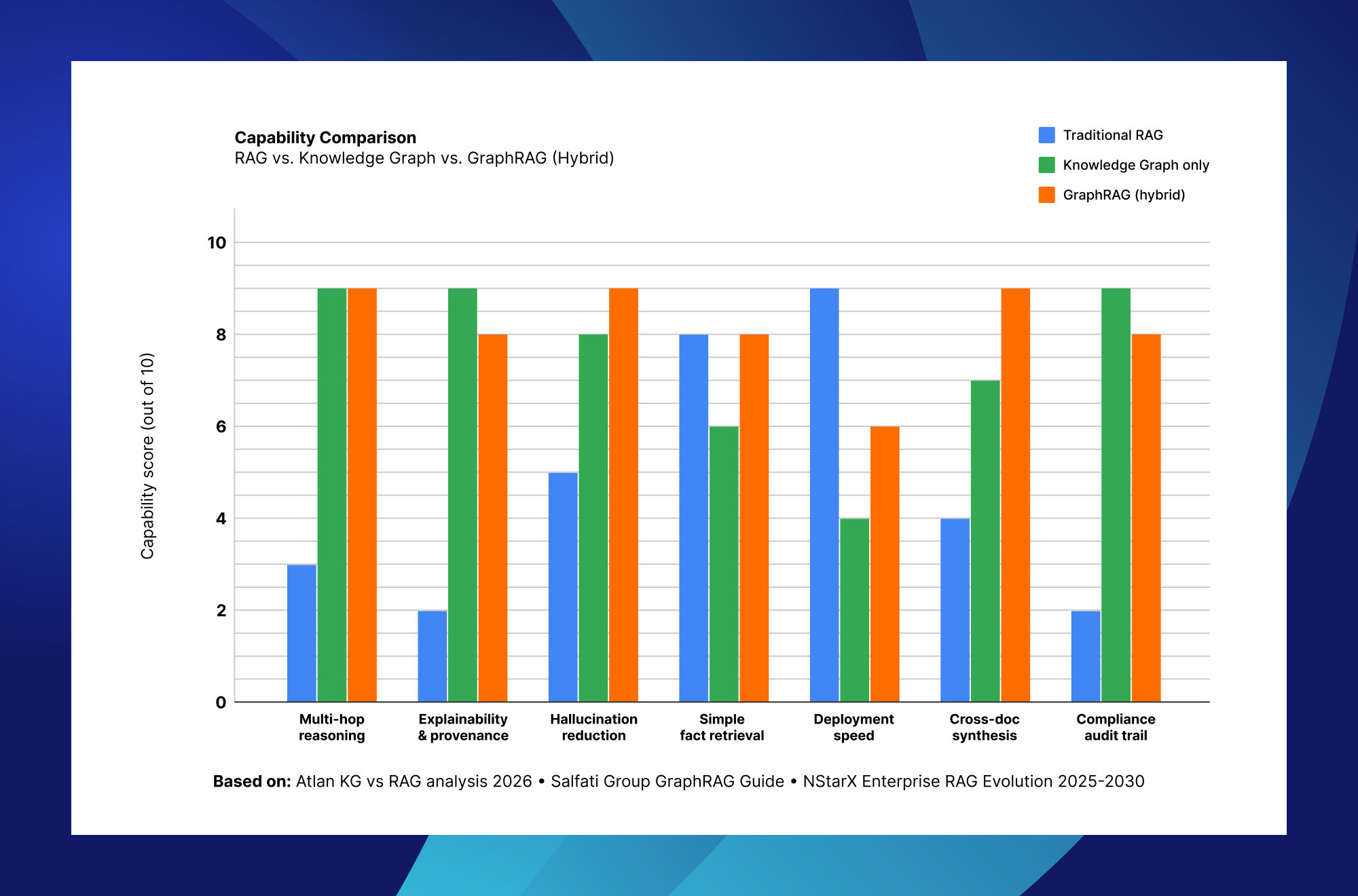
Real-World Enterprise Use Cases — Where Knowledge Graphs Deliver
Financial Services: Fraud Detection and Relationship Intelligence
Banks use GraphRAG to detect money laundering rings by modeling entities — accounts, companies, individuals — and transactions as a graph. The system can answer “How is Customer A connected to Sanctioned Entity B?” across millions of documents and transaction logs. This query cannot be answered by vector similarity search, because the connection between two entities may span multiple relationship hops through intermediary entities — none of which appear in the same document chunk.
The graph structure reveals what vector search misses: a seemingly unconnected account becomes suspicious when the graph shows it shares a registered agent with three accounts under investigation, which in turn share a phone number with a sanctioned entity’s historical contact record. Financial services firms use graph-based retrieval to answer multi-hop questions requiring traversal of disparate data sources, uncovering entity connections that pure vector search misses entirely.
Healthcare and Life Sciences: Connected Research Graphs
Cedars-Sinai built a 1.6 million-edge Alzheimer’s research knowledge graph using Memgraph (2024), enabling researchers to traverse relationships between genes, proteins, drugs, clinical trials, and patient outcomes at a scale and connection density impossible with traditional document retrieval. Precina Health achieved a 1% monthly HbA1c reduction — 12 times faster than standard care — using a GraphRAG system that connects patient records, treatment protocols, medication interactions, and outcomes in a structured reasoning graph.
In pharmaceutical drug discovery, knowledge graphs covering pharmaceutical companies reduce time to identify connections by 30%, per Coveo’s analysis. The regulatory compliance use case is equally compelling: FDA approval pathways, contraindication networks, and clinical trial relationships can be traversed and explained with full provenance — a requirement that vector RAG cannot meet for regulatory submissions.
Legal: Document Analysis with Reasoning Paths
webAI’s Knowledge Graph RAG implementation achieved 92% accuracy in legal document analysis — setting a benchmark in the space as of July 2025. Legal workflows are structurally well-suited to knowledge graph approaches because they involve a high density of entity relationships: parties, contracts, regulations, precedents, and obligations that connect to each other through documented relationships that must be traceable.
The EU AI Act compliance use case is directly relevant: knowledge graphs provide transparent reasoning paths that show exactly which regulations, which articles, and which relationships were traversed to reach a compliance determination. For organizations that must demonstrate EU AI Act compliance to auditors and regulators, this explainability is not optional infrastructure — it is a legal requirement.
Enterprise Knowledge Management: The Fujitsu Model
Fujitsu’s enterprise-wide AI framework — described as the world’s first enterprise-wide generative AI system — uses a hybrid architecture combining knowledge graph extended RAG with generative AI for document-heavy industries. The architecture enables real-time insights from both structured and unstructured data, connecting equipment maintenance records (documents) with part specifications (structured data) and supplier relationships (graph edges) — enabling queries like “Which suppliers for critical components have quality issues in the past 18 months?” that require traversing relationships across data types.
This manufacturing use case illustrates the practical power of the three-layer knowledge architecture. The supplier question requires semantic retrieval (which documents discuss supplier quality?), graph traversal (which suppliers connect to which components?), and structured data joins (what are the quality metrics?). No single retrieval mechanism handles all three — which is why hybrid GraphRAG architectures are becoming the production standard for complex enterprise knowledge management.
The Enterprise Adoption Trajectory — Where the Market Is Heading
Enterprise AI Retrieval Architecture — Adoption Trajectory 2022–2028
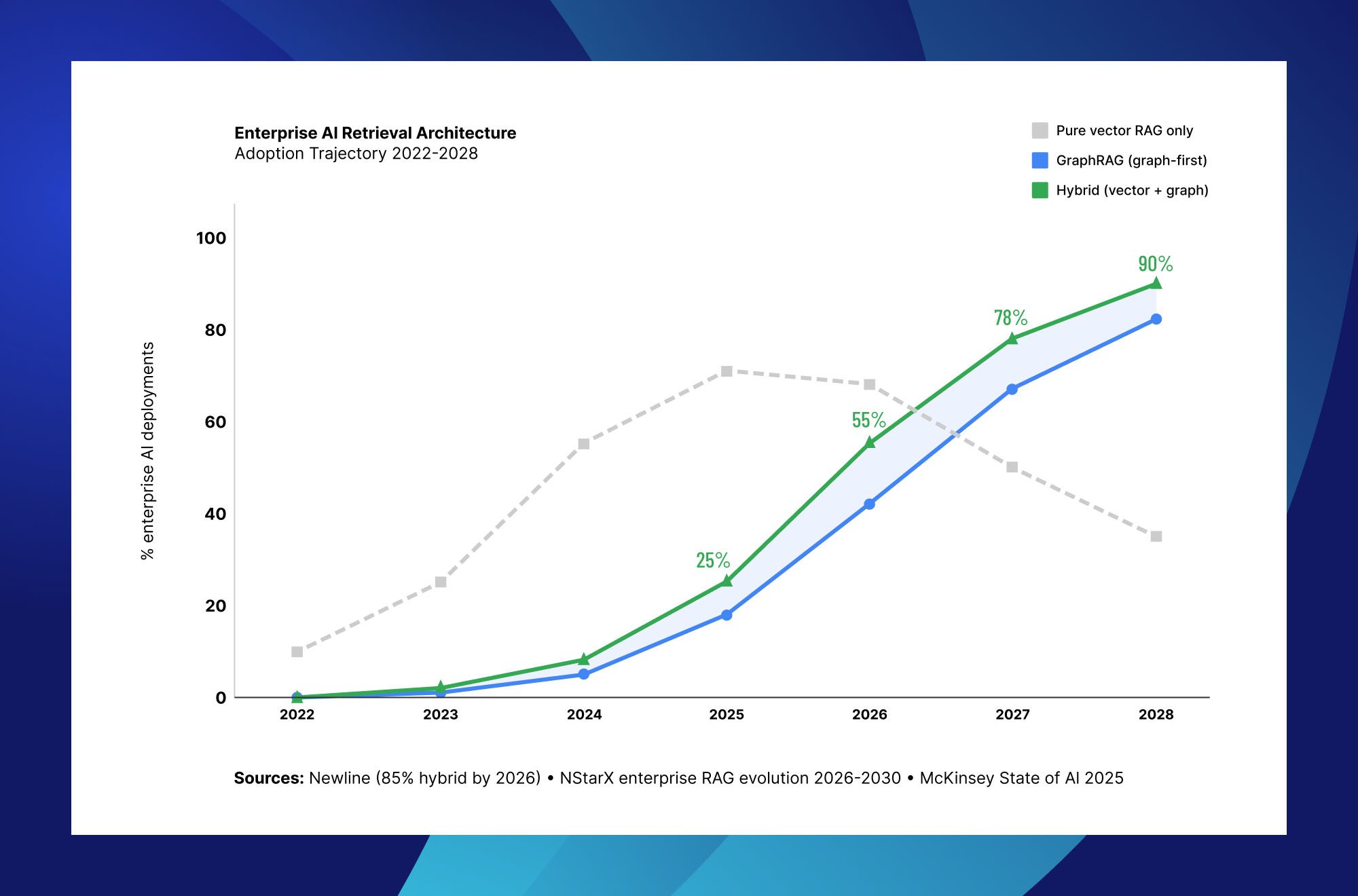
By 2026, 85% of enterprises will adopt hybrid RAG systems combining vector and graph databases to balance speed and depth, according to Neo4j’s LLM integration analysis cited by Newline. The RAG market itself was estimated at $1.94 billion in 2025 and is projected to reach $9.86 billion by 2030 at a 38.4% CAGR — making it the largest single component in the enterprise AI context stack today.
Microsoft’s GraphRAG project has become the cornerstone of this transformation. Released open-source in 2024, reaching production maturity with version 1.0 in late 2024, and continuing to evolve through its March 2026 release with performance optimizations and new query capabilities. LazyGraphRAG, integrated into Microsoft Discovery as of June 2025, achieved a win rate of 96 of 96 comparisons against vector RAG, RAPTOR, LightRAG, and standard GraphRAG methods — including maintaining superiority against 1 million-token context windows on all but one specific query class.
The enterprise vendor ecosystem has moved accordingly. LangChain and LlamaIndex both have native GraphRAG integrations. ServiceNow and Workday integrated RAG into their platforms in 2024. The Neo4j GraphRAG Context Provider is now officially integrated with Microsoft’s Agent Framework, enabling Azure-based agents to query Neo4j knowledge graphs through a standardized interface.
Building a Knowledge Graph for Enterprise AI — The Practical Implementation Guide
Knowledge Graph Governance — The Enterprise Requirements
Knowledge graphs in enterprise AI are not just technical infrastructure — they are organizational knowledge assets that require governance frameworks comparable to those applied to master data management and enterprise data architecture.
Data Freshness and Incremental Update
A study documented a 16.6% accuracy drop for time-sensitive queries in GraphRAG systems where the graph has not been recently updated. The fundamental challenge: re-indexing the entire graph is expensive, and quick updates require incremental graph modification, which is architecturally complex. Production knowledge graph systems require explicit data freshness policies — defining which entity and relationship types require near-real-time update, which can tolerate daily batch re-indexing, and which can be updated on weekly cycles.
Security and Privacy in Graph Structures
Graph structures can reveal sensitive relationships that individual entity anonymization cannot prevent. Anonymizing patient names does not help if their graph connections — visiting a specific physician, participating in a specific trial, co-enrolled with other patients — enable re-identification through relationship patterns. Knowledge graph deployments in regulated industries require privacy-by-design graph schemas, differential privacy mechanisms for sensitive relationship types, and access control at the edge level (not just the node level) so that sensitive relationships are not traversable by unauthorized queries.
Ontology Governance
As knowledge graphs grow, their ontologies drift. New entity types get added informally. Relationships accumulate inconsistent naming. Duplicate entities represent the same real-world concept under different names. Enterprise knowledge graph programs require dedicated ontology governance — a function responsible for maintaining schema consistency, resolving entity disambiguation, and ensuring that the graph’s semantic structure remains coherent as organizational knowledge evolves.
Frequently Asked Questions
Conclusion: From Retrieval to Reasoning — The Knowledge Graph Imperative
The enterprise AI programs that will define competitive advantage over the next three years are not the ones with the most documents in a vector store. They are the ones with the most intelligently structured knowledge — where the connections between entities are as queryable as the entities themselves, where reasoning paths are as explainable as the answers they produce, and where the AI system can answer not just “what does this document say?” but “how does what this document says connect to what those twenty other documents say, and what does that connection mean for this decision?”
Knowledge graphs for enterprise AI are not a replacement for traditional RAG in the absolute sense — they are the architectural evolution that makes AI systems capable of the kind of reasoning that actually drives enterprise value. The 3.4x accuracy improvement on enterprise benchmarks is the measurable expression of a more fundamental shift: from retrieval as similarity search to retrieval as structured reasoning.
By 2026, 85% of enterprises will adopt hybrid RAG systems combining vector and graph databases. LazyGraphRAG has reduced the cost barrier that was the primary obstacle to knowledge graph adoption. Microsoft, Neo4j, AWS, Google Cloud, and the major enterprise software vendors have all committed to GraphRAG as a core architectural direction. The technology has reached production maturity. The economics have become defensible. The regulatory requirements — particularly EU AI Act explainability mandates — are making knowledge graphs not just a performance enhancement but a compliance necessity for regulated industries.
At Trantor (trantorinc.com), we help enterprise organizations design and build knowledge graph implementations that deliver the specific value their business queries require — not generic graph infrastructure, but domain-specific knowledge graphs with the ontologies, entity extraction, hybrid routing, and governance frameworks that make the difference between a compelling proof-of-concept and a production system that answers the questions your organization actually needs answered. We bring architectural depth in both the graph database layer (Neo4j, FalkorDB, ArangoDB) and the orchestration layer (LangGraph, LlamaIndex, LangChain GraphRAG integrations), combined with the domain expertise to design entity schemas and relationship ontologies that capture what matters for your specific regulatory, operational, and strategic intelligence requirements.
Whether you are evaluating GraphRAG as an upgrade path from your existing vector RAG deployment, designing a knowledge graph for a compliance-critical use case in financial services or healthcare, building the fraud detection relationship graph that your risk team has been asking for, or architecting the enterprise knowledge management system that connects your structured and unstructured data into a single queryable intelligence layer — that is exactly the work we are built for.
The future of enterprise AI is not just retrieval. It is structured reasoning over organized knowledge. Trantor helps you build it.