Artificial Intelligence, zBlog
AI-Augmented Hiring — How Engineering Teams Use AI to Assess Technical Talent
trantorindia | Updated: June 1, 2026
Hiring strong engineers has always been hard. But in 2026, the traditional technical hiring process — keyword-scanned resumes, LeetCode puzzles disconnected from real work, gut-feel interviewer decisions, weeks of coordination overhead — is failing engineering teams in a new and urgent way.
The gap between AI talent demand and supply has reached a global ratio of 3.2 to 1 according to Second Talent’s 2026 AI Talent Shortage analysis. AI expertise is the top hiring priority cited by 91% of organizations in 2026, up from 89% in 2025. The engineering talent pool is more competitive than ever — and the organizations that cannot identify and hire strong engineers faster and more accurately than their competitors will fall behind on the technology that now determines competitive advantage.
AI-augmented hiring is the answer. Not AI as a replacement for human judgment — but AI as infrastructure that handles the volume work of screening, sourcing, scheduling, and initial assessment so that human recruiters and engineering leaders can focus the time and judgment that actually matters on the decisions that actually matter.
87% of companies now use AI in their recruitment process. AI-powered screening tools reduce resume review time by up to 75%. Companies using AI in talent acquisition report a 40% reduction in time-to-hire. And yet the gap between AI deployment and effective implementation remains enormous: only 6% of HR leaders have automated 75% of their processes. The tools exist. The question is whether your hiring system is using them correctly.
Why Traditional Technical Hiring Is Failing Engineering Teams in 2026
The standard engineering hiring process was designed for a world that no longer exists. It assumes that technical competence can be reliably measured by solving algorithmic puzzles under time pressure in a whiteboard interview. It assumes that resume keywords are a reliable proxy for relevant skills. It assumes that interview performance on LeetCode-style problems predicts on-the-job performance building real software. None of these assumptions hold up well in 2026.
The Signal Problem: AI Has Changed What Technical Skill Looks Like
AI increases engineers’ productivity by an average of 34%, according to Karat’s survey of 400 engineering leaders. But that boost does not apply evenly. Instead of leveling the playing field, AI is widening the gap between strong and weaker engineers. Strong engineers who know how to effectively leverage AI create dramatically more value by automating routine work, accelerating development, and exploring more ideas. Weaker engineers using AI produce more code with more problems.
This creates a direct problem for traditional hiring. An interview process that tests whether a candidate can write a binary search tree from memory is no longer measuring what matters. The questions that predict on-the-job performance in 2026 are different: Can this engineer evaluate AI output critically? Can they identify when an AI suggestion is wrong? Do they understand the code they are asking AI to generate? Can they debug an AI-generated solution that is subtly incorrect?
KEY INSIGHT: 73% of engineering leaders say strong engineers are worth at least 3x their total compensation — a figure that jumped significantly from 2023 to 2025, reflecting the impact of AI on productivity amplification. The value of identifying the right engineer has never been higher, and the cost of a bad hire has never been more significant. Source: Karat 2025-2026 AI Workforce Transformation Report.
The Volume Problem: Manual Screening Cannot Scale
The average engineering role receives 250 applications. Manual resume screening at that volume is not just slow — it is inaccurate. Human reviewers unconsciously screen for proxies (brand-name employers, elite universities, specific keywords) rather than actual technical competence. Karat’s data indicates that automated code tests, when used as the primary screen, could be filtering out as many as one in three hires — candidates who would have received offers based on live technical interviews but who fail binary pass/fail automated tests that do not capture how they actually work.
The coordination overhead on top of this is brutal. Scheduling interviews across multiple time zones and calendar systems, coordinating between engineering interviewers who are also trying to build products, following up with candidates, managing assessment platforms — these administrative tasks consume recruiter time that should be going toward candidate relationship building, offer negotiation, and the judgment-intensive work that actually closes hires.
AI Adoption in Technical Hiring — By Function (2025–2026)
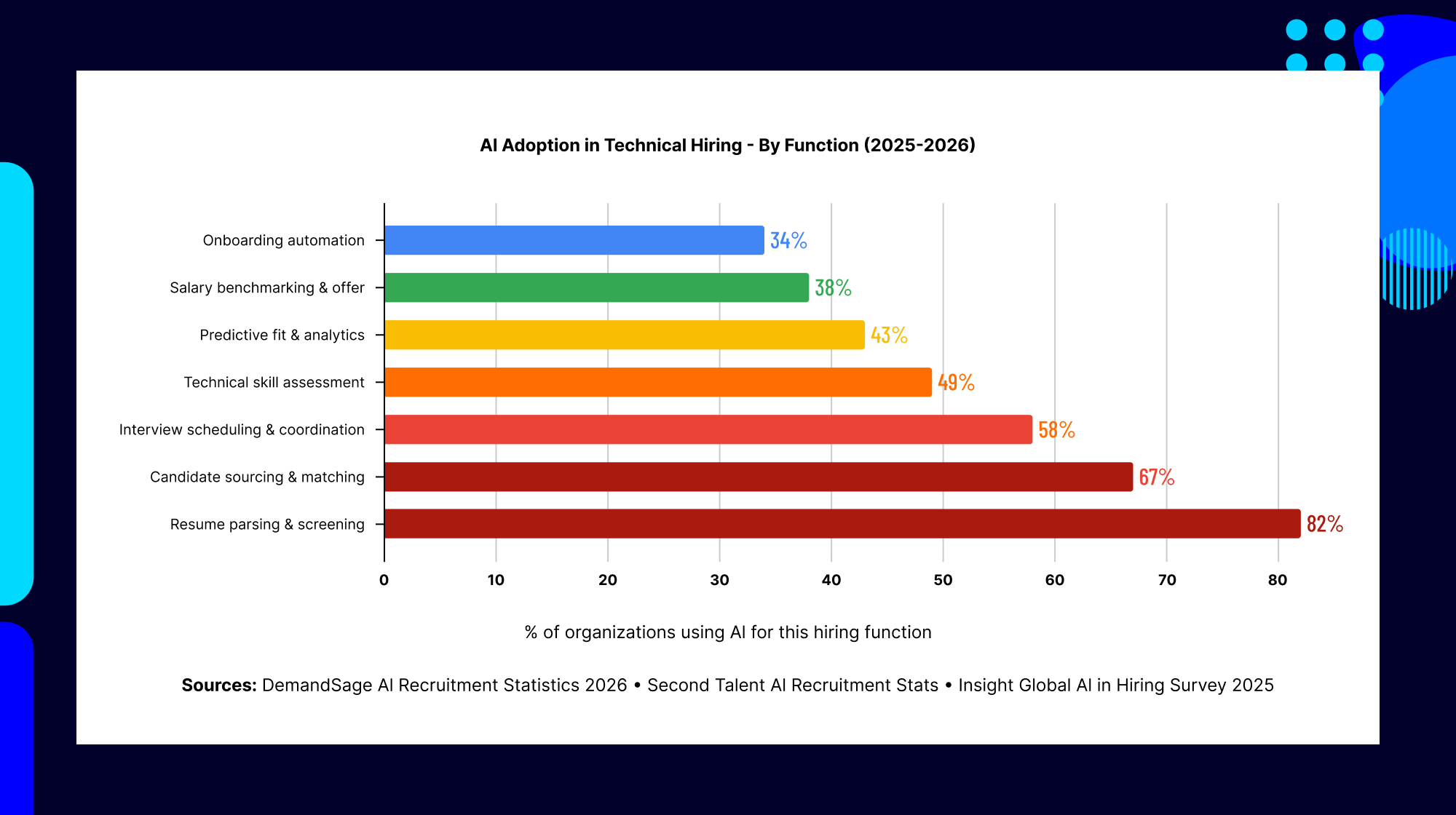
How AI-Augmented Hiring Works — The Complete Engineering Pipeline
AI-augmented hiring does not replace the technical hiring process. It redesigns it — systematically identifying which parts of the pipeline benefit from AI handling the volume work, and which parts require irreducibly human judgment. The result is a pipeline that is faster, more consistent, less biased, and more predictive.
Engineering Hiring Pipeline — Traditional vs. AI-Augmented (2026)
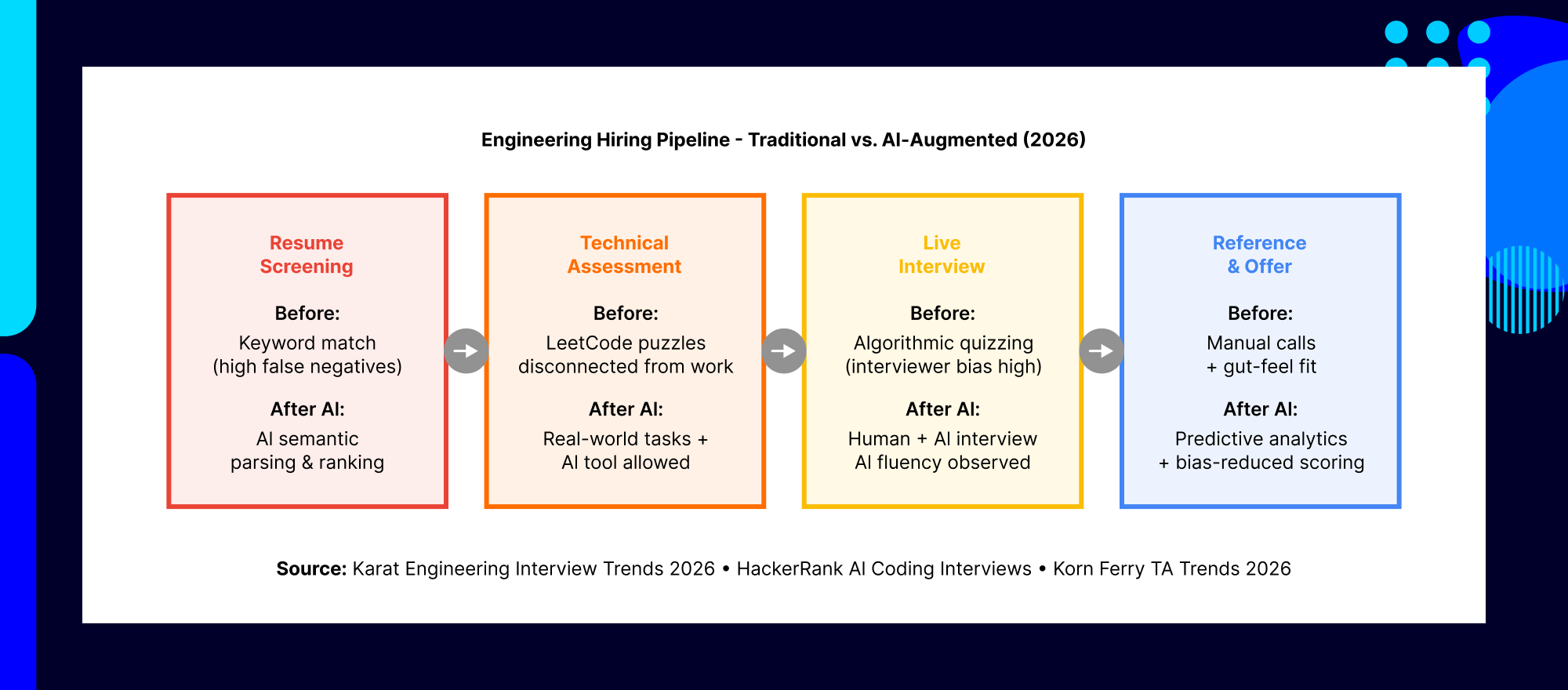
Stage 1: AI-Powered Resume Screening and Sourcing
KEY INSIGHT: 41% of recruiters now use AI daily for candidate sourcing and screening. AI-powered screening tools can reduce the time spent on resume reviewing by up to 75% (Talent Board and Phenom research). AI can also reduce gender bias by 61% and racial bias by 61% when properly designed — but only when built on diverse training data and regularly audited. Source: DemandSage AI Recruitment Statistics 2026.
Stage 2: AI-Enhanced Technical Assessment
AI-generated technical assessments now evaluate: core coding and algorithmic challenges; prompt engineering and RAG workflows; code quality and problem-solving approach; and — critically — how candidates collaborate with AI tools in a controlled IDE environment. This last category gives hiring teams a deeper signal on how engineers will perform in AI-augmented development environments.
Stage 3: The Human + AI Interview — The Most Important Innovation of 2026
Organizations that use human + AI hiring assessments anticipate better outcomes over the next three years compared to organizations that still prohibit AI use in interviews. The format also naturally detects AI-dependent candidates who cannot explain or debug the code they used AI to generate. Source: Karat Engineering Interview Trends 2026, survey of 400 engineering leaders.
Stage 4: AI-Powered Interview Scheduling and Coordination
Stage 5: Predictive Analytics and Hiring Decision Support
Technical Hiring Metrics — Before vs. After AI Augmentation
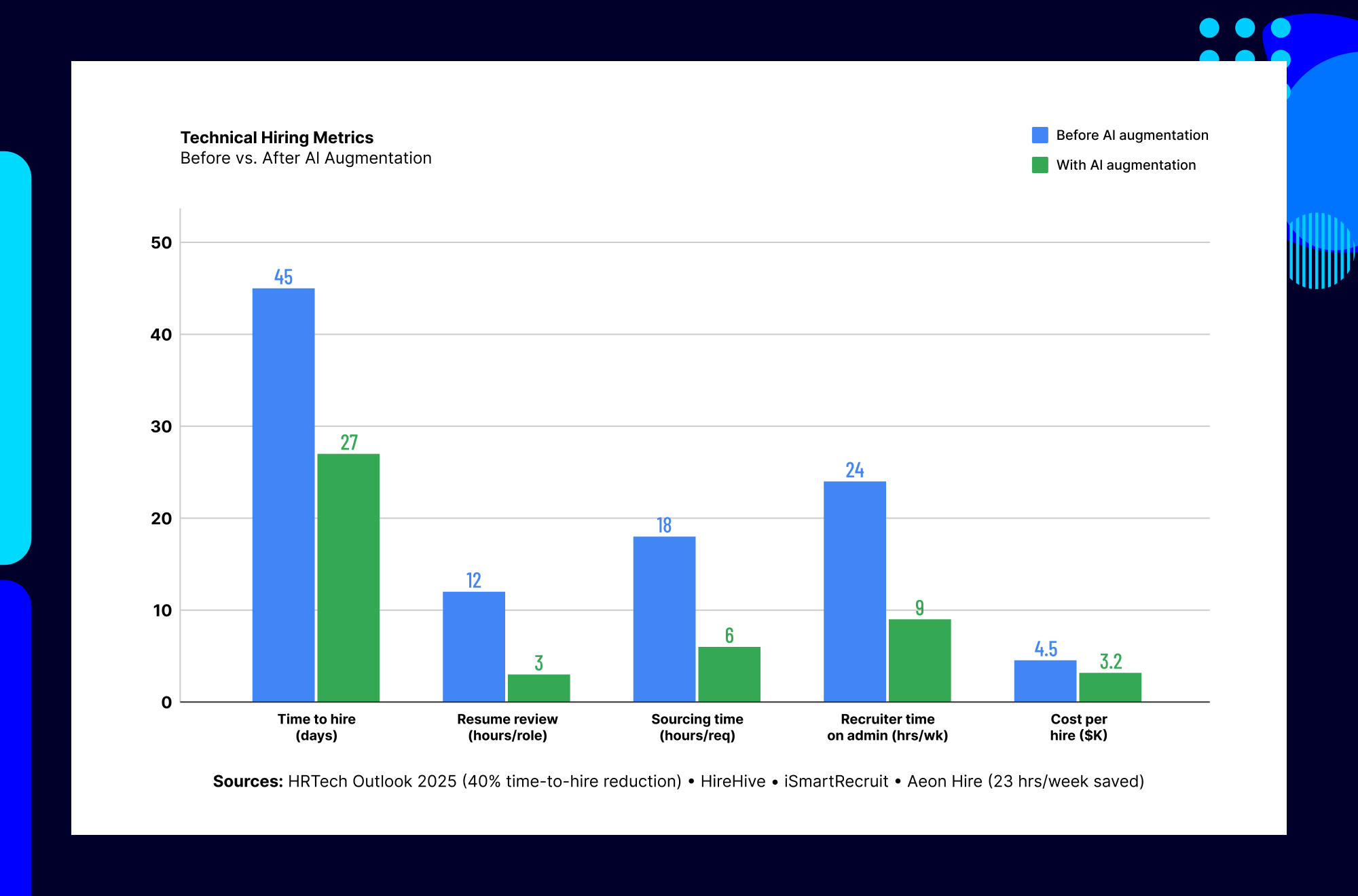
The Human-AI Division of Labor — What Machines Handle, What Humans Own
The most important governance question in AI-augmented hiring is not which tools to use. It is which decisions to keep human. Not every aspect of recruiting should be automated. Successful AI implementations focus on automating tasks that are high-volume, logic-based, and data-rich — and keeping humans centered on the high-value, high-judgment aspects of recruiting: building relationships, assessing culture fit, and making final hiring decisions.
AI-Augmented Hiring — Optimal Division of Labor
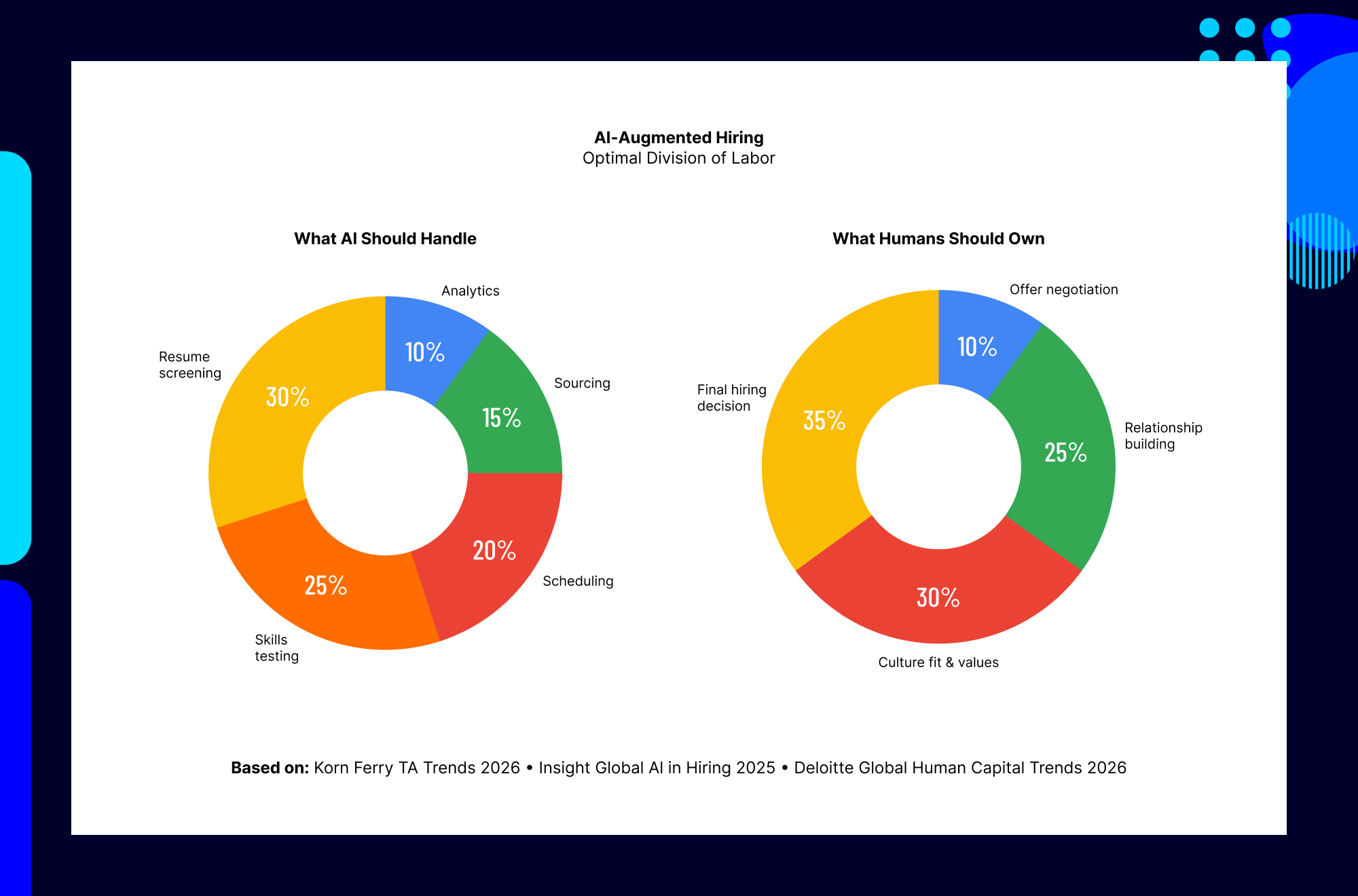
AI-Augmented Hiring — Optimal Division of Labor
The Technical Assessment Platform Landscape — Tools Engineering Teams Are Using
Choosing the right technical assessment platform matters because platforms vary significantly in assessment realism, AI-assisted evaluation depth, live interview capability, and proctoring integrity. The platforms that engineering teams trust in 2026 have moved beyond algorithmic puzzle libraries toward real-world engineering task environments that mirror actual day-to-day work.
Technical Assessment Platforms — Feature Comparison 2026
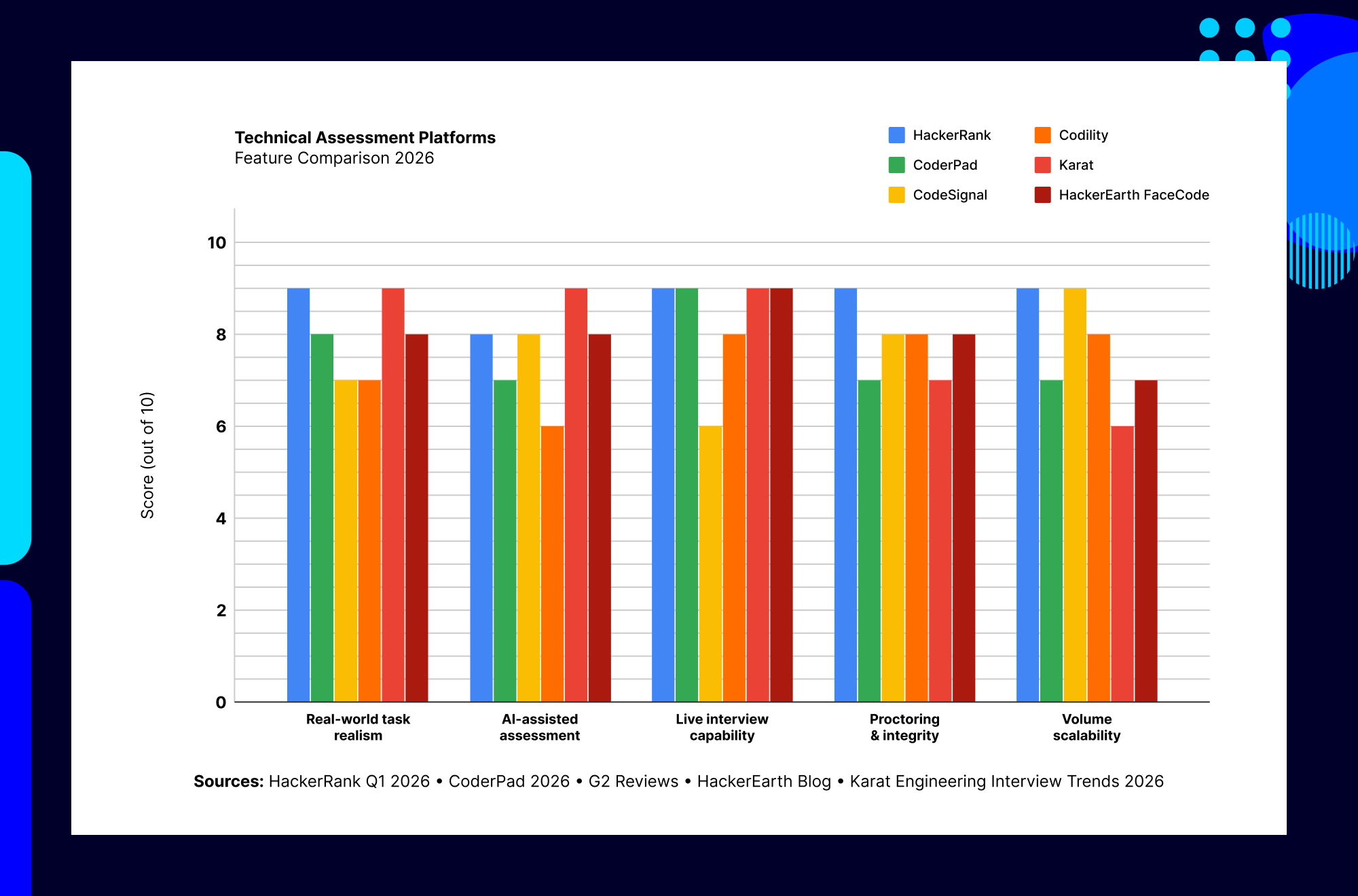
Technical Assessment Platforms — Feature Comparison 2026
HackerRank: Leads with 7,500+ curated coding challenges, 58 programming language support, AI-driven shortlisting, and CodePair live interviews with a collaborative IDE. Multi-monitor detection and tab-switch tracking for assessment integrity. AI Assistants in the IDE show how candidates work with modern tools. Best for high-volume tech hiring with comprehensive integrity features.
CoderPad: Achieves 50% faster IDE performance and 9.2 technical screening rating on G2. Strong pair programming focus with real-time collaborative coding. Best for teams prioritizing live, collaborative interview experiences over asynchronous assessment volume.
CodeSignal: Uses AI and proven scoring methodologies to evaluate candidates, reducing bias and improving consistency across large candidate pools. Best for high-volume standardized testing where consistent scoring across thousands of candidates matters most.
Codility: Provides mature real-life engineering tasks including bug-fixing and domain-specific assessments. 40+ programming language support and strong proctoring with behavior flags and plagiarism detection. Noted for assessment rigor over candidate experience.
Karat: Human-led, AI-enabled interview service that designs and conducts technical interviews on behalf of engineering teams. Allows AI tools in interviews to observe AI fluency alongside technical skill. The NextGen platform specifically addresses the human + AI interview format that 2026 demands.
KEY INSIGHT: The technical assessment market was estimated at $2 billion in 2025 and is projected to reach $6.5 billion by 2033 at a 15% CAGR. When AI use is near-universal among developers — with 97% using AI assistants — assessment platforms need to both accommodate AI-assisted work and detect when candidates rely on external help inappropriately. Source: CoderPad Technical Screening Market Analysis Q1 2026.
The Candidate Side — What Engineers Think About AI-Augmented Hiring
AI-augmented hiring has to work for candidates, not just for engineering teams. A Boston Consulting Group survey found that 42% of candidates who had a negative interview experience would reject an offer entirely. The way AI is used in technical hiring is itself a signal to candidates about how the organization uses technology.
Candidate Perspectives on AI in Technical Hiring (2025–2026)
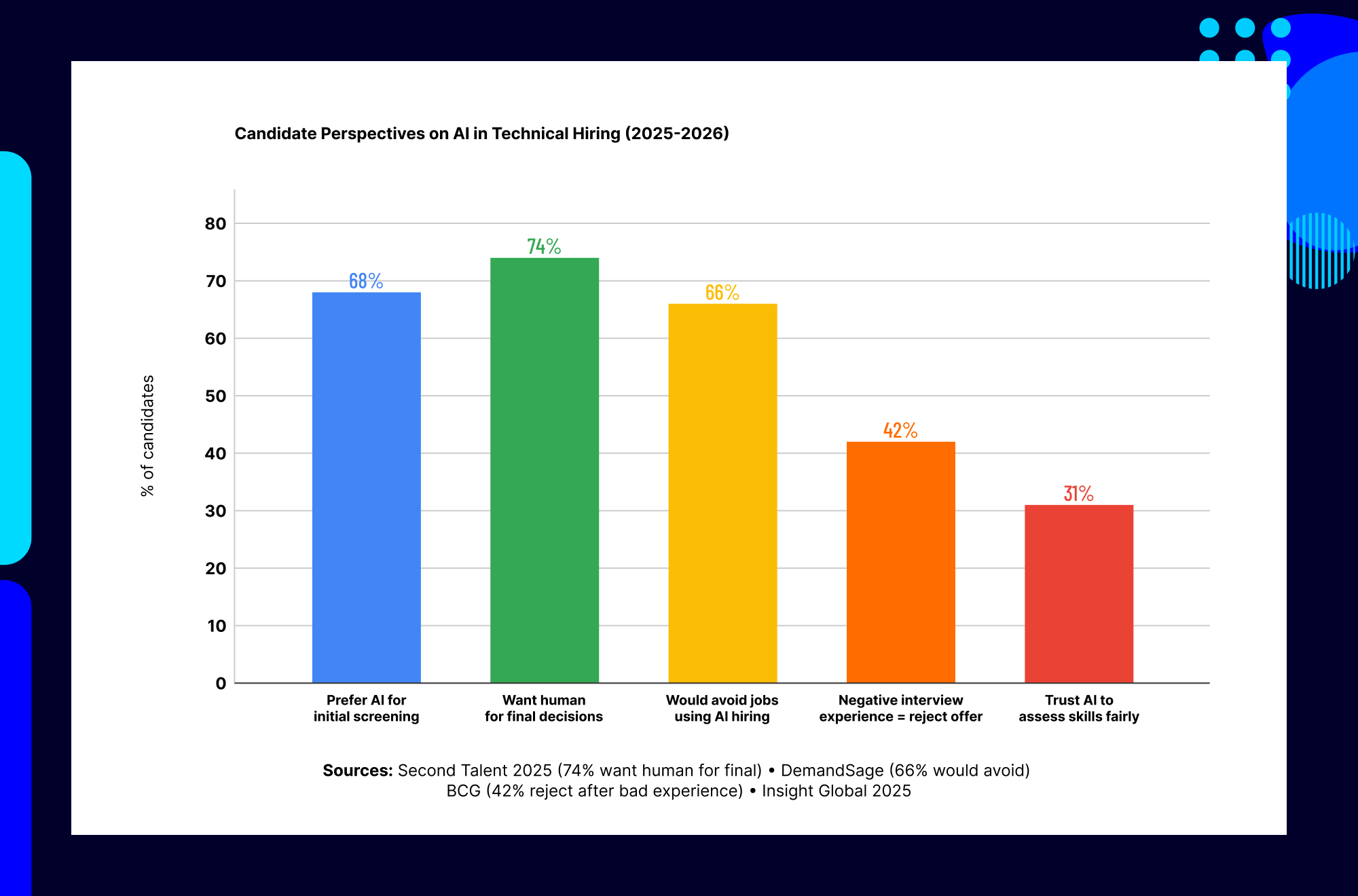
The data on candidate preferences is nuanced and demands careful reading. 68% of candidates prefer AI for initial screenings — they appreciate the speed, the availability, and the removal of the scheduling friction that human-led initial screenings involve. But 74% want human interaction for final decisions. The human judgment call that determines whether someone gets a job offer is the point where candidates most strongly reject algorithmic authority.
66% of U.S. adults say they would avoid applying for jobs that use AI in hiring decisions — a statistic that demands context. The key phrase is “in hiring decisions.” Candidates are not objecting to AI assistance in the hiring process. They are objecting to AI making the final call. Organizations that communicate clearly about the division of labor — AI helps find you and assess your technical skills, humans make the hiring decision — experience significantly better candidate sentiment than those whose AI use is opaque.
GOVERNANCE NOTE: Transparency is not optional. The EU AI Act classifies AI systems used in employment decisions as high-risk, requiring explainability, human oversight, and candidate notification. In the U.S., several states and cities have enacted AI in employment disclosure laws. Candidates selected by AI-assisted processes have an 18% higher chance of accepting an offer when extended (Forbes research) — but organizations that use AI opaquely risk both legal exposure and candidate rejection.
Bias, Governance, and the Ethical Imperative in AI-Augmented Technical Hiring
The most important and most underaddressed question in AI-augmented hiring is not efficiency. It is fairness. AI systems learn from historical data. If your past hiring patterns favored certain demographics or backgrounds, your AI will learn to replicate those patterns — quietly, at scale, without the friction of human bias that at least creates visible moments for correction.
In 2023, a class-action lawsuit was filed against Workday, alleging that its AI screening tools discriminated based on race, age, and disability — rejecting a plaintiff from over 100 roles despite their qualifications. The case marked a turning point for the industry. With far more sophisticated AI systems now in play, the governance requirements have become more urgent, not less.
The Bias Risks Specific to Technical Hiring
BIAS RISK: Code tests are filtering out as many as one in three qualified hires — disproportionately impacting candidates from underrepresented and nontraditional backgrounds who could succeed based on live technical interviews but who fail binary pass/fail automated tests. AI sourcing trained on historical hiring data may systematically de-prioritize candidates from HBCUs, community colleges, or non-traditional backgrounds regardless of actual technical competence. Regular bias audits across protected characteristics are not optional — they are a legal and ethical requirement. Source: Karat Guide to Technical Interviews.
Building Governance Into Your AI Hiring Program
Regular bias audits: Test outcomes across demographics at every stage of the pipeline. If your AI-screened shortlists skew in any demographic direction, investigate the training data and decision criteria before scaling.
Structured scoring rubrics: Rubrics ensure consistency by aligning interviewers around concrete observations rather than gut feel. They shift assessment from subjective experience to observable evidence, making it harder for unconscious bias to drive decisions.
Candidate disclosure: Tell candidates where and how AI is used in the evaluation process. Organizations that communicate this clearly build more candidate trust than those that are opaque — and in an increasing number of jurisdictions, disclosure is legally required.
Human review for adverse impact: Any AI decision that disproportionately impacts a protected group requires human review before action. Design your process so that AI recommendations are inputs to human decisions, not automated outputs.
Interviewer training on AI-era skills: Interviewers cannot evaluate AI-era skills if the interview environment still reflects how engineers worked a decade ago. Train interviewers on what to look for when candidates use AI tools — and what to probe to distinguish genuine competence from AI-assisted performance.
Building Your AI-Augmented Technical Hiring Program — The 4-Phase Roadmap
Phase 1 — Audit and Baseline (Weeks 1–4)
Before deploying AI tools, establish baseline metrics for your current technical hiring process: current time-to-hire, resume-to-interview conversion rates, offer acceptance rates, and 90-day retention of technical hires. Audit your current interview process for bias signals — do certain demographic groups pass your technical screens at systematically lower rates than would be expected from their qualification levels? Document the findings before AI deployment so you can measure whether AI augmentation improves or worsens these outcomes.
Phase 2 — Resume Screening and Sourcing AI (Months 1–2)
Implement AI-powered resume parsing and sourcing as your first deployment. This stage has the clearest ROI, the lowest governance risk (humans still make the decision to advance candidates), and the most immediate impact on recruiter time. Configure your AI screening criteria against the actual job requirements — not historical hiring patterns — and establish the bias monitoring process before you process your first batch of candidates.
Phase 3 — Technical Assessment Transformation (Months 2–4)
Migrate from algorithmic puzzle assessments to real-world engineering task evaluations on platforms like HackerRank, CodeSignal, or Codility. Configure AI-generated assessments from job descriptions for each role. Establish the AI-use policy for your assessments — the emerging best practice in 2026 is to allow AI tools and observe how candidates use them, rather than prohibit AI and attempt to detect cheating in an environment where AI assistance is universal.
Phase 4 — Human + AI Interview Standardization (Months 4–6)
Design and deploy the human + AI interview format across your engineering hiring. Define the scoring rubrics that evaluate AI fluency alongside core technical competence. Train interviewers on observing how candidates work with AI — the questions to ask, the behaviors to note, and the red flags (over-reliance, inability to explain AI output, failure to catch AI hallucinations) that predict poor on-the-job performance. Measure the predictive validity of your new interview format against the 90-day performance of your hires.
Frequently Asked Questions About AI-Augmented Technical Hiring
Conclusion: The Engineering Teams That Hire Well in 2026 Will Build the Future
The global ratio of AI talent demand to supply stands at 3.2 to 1. AI expertise is the top hiring priority for 91% of organizations. Engineering talent has never been more competitive or more valuable — 73% of engineering leaders say a strong engineer is worth at least 3x their total compensation in an AI-augmented world.
The organizations that win the engineering talent competition in 2026 will not be the ones that use the most AI in their hiring process. They will be the ones that use AI most intelligently — to handle the volume and consistency work that AI genuinely does better than humans, while investing their human judgment, their recruiter relationships, and their candidate experience design in the places that actually determine who accepts an offer and who excels once they do.
That means evolving technical assessments beyond LeetCode puzzles to real-world engineering tasks that predict actual job performance. It means designing human + AI interview formats that assess AI fluency alongside technical competence. It means building the governance infrastructure — bias audits, structured rubrics, candidate disclosure, human review — that makes AI-augmented hiring legally defensible, ethically sound, and genuinely more equitable than the manual processes it replaces.
At Trantor (trantorinc.com), we help engineering organizations build and scale technical teams in an AI-augmented world. We understand the technical hiring landscape from both sides — as a technology company that hires engineers ourselves, and as a partner that helps clients build their engineering capabilities at scale. Whether you are redesigning your technical assessment process for the AI era, building the governance framework that makes your AI hiring program compliant and fair, developing the human + AI interview format that identifies the engineers who will thrive in 2026 workflows, or scaling your engineering hiring function to meet demand that manual processes cannot keep pace with — that is the conversation we are built for.
The best engineers are evaluating your hiring process as carefully as you are evaluating their technical skills. The organizations that demonstrate AI-era judgment in how they hire are the ones that attract AI-era talent.
Hire for the way engineers actually work in 2026. Trantor helps you build the process that gets you there.