Artificial Intelligence, zBlog
How to Build an AI Center of Excellence — Team, Budget, and KPIs
trantorindia | Updated: June 9, 2026
Every week, another enterprise announces an AI Center of Excellence. And every quarter, Gartner, McKinsey, and the same enterprise’s own internal review team acknowledge that the results are not materializing the way anyone expected.
The problem is almost never the technology. It is the architecture of the thing — the organizational model, the funding structure, the governance, and the metrics that tell you whether you are building something real or just adding another committee to your org chart. Most guides on how to build an AI Center of Excellence describe the what. This one focuses on the how — the decisions that separate a high-performing CoE from an expensive placeholder.
By 2025, Gartner found that more than 75% of enterprises had moved from experimenting with AI to operationalizing it. Yet McKinsey’s State of AI 2025 survey found that only 52% of AI high performers have a documented process for taking solutions from development to production, compared to just 34% of all other organizations. That gap — between the organizations that operationalize AI and those that perpetually pilot it — is exactly the gap an AI Center of Excellence is designed to close. When it is built correctly.
An AI Center of Excellence is not a committee that reviews AI projects. It is an operating model that builds and ships them. The difference matters enormously, because AI deployment requires execution velocity, not approval latency. A CoE that adds steps without adding capability is worse than no CoE at all — it gives leadership the impression of governance without delivering the infrastructure that actually makes AI programs work.
What an AI Center of Excellence Actually Is — and What It Is Not
Before you hire anyone, write a charter, or book an offsite to align on purpose, you need a clear answer to one question: what is this thing for?
An AI Center of Excellence is a centralized function that owns the standards, infrastructure, governance, and institutional knowledge that allow AI to be built and deployed reliably across the organization. It does not build every AI solution. It builds the foundation that makes every AI solution buildable. That distinction shapes everything — the team you hire, the budget you request, and the metrics you report.
EPC Group, which has stood up 14 enterprise AI CoEs since 2023, describes the distinction this way: a committee reviews, a CoE builds. That captures it precisely. The CoE charter should define five things explicitly from day one: why the CoE exists and what it owns; the scope of AI use cases and technologies it covers; the decision rights — what it approves, recommends, and vetoes; the funding model; and how the CoE itself will be measured.
The Three Operating Models — Centralized, Federated, and Hub-and-Spoke
Centralized CoE: A single team owns all AI development across the enterprise. High consistency, high governance control. Bottleneck risk increases as demand grows. Best for regulated industries or early-stage programs where governance must be airtight before velocity.
Federated CoE: Business units run their own AI programs with loose coordination from a central body. High velocity, low consistency. Governance gaps accumulate. Best for organizations where business units are already running mature AI programs and the CoE’s job is to establish standards, not execution.
Hub-and-Spoke CoE (2026 standard): A central hub owns platforms, standards, governance, and shared infrastructure. Business unit “spokes” — embedded AI leads with deep domain knowledge — execute within the frameworks the hub provides. This is the model most enterprises are converging on, because it delivers the governance of centralized with the velocity of federated.
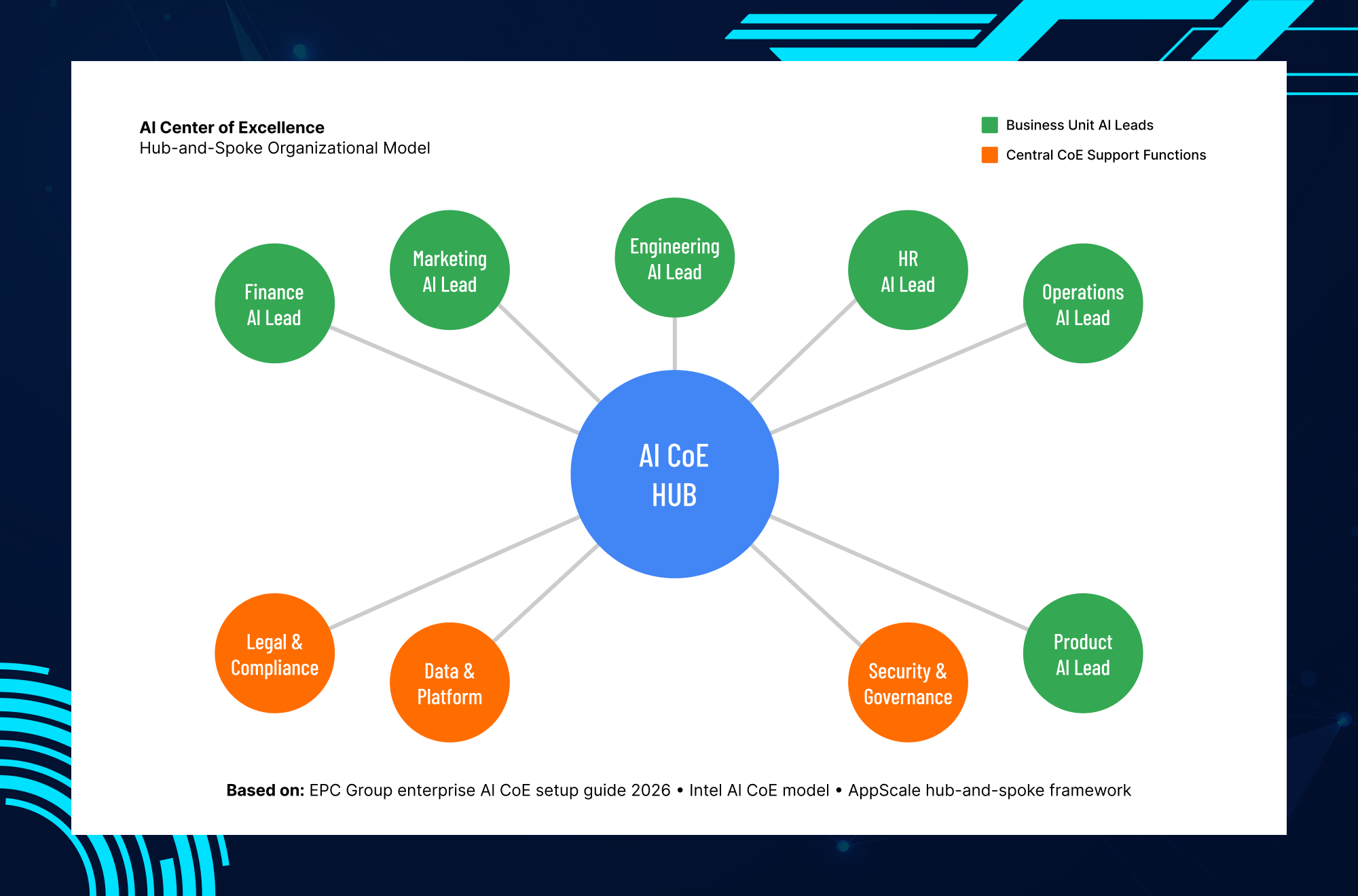
KEY INSIGHT: Intel’s AI CoE is organized in a vertical manner — each AI team is engaged in joint ventures with one of Intel’s various business units. Each team includes data scientists, subject matter experts, ML engineers, AI product managers, a team manager accountable for the vertical’s success, and a BU sponsor. This model embeds AI into the business rather than positioning it as a separate function that works in isolation.
Building the AI Center of Excellence Team — Roles, Hiring Sequence, and Salary Ranges
The biggest team design mistake enterprises make is building an org chart that reflects what they wish they could hire, then spending two years trying to find people who do not exist in the labor market they are recruiting from. ManpowerGroup’s 2026 Talent Shortage Survey found that AI skills are now the hardest to recruit globally, with 72% of employers reporting hiring difficulty. The CoE team design needs to account for the reality of the market, not the ideal.
Roles should be defined in terms of outcomes, not narrow technical specializations, to maximize the pool of qualified candidates. And the sequence in which you hire matters as much as the roles themselves.
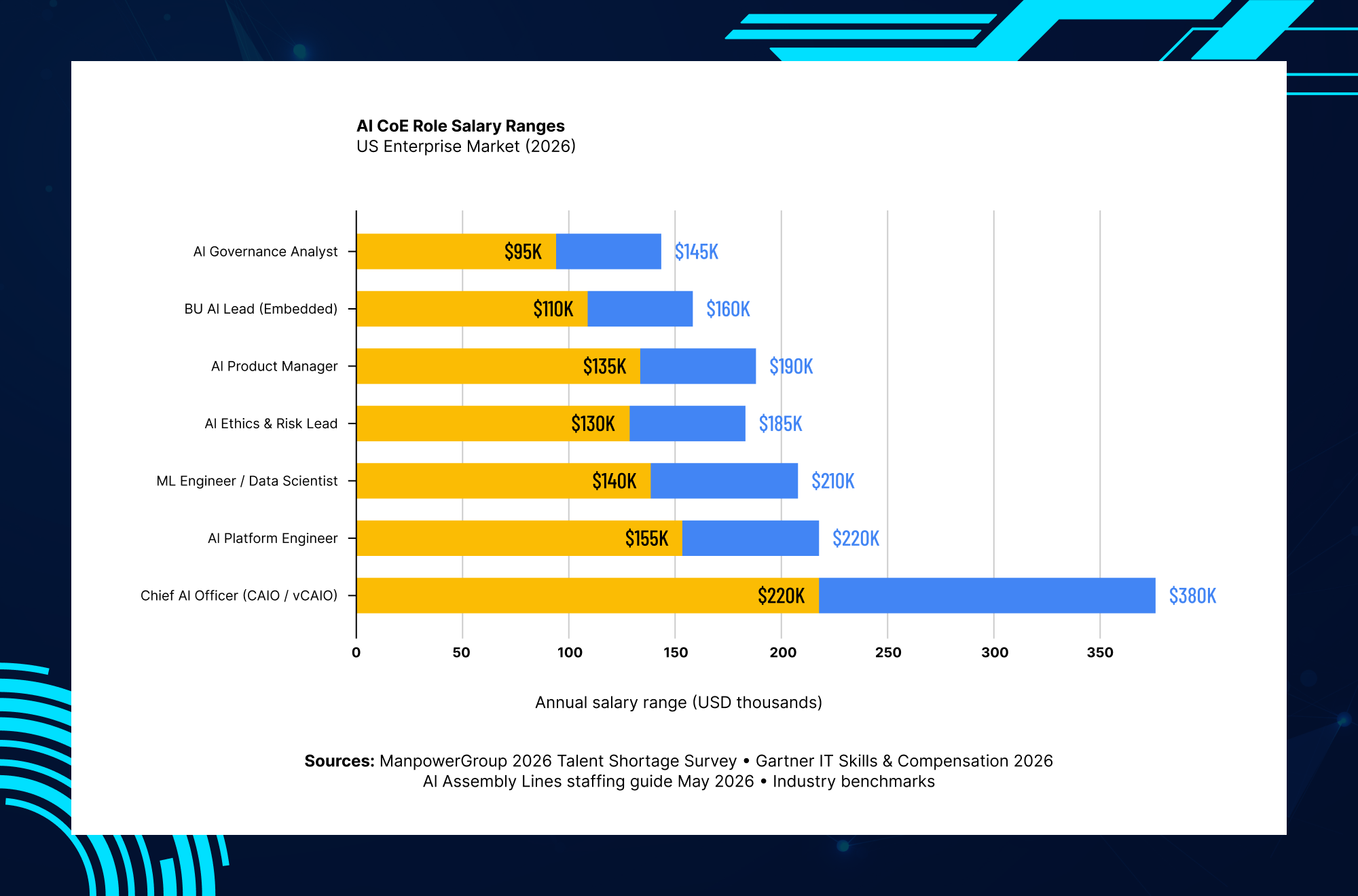
The Founding Team: Who You Need Before You Build Anything
The first three hires define the CoE’s character more than any subsequent hires. Get these wrong and the organizational antibodies will form before the CoE has anything to show.
CAIO or vCAIO (Virtual CAIO): This role is the most important hire and the hardest to make correctly. The CAIO needs to be credible to engineers (so they need to understand AI architecture), credible to business leaders (so they need to speak in business outcomes, not model metrics), and credible to executives (so they need to connect AI investment to strategy). This combination is genuinely rare. Many organizations are using a vCAIO through a partner relationship to access this profile without the full-time compensation commitment while the CoE establishes its track record.
AI Platform Engineer: Before the CoE can build anything, someone needs to build the thing they will build on — the ML platform, the data pipeline standards, the model registry, the deployment infrastructure. This role is foundational. Without it, every AI project reinvents its own infrastructure, and the compounding efficiency that justifies the CoE investment never materializes.
AI Product Manager: Business units will bring ideas. They will also bring noise. The AI PM filters the intake, sizes the value, and prioritizes the use cases that the CoE should actually work on. This role is the bridge between what the business wants and what the CoE can deliver. Organizations that underinvest here consistently report that their CoE is either chasing the wrong problems or saying yes to everything and delivering nothing.
Phase 2 Hires: Building Out the Core
Once the founding team has shipped one production deployment and established the platform baseline, the next hires expand capacity and governance depth.
The AI Ethics and Risk Lead is the hire most CoEs delay until something goes wrong. In 2026, with the EU AI Act fully applicable from August and US state-level AI legislation proliferating, this is not a hire you can defer. ISO/IEC 42001 certification — the AI management system standard — has become what Forbes describes as “the hottest ticket in 2025” as companies move from AI hype to real compliance demands. The Ethics and Risk Lead owns this.
GOVERNANCE NOTE: 52% of AI high performers have a documented process for taking AI solutions from development to production, vs. only 34% of other organizations (McKinsey State of AI 2025). That gap does not reflect modeling sophistication. It reflects the presence or absence of the technical infrastructure and operational processes that the CoE owns. The platform and governance investment is not overhead — it is what separates programs that scale from programs that perpetually pilot.
Building an AI Center of Excellence Budget That Gets Approved — and Delivers
The budget conversation is where most CoE proposals either win executive commitment or die in committee. The proposals that succeed are not the ones with the most detailed spreadsheets. They are the ones that connect the investment to business outcomes with enough specificity that an executive can see what they are buying.
Companies plan to spend approximately 1.7% of revenue on AI-related initiatives in 2026, according to Mavvrik’s AI Cost Statistics 2026 analysis. For a $1 billion enterprise, that is $17 million — but most of that does not flow through the CoE directly. The CoE budget is the infrastructure investment that makes the business unit AI spending productive. Getting this framing right in the budget proposal is critical.
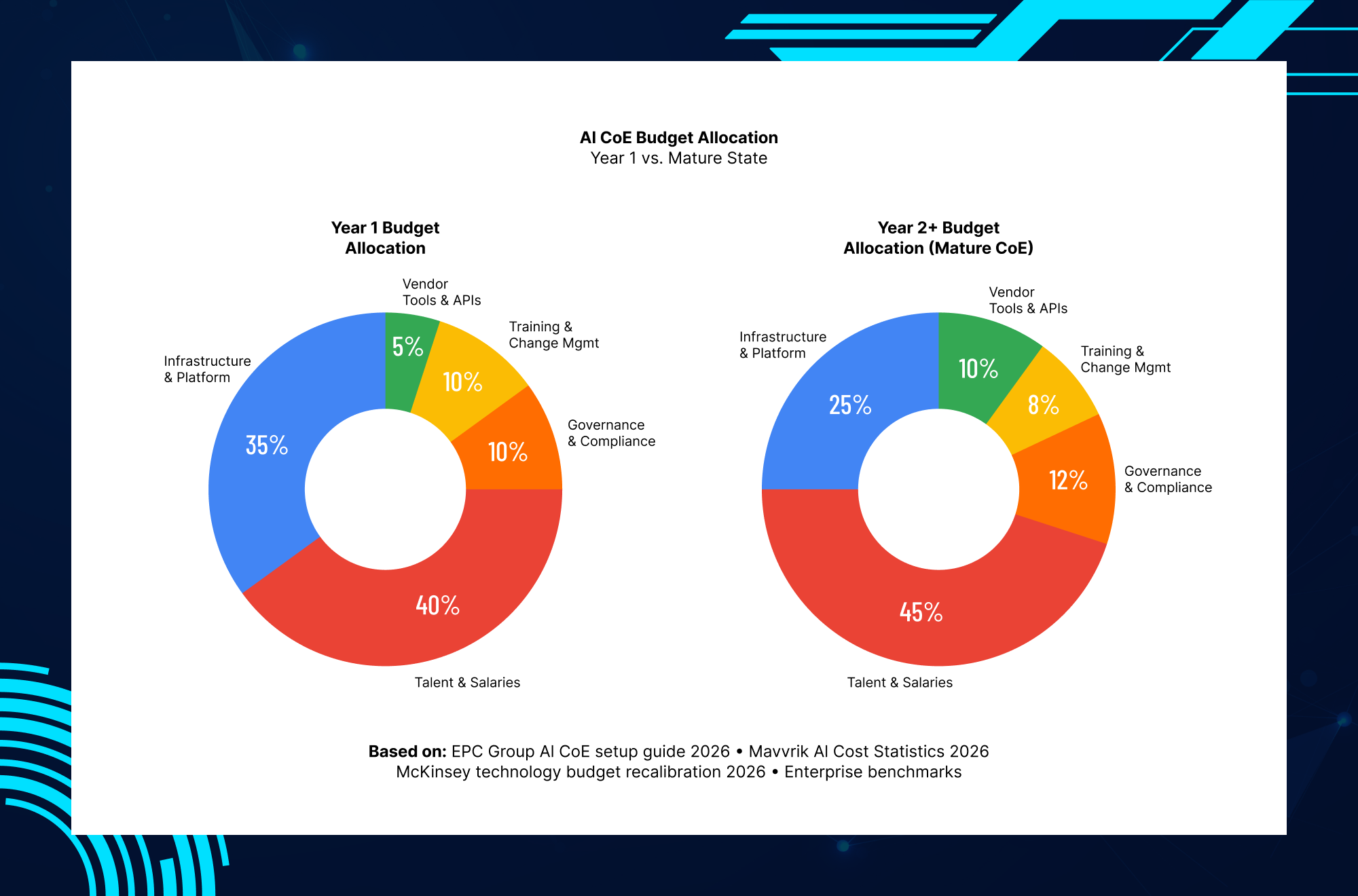
Year 1 Budget Framework — The Foundational Investment
Infrastructure and Platform (35%): Cloud compute, ML platform tooling, data pipeline infrastructure, model registry, and the monitoring systems that make production AI manageable. This is the highest upfront cost and the most durable investment — infrastructure built in Year 1 serves the entire program for years. Gartner notes that technology budgets are set to rise for 75% of CFOs in 2026, with nearly half planning increases of 10% or more. The infrastructure layer is where this investment is most justified.
Talent and Salaries (40%): The largest ongoing cost. For the founding team of three (CAIO, Platform Engineer, AI PM), expect $500K–$800K in total compensation in Year 1, plus benefits and overhead. Budget for recruiting costs — filling senior AI roles takes an average of 4–6 months in the current market, with 72% of employers reporting difficulty. Plan for the gap.
Governance and Compliance (10%): Legal review of AI use cases, privacy impact assessments, audit tooling, and the framework development that keeps the program legally defensible. This is typically the most underfunded category in initial CoE proposals and the most expensive one to retrofit after something goes wrong.
Training and Change Management (10%): The category that determines whether business units actually use what the CoE builds. AI deployments fail not because the model is wrong but because the organization does not change its workflows to take advantage of it. Budget here is an ROI multiplier, not overhead.
Vendor Tools and APIs (5%): Third-party AI platforms, API access for foundational models, and evaluation tooling. This category grows significantly in Years 2 and 3 as the use case portfolio expands.
Budget Ranges by Enterprise Size
Based on: EPC Group AI CoE enterprise deployments 2023–2026 · Mavvrik AI Cost Statistics 2026 · industry benchmarks
BUDGET REALITY CHECK: Only 3% of organizations report 10–20% ROI from AI initiatives. The vast majority (53%) report 1–5% ROI (McKinsey State of AI 2025). This is not because AI does not deliver — it is because most organizations are measuring productivity gains and cost avoidance, not margin expansion or revenue growth. Design your CoE measurement framework around business outcomes from the start, or you will win the first budget cycle and lose the second one when finance asks why productivity lifted but margins did not.
AI CoE Governance — The Framework That Makes the Whole Thing Work
Governance is the part of the CoE conversation that most enterprise leaders want to skim past to get to the exciting part. The charter, the decision rights, the review cadence, the risk framework — it sounds like administrative overhead. It is actually the thing that determines whether your CoE can operate at speed without creating liability.
The CoE Charter — Five Things It Must Say Explicitly
EPC Group’s template from 14 enterprise CoE deployments specifies five charter components that must be explicit before the first hire. Purpose — why the CoE exists and what it owns. Scope — which AI technologies and use cases are in scope versus owned by business units. Decision rights — what the CoE approves versus recommends versus vetoes. Funding model — how the CoE is funded (central budget, BU chargebacks, or hybrid). And success metrics — how the CoE itself will be measured.
The decision rights section is where most charters are vague when they should be precise. “The CoE will advise on AI deployments” creates governance theater. “The CoE must approve any AI deployment that affects customer data, regulatory compliance, or systems of record before production release” creates governance infrastructure. The difference is the difference between a rubber stamp and a meaningful gate.
The Use Case Intake and Prioritization Process
A mature CoE needs a repeatable process for evaluating use case proposals from business units. Intel’s approach — developed over years of managing AI at enterprise scale — is instructive: before investing heavily in a project, they answer feasibility and value assessment questions systematically. They ensure there is a business partner willing to invest and own the required change management. They ensure the project is feasible in terms of data and execution. By performing proper due diligence prior to investing, they can select projects with the greatest potential, or at least fail faster on the others.
The prioritization framework should score use cases on four dimensions: business value (revenue impact, cost reduction, strategic importance), technical feasibility (data quality, model availability, integration complexity), organizational readiness (change management requirements, BU sponsor commitment), and governance risk (regulatory exposure, data sensitivity, reversibility of errors).
Governance Cadence — The Operating Rhythm
Weekly: Engineering standups, sprint reviews, production monitoring review
Bi-weekly: Use case intake review, prioritization updates, blocker escalation
Monthly: KPI review against targets, budget tracking, risk incident review
Quarterly: Business unit NPS, use cases shipped vs. target, strategic roadmap review, governance framework updates
Annually: Charter review, organizational design assessment, budget proposal for following year, external audit of AI governance
AI Center of Excellence KPIs — The 5 Metrics That Tell You If It Is Working
The measurement problem in AI CoE programs is that teams default to technical metrics (model accuracy, inference latency, data pipeline throughput) that are meaningful to engineers and invisible to executives — or to activity metrics (number of use cases in progress, hours of AI training delivered) that look like progress without measuring it. Neither tells you whether the CoE is delivering what it exists to deliver.
EPC Group’s framework, refined across 14 enterprise CoE deployments, identifies five KPIs that separate high-performing CoEs from administrative ones.
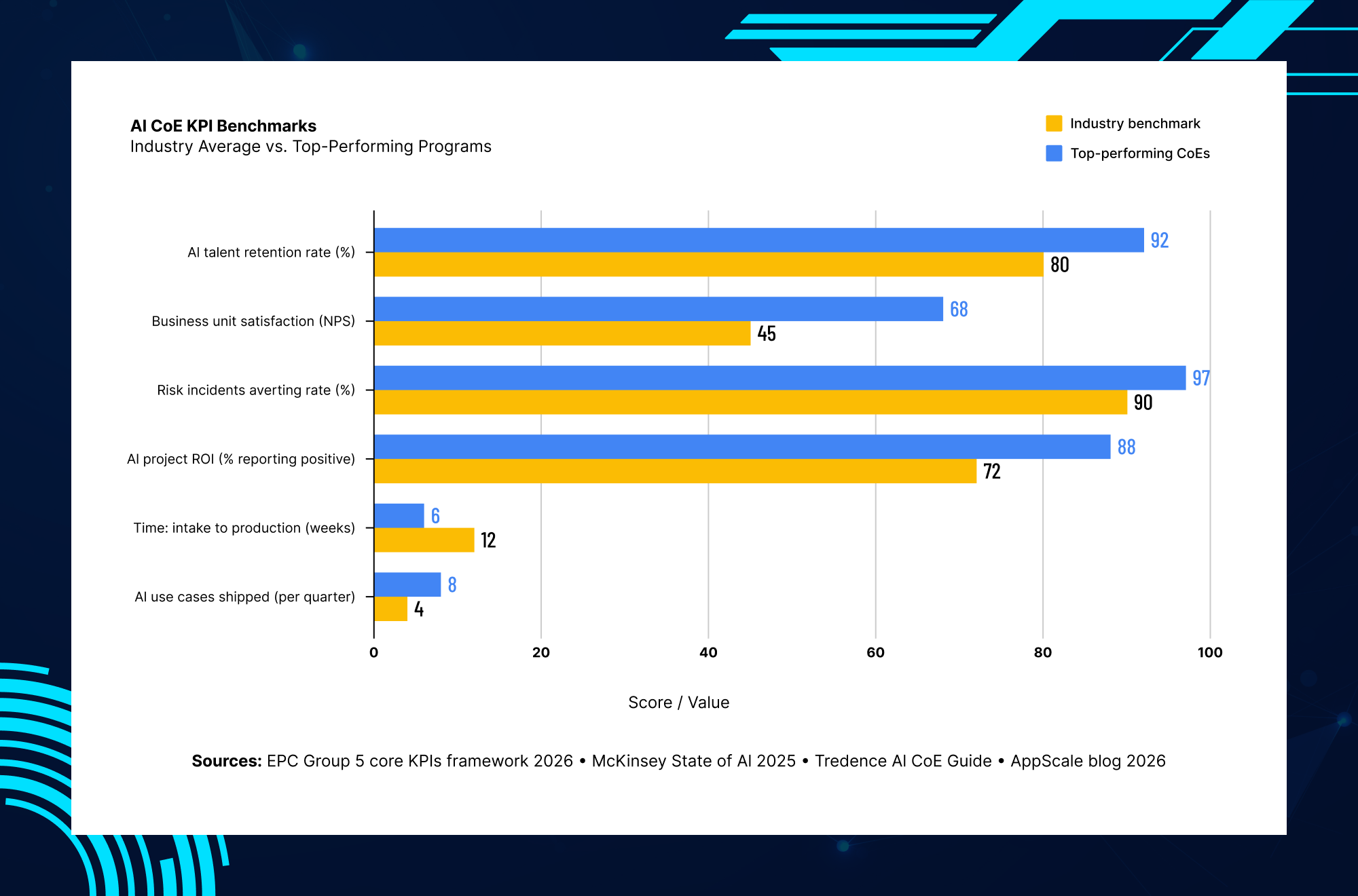
KPI 1 — AI Use Cases Shipped Per Quarter: This is the velocity metric. Not “in progress,” not “in staging,” not “piloting” — shipped, meaning in production, being used by the intended users, generating the intended value. Industry benchmark: 4 use cases per quarter for a mid-size CoE. Top-performing CoEs: 6–8. If your CoE is consistently shipping fewer than 2 per quarter after Year 1, the bottleneck analysis starts here.
KPI 2 — Annual ROI from Shipped Use Cases: Connect each shipped use case to a business outcome with a dollar value. Not a productivity estimate — an actual business outcome that finance can verify. This is the metric that wins the Year 2 and Year 3 budget cycles. Track it from day one, even when the numbers are small.
KPI 3 — Risk Incidents Averted Rate: How many high-risk AI deployments did the CoE governance process catch before they reached production? This metric demonstrates the governance value of the CoE in terms executives understand. J.P. Morgan’s AI governance on payment validation screening reduced false positives, improved queue management, and cut account validation rejection rates by 15–20% — directly measuring the value of governance infrastructure.
KPI 4 — Business Unit NPS: The Net Promoter Score from the business units the CoE serves. This is the metric most CoEs track informally and report never. It is actually the leading indicator of whether the CoE is seen as an enabler or an obstacle. If your BU NPS is below 30, your CoE is creating friction rather than removing it.
KPI 5 — Time from Intake to Production: How long does it take from a business unit submitting a use case to that use case reaching production? Industry benchmark: 12 weeks for a standard use case. Top performers: 6 weeks. If this number is growing rather than shrinking, your CoE infrastructure is not scaling with demand.
PRO TIP: Report all five KPIs together on a single dashboard that is visible to both executive sponsors and business unit leaders. The CoE’s credibility depends on transparency — showing the metrics that are improving and the ones that need attention. CoEs that selectively report only good news destroy trust when the bad news eventually surfaces. Transparency builds the organizational support that sustains multi-year programs.
The 90-Day AI CoE Launch Roadmap — From Charter to First Production Deployment
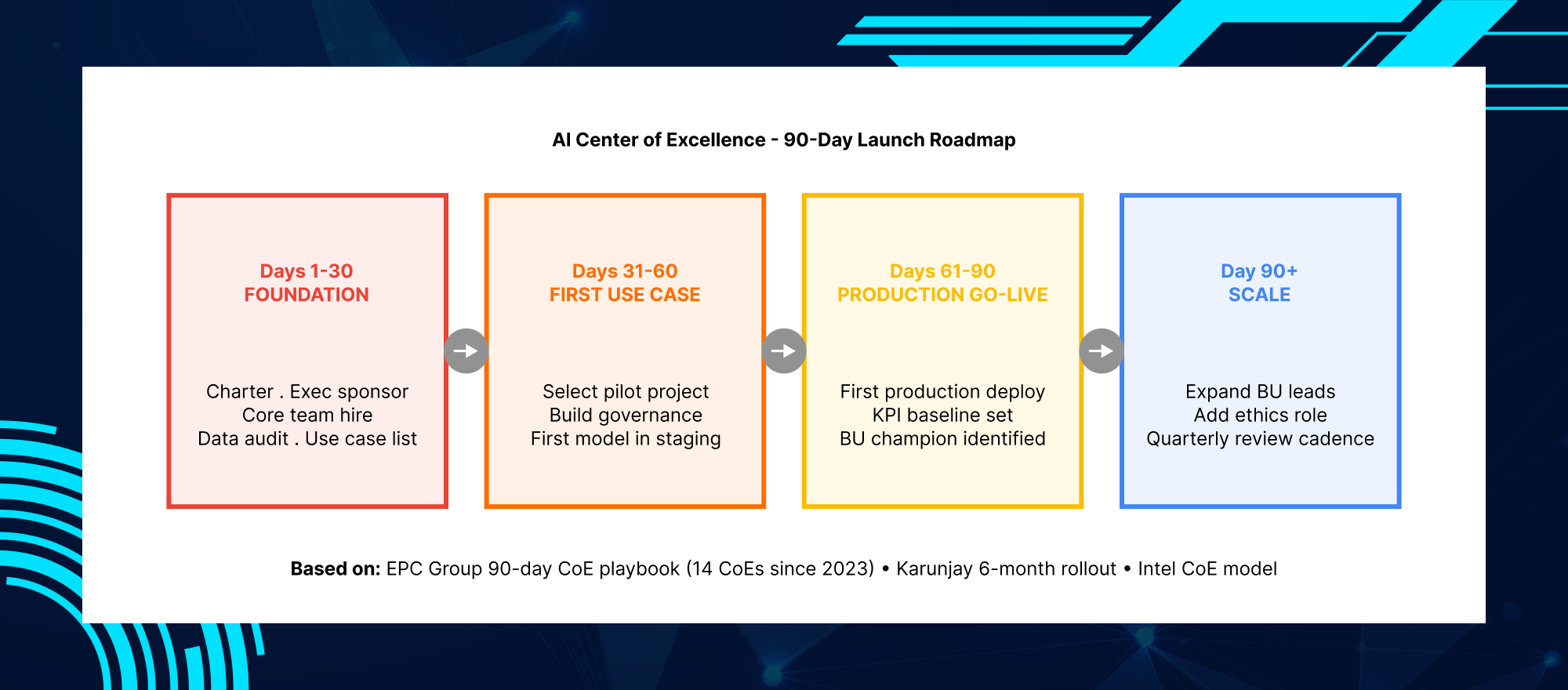
Days 1–30: Foundation
The first 30 days are about creating the conditions that make everything else possible. Write the charter. Secure the executive sponsor — this is non-negotiable. Without a named, accountable executive who will fight for budget and remove organizational obstacles, most AI CoEs stall before the first use case reaches staging. Conduct the data audit — what data exists, where it lives, how clean it is, and what the access controls look like. Build the initial use case list from business unit conversations, not internal brainstorming.
The founding team hires should be in progress by the end of Week 2 — not approved to hire, actively in process. The AI talent market moves slowly, and the cost of a 4-month recruiting gap at this stage is significant.
Days 31–60: First Use Case
Select the pilot use case against specific criteria: high business value, clearly defined success metric, structured and accessible data, a committed BU sponsor, and a workflow change that is manageable within 30 days. The pilot is not the most important AI opportunity in the organization. It is the most important AI opportunity that can succeed in 30 days with the resources you have. The goal of the pilot is not the value it delivers — though that matters. The goal is demonstrating organizational competency that wins the next budget cycle.
Build the governance framework during this phase, not after. The model review process, the deployment approval checklist, the production monitoring standards — establish these before the first deployment, not in response to the first incident.
Days 61–90: Production Go-Live
Ship the first use case to production. This sounds simple. It is not. The technical deployment is usually the easy part. The hard part is the organizational change management — ensuring the intended users are trained, the workflow is updated, and there is a feedback mechanism that captures both what is working and what needs adjustment. A technically excellent model deployed into an organization that does not change how it works around the model delivers no value.
By Day 90: set the KPI baseline. Measure use cases shipped (1), time to production (actual versus target), BU sponsor satisfaction, and any risk incidents encountered. This becomes the baseline against which future quarters are measured.
Why AI Centers of Excellence Fail — And How to Avoid Each One
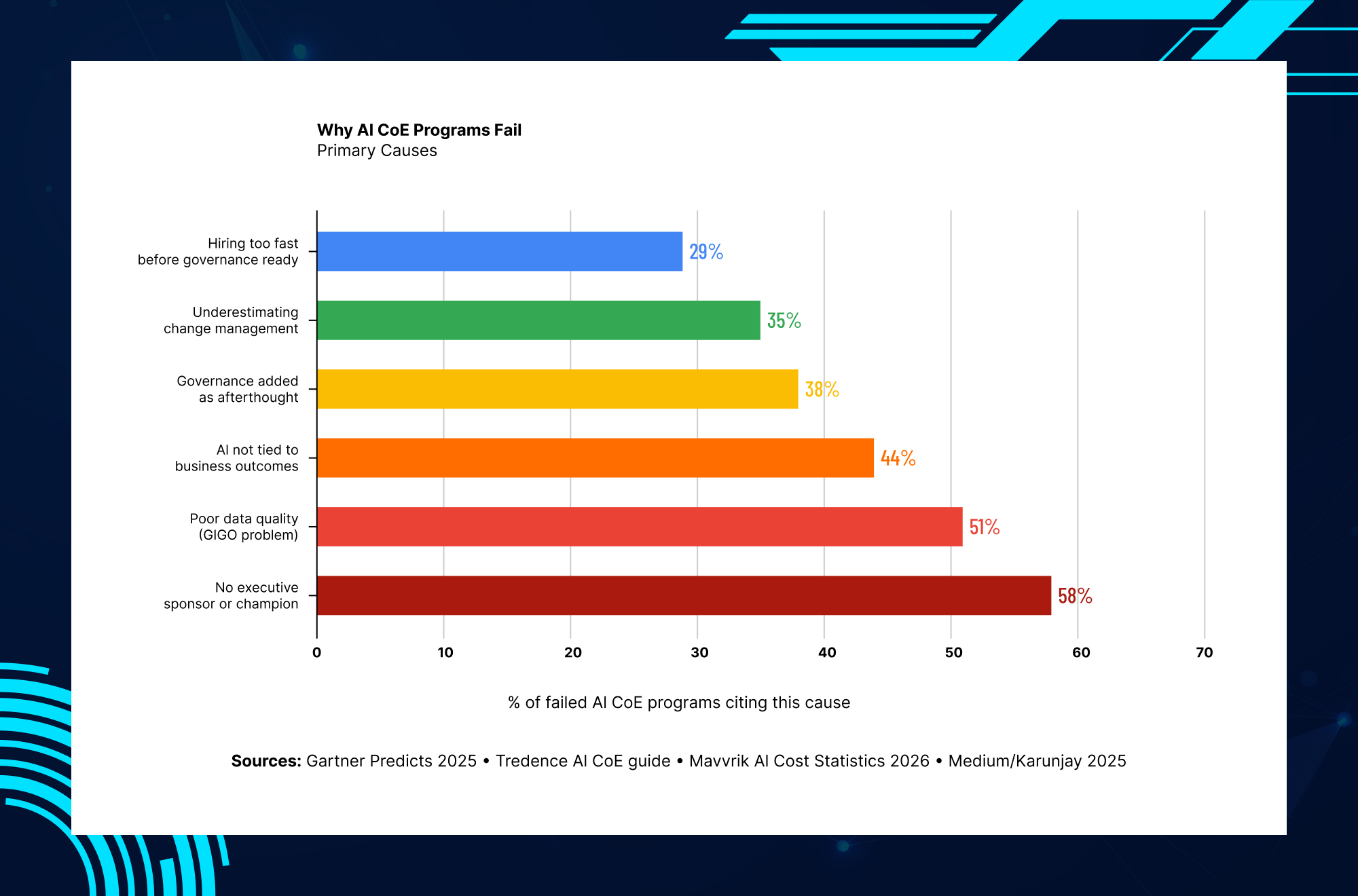
Failure Mode 1 — No executive sponsor (58% of failed programs): In the absence of executive sponsorship, most AI initiatives fail at the proof-of-concept level. The executive sponsor is not a cheerleader — they are the person who moves budget when finance resists, removes organizational blockers when business units are slow to engage, and provides the air cover that lets the CoE team move faster than normal enterprise processes allow. This person must be named in the charter, must attend the quarterly review, and must be reachable when the CoE team needs escalation support.
Failure Mode 2 — Poor data quality (51%): Gartner predicts 60% of AI projects unsupported by AI-ready data will be abandoned. The AI CoE does not fix data problems — it identifies them early enough that they can be addressed before they kill a program. The data audit in Days 1–30 is not ceremonial. It is the risk assessment that determines which use cases are genuinely feasible and which will stall in the data preparation phase.
Failure Mode 3 — AI not tied to business outcomes (44%): This is the measurement failure described in the KPI section. A CoE that reports model accuracy to executives who care about cost reduction is speaking a language nobody can act on. Every use case in the CoE pipeline should have an explicit business outcome attached to it before any development begins.
Failure Mode 4 — Governance added as an afterthought (38%): The EU AI Act’s full applicability from August 2026, combined with accelerating US state-level AI legislation, makes governance a liability question, not just an operational one. Building governance into the CoE from the charter stage is not slower than adding it reactively. It is faster, because you avoid the incident-driven remediation cycle that derails programs at exactly the moment they are gaining momentum.
Failure Mode 5 — Underestimating change management (35%): Models do not fail deployments. Organizations fail deployments by not changing how they work around the models. Budget the change management investment at 10% of total CoE spend in Year 1. Track BU NPS as a leading indicator of adoption. Do not count a use case as shipped until actual users are actually using it in their actual workflow.
Frequently Asked Questions About Building an AI Center of Excellence
Conclusion: The AI CoE Is Not the Destination — It Is the Infrastructure That Gets You There
Every enterprise building AI programs at scale eventually reaches the same conclusion: you cannot build a portfolio of AI solutions without building the organizational infrastructure that supports them. The AI Center of Excellence is that infrastructure. Not a department. Not a committee. An operating model.
The organizations that build CoEs correctly — with a clear charter, the right founding team, a governance framework that enables rather than bureaucratizes, a budget connected to business outcomes, and the five KPIs that tell you whether it is working — are the ones that compound their AI investment over time. Use case 10 is faster and cheaper than use case 1, because the platform, the standards, and the organizational muscle are already built.
The organizations that build CoEs incorrectly — without executive sponsorship, without data quality investment, without change management, without governance until something goes wrong — get the cost of a CoE without the returns. They pilot endlessly. They report activity metrics to executives who need outcome metrics. They build models that nobody changes their workflow to use.
At Trantor (trantorinc.com), we have been building enterprise technology programs since 2012, and AI Center of Excellence design is one of the most consequential inflection points we help clients navigate. We bring the architectural depth to design the AI CoE model that fits your organization — the right operating structure for your culture, the governance framework that satisfies your regulatory requirements, the talent strategy that works in the market you are actually recruiting in, and the KPI framework that wins your executive sponsors’ continued investment. Our CaptiveCoE™ model specifically addresses the challenge of building AI capability at speed without over-hiring or burning cash — providing the dedicated, co-branded teams that scale on demand as your AI program matures. Whether you are designing your first AI Center of Excellence from scratch, auditing a program that is not delivering the results the original business case promised, or building the governance infrastructure that makes your existing AI investments legally defensible and organizationally scalable — that is the work we are built for.