Artificial Intelligence, zBlog
ChatGPT Ads for Enterprise: The Complete B2B Guide (2026)
trantorindia | Updated: May 19, 2026
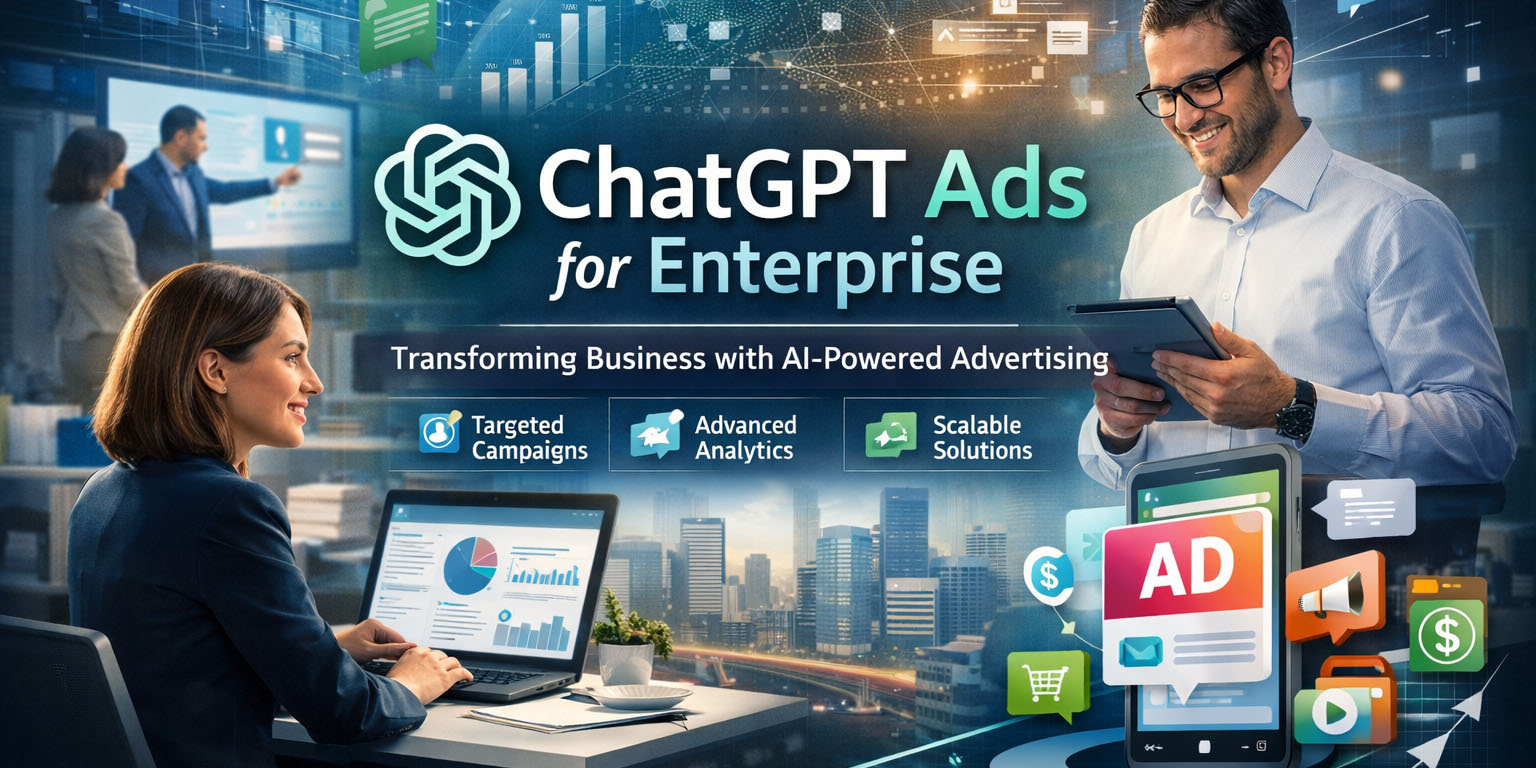
If you run marketing for an enterprise company, you’ve probably spent the last few months watching the ChatGPT ads rollout with cautious curiosity. Is it real? Is it ready? Is it worth your budget?
The answer to all three: yes — but with important caveats that most generic guides completely miss.
ChatGPT ads for enterprise aren’t just “another channel.” They represent the first time in two decades that a serious challenger to Google’s advertising dominance has emerged — and it’s built not on keyword matching, but on something far more powerful: conversational intent. The moment a B2B decision-maker types “what’s the best enterprise data management platform for a mid-size logistics company?” into ChatGPT, they’ve handed advertisers more buying-signal context in a single prompt than most search queries could ever provide.
This guide is written specifically for enterprise marketing leaders, CMOs, demand gen teams, and digital strategists who want to understand ChatGPT advertising from the ground up — what it is, how it works, what it costs, how to build a B2B strategy around it, and where the real opportunities are hiding in 2026.
1. What Are ChatGPT Ads — and Why Now?
On February 9, 2026, OpenAI officially launched advertising inside ChatGPT. This wasn’t a surprise — the signals had been building for months — but the speed of execution turned heads across the industry.
OpenAI confirmed ads are now shown to logged-in adult users on the Free and ChatGPT Go ($8/month) tiers in the United States, with international expansion already underway into Canada, Australia, and New Zealand as of late March 2026. The self-serve Ads Manager entered beta on May 5, 2026, opening the door wider for brands beyond the original enterprise pilot partners.
Why does this matter for B2B enterprise marketers specifically?
Because the way enterprise buyers research is changing — fast. According to research published by MediaLink in October 2025, 84% of marketers now observe consumer behavior shifts away from traditional search and web browsing toward AI-powered answer engines, with 45% planning to moderately or significantly shift their brand budgets within 12 months.
Enterprise software buyers, procurement leaders, and C-suite executives are increasingly turning to ChatGPT to shortlist vendors, compare platforms, and frame their RFP requirements — before they ever visit your website. That’s not a trend to monitor. That’s a buying journey happening right now, without your brand in the room.
ChatGPT ads put your brand in that room.
2. How ChatGPT Advertising Works: The Mechanics
Understanding how ChatGPT ads actually work is critical before you invest a dollar. This is not keyword advertising. The rules are genuinely different.
Contextual, Not Keyword-Based
Traditional search advertising runs on a keyword bid model — you choose terms, set bids, and your ad appears when someone types that string. ChatGPT’s ad environment operates on a fundamentally different substrate. Users don’t enter keywords; they have conversations.
OpenAI uses the full semantic context of a conversation — every turn, every question, every follow-up — to determine which sponsored placement belongs in that moment. Advertisers provide “context hints” describing the types of questions, needs, or situations that align with their product. Think of it less as “bidding on a keyword” and more as “describing the conversation moment your brand belongs in.”
Where Ads Appear
Ads appear as clearly labeled “Sponsored” cards at the bottom of ChatGPT’s response — visually separated from the AI’s organic answer. OpenAI has been explicit: ads do not influence what ChatGPT says. The organic answer is generated independently; the sponsored placement appears below it, contextually matched. This separation matters enormously for B2B brand credibility.
The Conversation Memory Advantage
Since February 2026, ChatGPT’s memory feature allows it to retain user preferences across sessions. A procurement manager who has been researching ERP solutions across multiple sessions may see increasingly relevant sponsored content aligned with that research arc — a targeting capability that simply doesn’t exist on any other ad platform today.
3. Who Sees ChatGPT Ads (and Who Doesn’t)
This is where enterprise B2B strategy gets interesting — and counterintuitive.
Here’s the strategic implication most B2B guides miss: your own enterprise clients likely won’t see your ChatGPT ads — because companies deploying ChatGPT at scale use Business or Enterprise plans, which are completely ad-free. So who are you actually reaching?
- Individual business owners and SMB decision-makers on free or Go plans
- Mid-market managers and team leads who use personal ChatGPT accounts for work research
- Early-stage buyers who haven’t yet introduced ChatGPT at the enterprise level
- Consumer-side influencers whose personal research shapes enterprise purchasing conversations
This isn’t a limitation — it’s a targeting insight. Enterprise sales cycles often start with a curious individual contributor running their own research. ChatGPT ads reach them at exactly that moment.
4. ChatGPT Ad Formats for Enterprise
As of May 2026, three formats are available — each suited to a different stage of the B2B buying journey:
5. Pricing and Budget: What Enterprise Advertisers Need to Know
For context: Meta’s average CPM runs $14–$20 across its platforms. Google Search comparables run $8–$15 CPM equivalent. ChatGPT is pricing itself at a premium — justified by the argument that conversational, decision-moment intent is worth more per impression than passive social browsing.
For enterprise B2B brands with average contract values in the six to seven figures, even a handful of qualified conversions from ChatGPT ads can deliver ROI that makes the premium CPM look modest. The original pilot required a $200,000 minimum commitment — that barrier no longer applies since the self-serve beta opened in May 2026.
OpenAI launched a Conversions API and measurement pixel in May 2026, enabling proper attribution tracking — a critical development for enterprise advertisers who need to connect ad spend to pipeline.
CPM Comparison Across Major B2B Ad Platforms (2026)
6. ChatGPT Ads vs. Google Ads vs. LinkedIn Ads: The B2B Comparison
Every enterprise marketer will ask this question, so here it is answered directly.
The honest B2B verdict: ChatGPT ads are not a replacement for Google Ads. They are a complementary, high-intent layer for reaching enterprise buyers during the research and comparison phase — the “messy middle” of the B2B buying journey where decisions are actually forming. LinkedIn remains the gold standard for role-based targeting and ABM. Google captures high-intent bottom-of-funnel searches. ChatGPT fills the emerging gap: the buyer who is thinking through their options conversationally, before they even know what to search for.
7. The Enterprise B2B Opportunity: Where ChatGPT Ads Shine
Not every vertical benefits equally from ChatGPT advertising. For enterprise B2B, the sweet spots are clear.
Complex, High-Consideration Purchases
Enterprise software, cloud infrastructure, cybersecurity platforms, ERP and CRM systems, professional services, consulting, and managed services all involve long research cycles where buyers extensively interrogate their options. These are exactly the conversations happening on ChatGPT — and the exact moments where a well-placed sponsored placement can introduce your brand at the right time.
Technical Buyer Education
B2B buyers increasingly use ChatGPT to translate complex technical concepts before engaging with vendors. A DevSecOps manager asking “what’s the difference between SAST and DAST tools?” is in the early stages of a procurement decision. A sponsored placement from a relevant security platform in that moment is infinitely more valuable than a banner impression.
Competitive Displacement
When a prospect asks ChatGPT “what are the best alternatives to [Competitor X]?” — that is one of the highest-value B2B moments in advertising history, and ChatGPT ads can place your brand directly in the sponsored zone below that answer.
Geographic and Industry Expansion
Enterprise brands expanding into new verticals or geographies can use ChatGPT’s contextual targeting to build awareness with buyers who may not have heard of them yet — reaching people actively researching solutions in their category before brand consideration has even formed.
84% of marketers observe consumer behavior shifting away from traditional search toward AI-powered answer engines, with 45% planning to significantly shift brand budgets within 12 months.
8. Building Your Enterprise ChatGPT Ad Strategy for 2026
Here is the practical five-step framework for enterprise marketing teams entering the platform for the first time.
9. Answer Engine Optimization (AEO): The Organic Layer You Can’t Skip
If you’re investing in ChatGPT advertising, you should simultaneously be building your organic presence inside ChatGPT’s answers — because the two reinforce each other powerfully.
Answer Engine Optimization (AEO) is the practice of structuring your content so that AI platforms cite your brand, quote your data, and reference your expertise in their organic responses — regardless of whether you’re running paid ads.
Research from the 2026 State of AI Search found that pages with three or more schema markup types show a 13% higher likelihood of being cited by large language models. FAQ schema, in particular, increases AI coverage by approximately 28% within 21 days of implementation.
For enterprise brands, AEO investment means:
- Publishing original research and proprietary data
- Structured content with clear answers — write definitive explainer content for every question in your Intent Moment Map
- Named authorship and credentials — content with identified expert authors earns more AI citations
- Clean schema markup — implement FAQ, HowTo, Article, and Organization schema across your key content pages
Pro tip for enterprise marketers: The brands that run ChatGPT ads and invest in AEO earn a compounding advantage: paid visibility and organic citation simultaneously. If a user sees your ad, then asks ChatGPT about your brand directly and gets no organic citation — you’ve raised a question you can’t answer.
10. Privacy, Data, and Brand Safety for Enterprise
Enterprise marketing leaders rightly scrutinize data practices before investing in any new channel. Here is OpenAI’s stated position as of February 2026:
- OpenAI does not sell user data to advertisers
- OpenAI does not allow advertisers to access individual conversations
- Advertisers receive only aggregate performance data (impressions, clicks, conversions)
- Users can turn off ad personalization, clear their ad data, and upgrade to an ad-free paid plan
This is a meaningfully more privacy-preserving model than traditional behavioral ad platforms. Advertisers receive no individual user data, no conversation content, and no PII.
Topic exclusions to be aware of:
- No ads adjacent to health, mental health, or medical conversations
- No ads adjacent to political content
- No ads shown to users identified or predicted to be under 18
- No ads for adult content, certain financial products, or regulated industries
For most enterprise B2B verticals — software, professional services, technology infrastructure, consulting — these restrictions don’t create meaningful limitations. For healthcare SaaS or fintech, the restrictions require careful creative and targeting planning.
11. Measuring Success: KPIs and Attribution for B2B ChatGPT Campaigns
Use a multi-touch attribution model that credits ChatGPT as an assist, not only a first or last touch. For enterprise deals with 6–18 month sales cycles, first-touch attribution dramatically undervalues awareness channels. Discuss this with your Revenue Operations team before setting campaign success benchmarks.
12. What Not to Do: Common Enterprise Mistakes
13. Frequently Asked Questions
14. Conclusion: The Enterprise First-Mover Window Is Open — And Trantor Can Help You Walk Through It
ChatGPT ads for enterprise represent something genuinely rare in digital marketing: a high-intent channel in its early days, before every competitor has piled in, before CPMs have inflated, and before the playbook has been commoditized. Moments like this don’t come often. The brands that move in 2026 will have built platform familiarity, creative muscle, and measurement infrastructure that latecomers will spend years trying to replicate.
But here’s the honest truth: the biggest risk for enterprise B2B brands isn’t moving too fast on ChatGPT ads. It’s arriving with the wrong foundation. A paid channel built on top of weak content, no AEO strategy, misaligned landing pages, or disconnected CRM attribution will produce disappointing results — and those results will become the internal narrative that shuts down future AI marketing investment.
That’s exactly where Trantor comes in.
Since 2012, Trantor has been building enterprise technology and marketing solutions for organizations navigating exactly this kind of inflection point — moments where technology shifts faster than most companies’ internal capabilities can keep pace with. Trantor isn’t a traditional marketing agency, and it isn’t a pure-play technology firm. It sits at the intersection of both — which is precisely the vantage point you need when a channel like ChatGPT ads requires deep technical integration and sophisticated B2B marketing strategy simultaneously.
With deep expertise in cloud strategy, cloud-native development, AI/ML, and MarTech — and partnerships with Salesforce, SAP, UiPath, and LeanIX — Trantor brings the full-stack capability to build a ChatGPT advertising foundation that actually converts. The company’s proprietary CaptiveCoE™ model delivers co-branded, dedicated teams that scale on demand, meaning as ChatGPT advertising expands internationally and new formats emerge throughout 2026 and 2027, you’ll have a team that moves with the platform rather than a static agency retainer locked into last year’s playbook.
Here’s what working with Trantor looks like in practice:
The opportunity in front of enterprise B2B brands right now is real, measurable, and time-sensitive. Your buyers are in those 2.5 billion daily ChatGPT conversations. The question isn’t whether to show up — it’s whether you show up with the right foundation to make it count.
At Trantor, we’ve spent over a decade helping enterprises turn technology inflection points into competitive advantages. We’re ready to do the same for your ChatGPT advertising strategy.