Technology, zBlog
A Comprehensive Guide to Digital Twins in Healthcare
trantorindia | Updated: December 2, 2025
1. Introduction
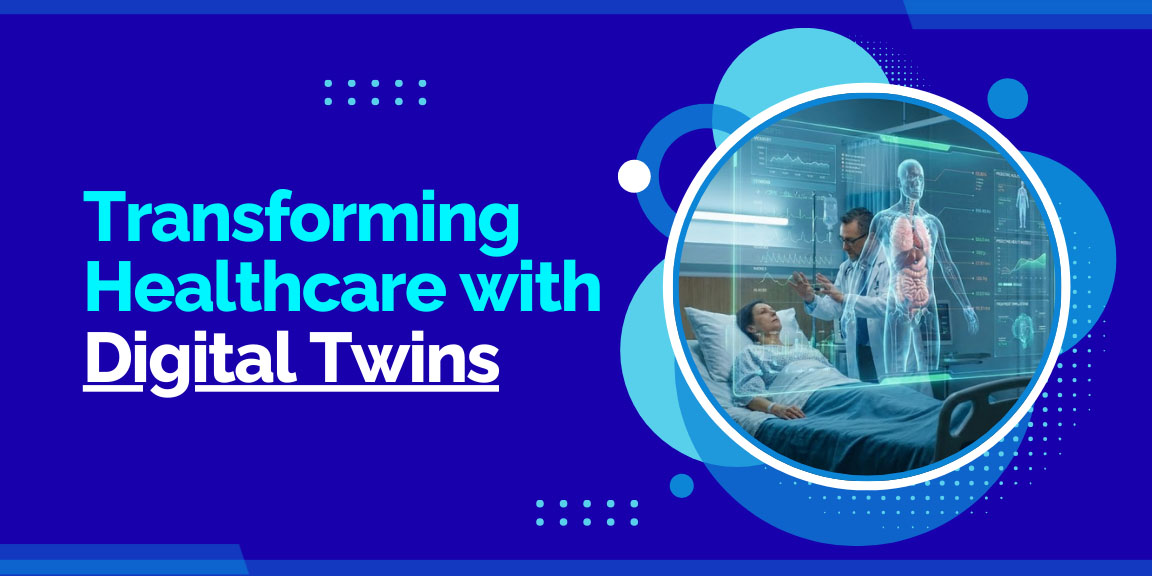
Today’s healthcare environment demands agility, precision, personalization, and cost-efficiency more than ever. With rising chronic disease burdens, aging populations, workforce shortages, and cost pressures in the U.S. healthcare system, there’s a compelling push toward technology-enabled transformation. One of the most promising innovations is the concept of the digital twins in healthcare – a virtual, dynamic replica of a process, system, or even an individual patient.
In the context of healthcare, Digital Twins in Healthcare means using advanced modelling, simulation and data-integration techniques to replicate and predict how systems, organs, patients or entire healthcare workflows behave — so we can anticipate issues, optimize treatments, reduce risk, and personalize care.
The market backs this potential: for example, the global digital twins in healthcare market is expected to reach about US$4.47 billion in 2025, and is projected to grow to US$59.94 billion by 2030, at a CAGR of about 68 %.
This guide will walk you through the full landscape: what digital twins in healthcare are, why they matter, how they’re applied, their benefits and challenges, and how organizations can adopt them effectively — culminating in steps your health system, medical device company, or life-sciences team can take today.
2. What Are Digital Twins in Healthcare?
Definition & Concept
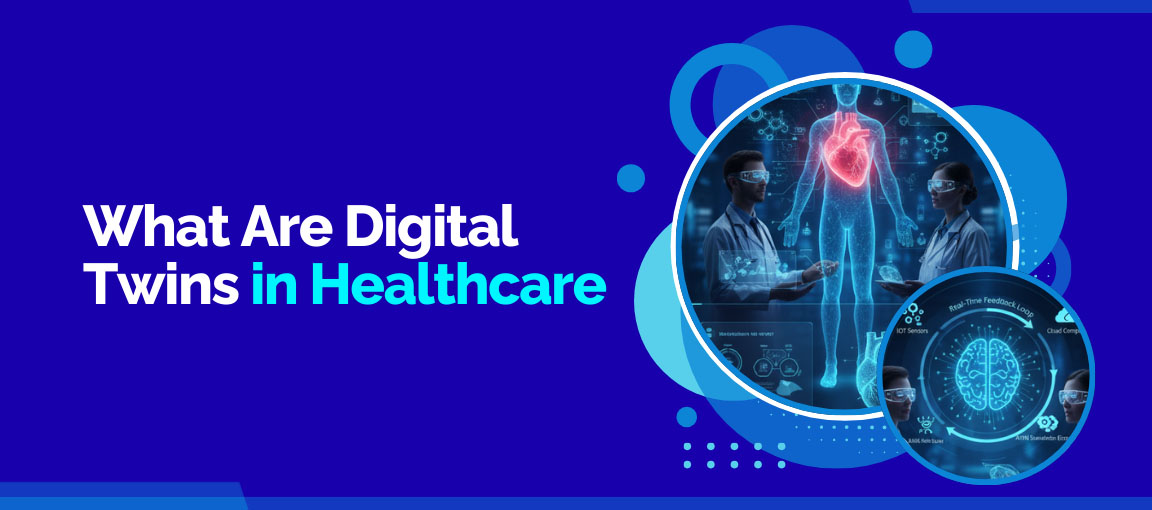
At its core, a digital twin is a virtual representation of a real entity (object, process, system, or person) that dynamically reflects its behaviour, state and context.
In healthcare, this might mean:
- A virtual model of a patient’s organ (e.g., heart, lungs) using imaging, genetics, clinical data.
- A simulation of a hospital workflow (e.g., patient flow, asset usage) to optimize operations.
- A digital replica of a medical device that predicts performance and maintenance needs.
- A “whole-body” twin for a patient that integrates multi-modal data and simulates treatment response.
As one review puts it: “We define a digital twin for healthcare as a virtual representation of a person … which allows dynamic simulation of potential treatment strategy, monitoring and prediction of health trajectory.”
How It Works: Key Components
- Data integration : clinical records, imaging, genomics, wearables, IoT sensors.
- Modelling & simulation engines : algorithms (often AI/ML) that emulate physiology, operations, device behaviour.
- Real-time feedback loop : continuous updates from sensors or systems to keep the twin current.
- Visualization & analytics : user interfaces for clinicians, operations teams, researchers to interact with the twin.
- Predictive/prescriptive logic : using the twin to test “what-if” scenarios, foresee complications, or optimize workflow.
Why it matters in healthcare
The promise of digital twins in healthcare lies in enabling what was previously only theoretical: highly personalized, predictive, and proactive care; optimizing complex hospital operations; reducing risk and cost; accelerating device/drug development.
Instead of reacting to issues, healthcare providers can anticipate and intervene ahead of time.
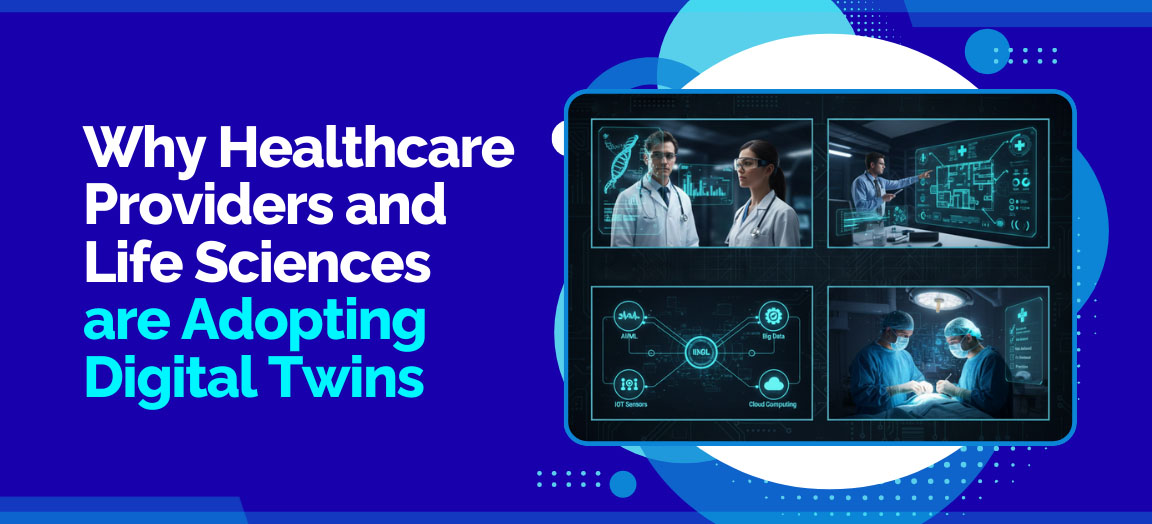
3. Why Healthcare Providers and Life Sciences Are Adopting Digital Twins
Several converging drivers are pushing adoption of digital twin technology in healthcare:
- Rising complexity of care : Patients today often present with multiple comorbidities, requiring personalized treatment plans. Digital twins allow modelling of individual trajectories.
- Demand for personalized medicine : The ability to simulate how a specific patient responds to therapy is a compelling value proposition. The market research indicates personalised medicine is a leading application segment for digital twins.
- Operational pressures : Hospitals, health systems and medical device firms face cost pressures, regulatory demands, and the need for efficiency. Digital twins help optimize workflows, asset utilization, and predictive maintenance.
- Technological maturation : Advances in AI, big data, IoT sensors, cloud computing and digital modelling make digital twins more feasible.
- Better outcomes and risk reduction : In clinical settings, the ability to virtually simulate a surgical procedure, device interaction or therapy response can reduce error and complication rates.
- Regulatory and market incentives : Especially in the U.S., value-based care models and reimbursement pressures create incentives to adopt technologies that improve outcomes and reduce cost.
According to review literature, digital twins in healthcare hold “transformative potential … to provide individualized care, operational optimization, and accelerated research.”
4. Types & Models of Digital Twins in Healthcare
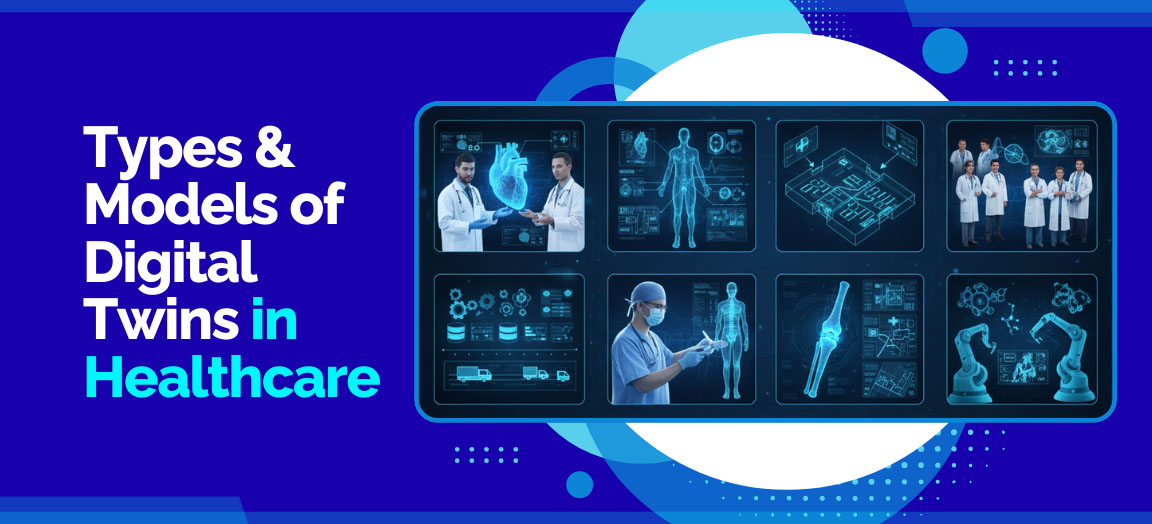
Understanding the taxonomy of digital twins helps clarify where they can be applied.
By Scope / Granularity
- Body-part or organ twin : A digital representation of a specific organ (e.g., heart, knee joint) for surgical planning or device testing.
- Whole-body twin : A comprehensive model of a patient integrating multiple systems, used for disease modelling, long-term monitoring.
- System twin : Represents a complex system such as a hospital department, patient flow model, or care delivery network.
- Process twin : Focuses on workflows and processes (e.g., asset management, operations, logistics) rather than physiology. Markets identify these types; for instance, the process twin segment was noted as the largest in some forecasts.
By Application
- Personalised medicine & patient twin
- Surgical planning & medical education
- Medical device design & testing
- Healthcare workflow/asset management
- Drug discovery & virtual clinical trials
By End User
- Healthcare providers (hospitals, health systems)
- Pharma/biopharma companies
- Medical device firms
- Research & academic institutions
- Diagnostic labs, payers, and other ancillary care providers
Reports indicate that healthcare providers currently account for the largest share.
5. Key Applications of Digital Twins in Healthcare
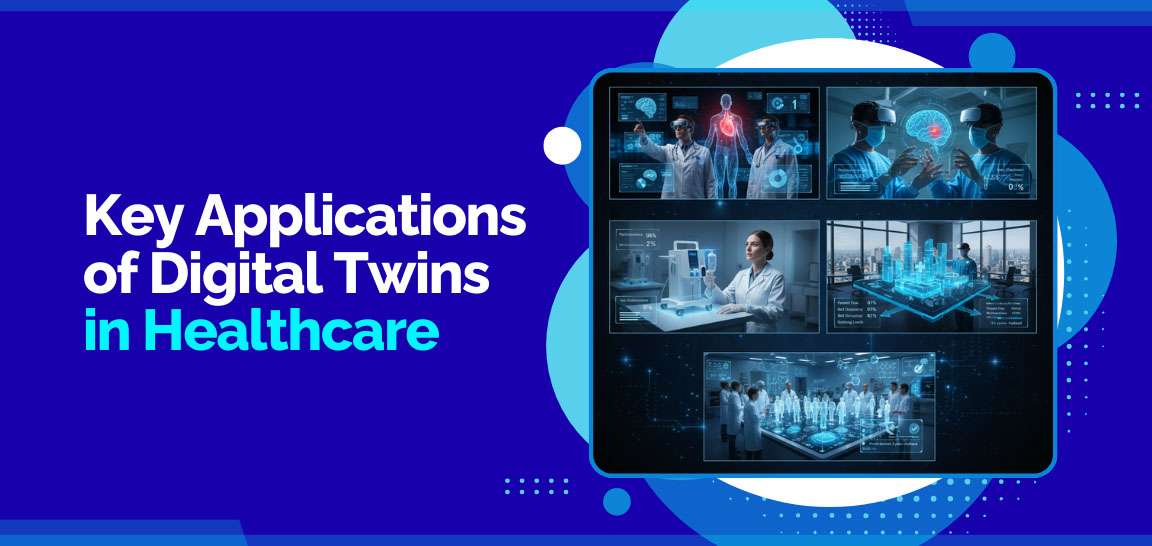
Below are detailed use-cases showing how Digital Twins in Healthcare are being applied.
5.1 Personalized Medicine & Patient-Specific Models
One of the most transformative use cases: creating a digital twin of a patient to simulate how that individual will respond to therapies.
Example: According to a publication discussing digital twin usage: “Digital twins can be virtual representations of organs … entire physiological systems or even a patient’s full body.”
Such models help clinicians test treatment options virtually, anticipate complications, personalize dosage and monitor disease progress.
For example, for oncology, cardiology or chronic disease management, a patient twin can integrate genetic data, imaging, wearables and lifestyle inputs.
5.2 Surgical Planning & Medical Education
Digital twins enable surgeons to rehearse operations on virtual replicas of patient anatomy, identify risks, and plan intervention.
Similarly, medical students can train in realistic simulations rather than purely theoretical models.
Use-case: A brain tumour surgery planned via digital twin modelling of the specific patient’s anatomy helps refine approach, reduce operative time, and improve outcomes.
5.3 Medical Device Design, Testing & Predictive Maintenance
Device manufacturers use digital twins to simulate product behavior, test durability, perform virtual prototyping and monitor devices in the field.
In healthcare operations, an equipment digital twin can monitor an MRI machine or an infusion pump in real-time, predict failures, schedule maintenance proactively, reducing downtime and cost.
5.4 Healthcare Workflow Optimization & Asset Management
Hospitals face challenges with patient flow, bed occupancy, equipment use, staff scheduling and supply chains.
Digital twins of processes and systems allow administrators to model scenarios: What happens if elective surgeries increase by 20%? What if a staffing shortage occurs?
One market report notes that the asset and process management segment in digital twins for healthcare held a large share.
5.5 Drug Discovery, Clinical Trials & Research
Pharma companies are deploying digital twin approaches to model disease progression, virtual patients, and simulate clinical trials, aiming to reduce time and cost.
The ability to create multiple virtual patient twins helps refine trial design, predict adverse events, and accelerate go-to-market.
6. Benefits: Improved Outcomes, Efficiency & Innovation
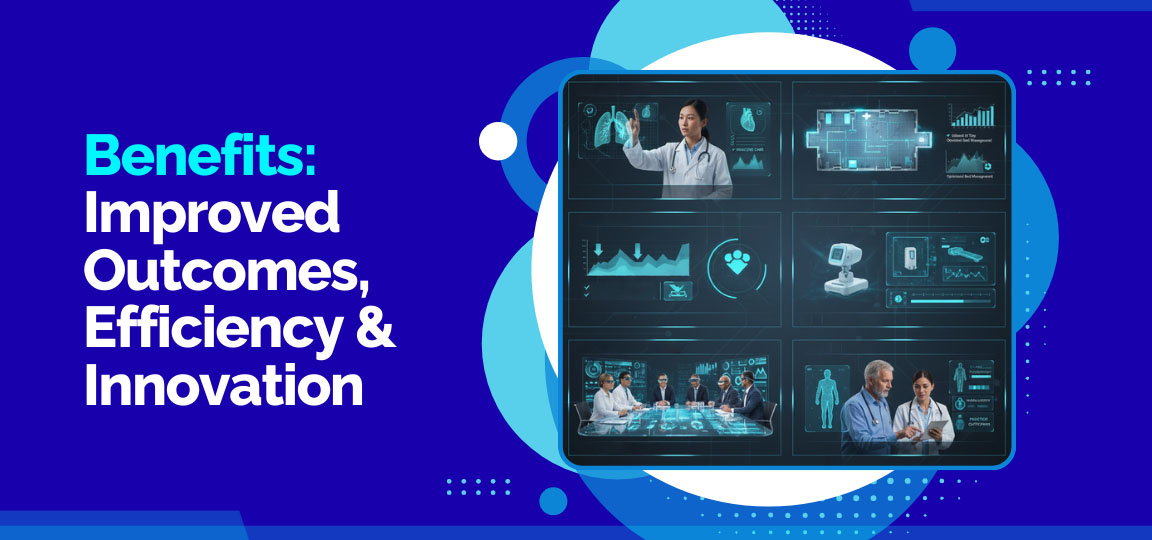
Adopting digital twins in healthcare brings multiple benefits:
- Improved clinical outcomes : By simulating scenarios and personalizing treatments, patient outcomes can improve, complications reduce, and care becomes proactive instead of reactive.
- Operational efficiency : Hospitals can shorten length of stay, optimize bed management, reduce resource waste, and streamline asset maintenance.
- Cost reduction : Less unplanned downtime, fewer complications, improved planning means savings.
- Innovation acceleration : Device manufacturers and pharma firms can prototype virtually, test faster, and enter markets sooner.
- Data-driven decision making : Visualisation and simulation aid stakeholder understanding and governance.
- Patient engagement : Patients gain understanding of their care path through visualised models and predicted outcomes.
One research article noted the transformative potential of digital twins in healthcare for individualized care and efficiency.
Moreover, businesses using digital twin technologies in general (outside healthcare) report productivity gains of 30% to 60% and reduced waste of 20%.
While healthcare-specific figures may vary, these broad industry results indicate potential magnitude of impact.
7. Challenges, Risks & Considerations
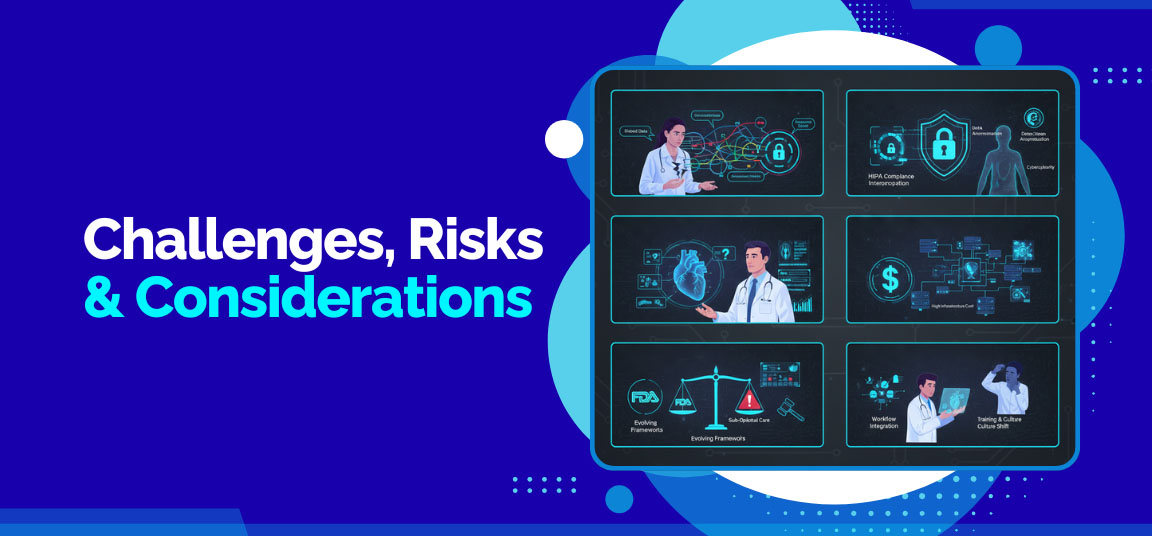
While digital twins are compelling, several caveats must be addressed.
7.1 Data Integration & Interoperability
Healthcare data is notoriously siloed, inconsistent, and heterogeneous (EHRs, imaging, genomics, wearables).
Building a digital twin requires seamless integration across sources. Review literature highlights data integration as a significant barrier.
7.2 Privacy, Security & Ethics
Patient twins involve highly sensitive personal data, including genetics, imaging, lifestyle and predictive models.
Ensuring HIPAA compliance, patient consent, data anonymization, cybersecurity and ethical use is crucial. Data governance must be robust.
7.3 Model Validity and Trust
A digital twin is only as good as its data and algorithms. Clinical validation, transparency of modelling assumptions, and trust from clinicians are essential. Over-promising without validated outcomes risks backlash.
7.4 Cost & Implementation Complexity
Setting up digital twin infrastructure — sensors, data pipelines, modelling engines, workflows — is expensive and complex.
Smaller hospitals or device firms may face budget and skills constraints.
7.5 Regulatory & Liability Considerations
As digital twins influence clinical decision-making, regulatory frameworks (FDA, CMS, etc.) must evolve.
Who is liable if a twin’s simulation leads to sub-optimal care? These questions remain open.
7.6 Change Management & Adoption
For clinicians and administrators to adopt twin-based workflows, training, culture, workflow integration and incentives matter.
Without buy-in, technology may go unused.
In sum, while digital twins in healthcare hold promise, success depends on thoughtful implementation, governance, integration, and outcomes validation.
8. How to Implement Digital Twins in Healthcare: Practical Guide
Below is a step-by-step roadmap for healthcare organizations, device manufacturers or research institutions looking to deploy digital twin initiatives.
Step 1: Define Strategic Use Cases
- Identify high-value problems (e.g., reducing ICU LOS, improving surgical outcomes, optimizing MRI downtime).
- Prioritize by business/clinical impact, feasibility, ROI and data readiness.
- Example: A hospital might select “patient organ twin for cardiac surgery planning” as pilot.
Step 2: Assess Data & Infrastructure Readiness
- Map out the data sources needed: EHR, imaging, wearables, sensors, supply chain, device telemetry.
- Evaluate data quality, integration capacity, interoperability (FHIR, DICOM, HL7), IoT readiness.
- Ensure infrastructure: cloud, edge computing, data lake, modelling performance.
Step 3: Choose Technology Stack & Vendor Partnerships
- Select modelling/simulation platforms (physics-based, AI/ML, hybrid) capable of handling healthcare domain.
- Consider digital twin software vendors, consulting partners, data scientists.
- Integrate with existing systems (ERP, HIS, EHR) and ensure vendor compliance with healthcare standards.
Step 4: Build Pilot & Validate
- Develop a minimum viable digital twin (MVDT) for a single use case.
- Engage clinicians, operations leaders early for user-centered design.
- Validate results: compare twin predictions vs actual outcomes; adjust model.
- Measure pilot metrics: time saved, cost avoided, complication reduction, resource utilization.
Step 5: Governance, Security, Ethics & Workflow Integration
- Establish data governance frameworks: governance board, ethics review, patient consent, anonymization protocols.
- Build security: encryption, access control, audit trails, device management.
- Integrate twin workflows into clinician/operations routines: visual dashboards, simulation tools, decision-support systems.
- Plan for change management: training, communication, continuous improvement.
Step 6: Scale & Monitor
- Once pilot succeeds, scale to other departments, devices or patients.
- Monitor performance: twin accuracy, user adoption, ROI metrics.
- Maintain and update twins: ensure data freshness, model recalibration, system health.
- Foster innovation: explore advanced use cases (e.g., hospital system twin, drug trial twin).
Step 7: Communicate Outcomes & Sustain Momentum
- Share results with stakeholders: clinical leadership, CIO, board, patients.
- Use outcomes to secure ongoing budget and expand scope.
- Stay aware of new regulatory requirements, standards and technology developments.
9. Real-World Case Studies & Emerging Trends
Case Study A: Patient-Specific Heart Twin
At a major U.S. hospital, cardiology teams used a digital twin model of a patient’s heart — built from imaging and electrophysiological data — to simulate ablation therapy.
They could test various strategies virtually, reducing procedure time and risk.
Case Study B: Hospital Workflow Twin
A health system created a “system twin” of its emergency department (ED) and inpatient flow.
The model allowed the team to simulate staffing changes, bed allocation, and surge scenarios (e.g., pandemic conditions).
They discovered bottlenecks and optimized staffing, improving throughput by ~15% and reducing wait times.
Emerging Trend: Digital Twins & AI Convergence
Digital twin models increasingly incorporate AI/ML analytics — not just simulation but predictive and prescriptive insights.
For instance, twin models may predict which patients are at highest risk of complications, suggest interventions, and continuously refine the model with new data.
Emerging Trend: Device Twin in Medical Equipment
Medical device manufacturers are creating digital twins of equipment to monitor real-time performance, schedule maintenance, predict failure, and optimize lifecycle.
These twins are enabling service business models and reducing downtime.
Emerging Trend: Virtual Clinical Trials & Research Acceleration
With regulatory interest in modelling and simulation, digital twin technology is being used in pharma/biopharma to simulate patient cohorts, predict responses, and design more efficient trials — potentially reducing drug development timelines and cost.
10. Future Outlook: What’s Next for Digital Twins in Healthcare
Looking ahead, here are some major trends shaping the future of digital twins in healthcare:
- Mainstream adoption : As infrastructure matures and pilots prove value, digital twins will move from niche innovation to core part of healthcare delivery. Forecasts suggest huge growth: e.g., one report projects $77.4 billion by 2034.
- Integration of genomics, multi-omics & real-world data : Twin models will incorporate more varied data (genetics, lifestyle, environment) for higher fidelity simulation.
- Patient engagement and “consumer twin” : Patients may have access to simplified twin models of their health, enabling self-management and shared decision making.
- Regulatory frameworks & standards : As digital twin use in clinical care grows, regulatory guidance, standards and validation frameworks will evolve (e.g., FDA, CMS).
- Interoperable twin ecosystems : Twins will not be siloed — hospital twin, device twin, patient twin will interconnect, enabling system-level insights.
- Cost-effective, scalable software platforms : With cloud and edge computing, more organizations (including community hospitals) will adopt twin solutions.
- Ethical, inclusive deployment : Ensuring health equity, data privacy, model transparency will become priorities to avoid bias and disparity.
- Workforce transformation : Clinicians and administrators will need new skills in simulation, analytics and decision support; training programs will evolve accordingly.
11. Frequently Asked Questions (FAQs)
Q1. What exactly is a digital twin in healthcare?
A: A digital twin in healthcare is a virtual model or replica of a system (organ, patient, hospital process, device) that reflects real-time data and can simulate outcomes.
It lets clinicians or operators test scenarios, predict behaviours, and make better decisions.
Q2. How does a digital twin differ from a traditional simulation?
A: Simulations are often static or hypothetical; a digital twin is dynamic, connected to live data, and able to evolve with the real system.
It provides a true “live” mirror rather than a one-off model.
Q3. Are digital twins in healthcare being used now in the U.S.?
A: Yes — multiple hospitals and device manufacturers are piloting digital twins for surgical planning, patient-specific modelling, equipment maintenance and workflow optimisation.
For instance, heart-twin models at U.S. centres are already in use.
Q4. What are the main barriers to adoption?
A: Key barriers include data integration and quality, regulatory and liability concerns, cost of deployment, workforce training, and ensuring model validity and clinician trust.
Q5. What kind of ROI can healthcare organisations expect?
A: While ROI varies by use case, organisations often see improvements such as reduced procedure times, fewer complications, better throughput, more efficient equipment use, and faster decision-making.
Broader industry results show productivity gains of 30-60% when digital twin-type systems are used.
Q6. How do digital twins support personalized medicine?
A: By modelling a specific patient’s anatomy, physiology, genetics, lifestyle and treatment options, digital twins can simulate different interventions and forecast outcomes — making care tailored and proactive rather than generic.
Q7. Can smaller hospitals or medical device firms adopt digital twins, or is it only for large organisations?
A: While larger organisations have led adoption, the cost and technology barrier are decreasing.
With cloud platforms, modular solutions, partnerships and pilot programmes, smaller hospitals and device firms can begin digital twin initiatives — starting small and scaling.
12. Conclusion & Next Steps
The era of digital twins in healthcare is no longer just futuristic—it’s unfolding today. Virtual replicas of patients, processes and devices are enabling care providers, device manufacturers and researchers to simulate, predict and optimise in ways previously unimaginable. From personalised treatment planning to hospital workflow redesign, digital twins are reshaping the healthcare landscape with greater accuracy, efficiency and insight.
If your organisation is looking to harness this wave of innovation, now is the moment to act. Begin by identifying high-impact use cases, invest in data infrastructure and partnerships, build pilot programmes, measure outcomes and scale strategically.
At the same time, you’ll want a technology partner who understands both the healthcare domain and software development at scale. That’s where Trantor Inc. comes in. With deep expertise in enterprise software solutions, data engineering, AI/ML and digital twin platforms, Trantor helps healthcare providers, medical device companies and life sciences firms design, build and deploy custom digital twin solutions. Whether you’re looking to simulate a patient’s heart response to treatment, optimize hospital assets and workflows or accelerate medical device development, Trantor has the domain knowledge, technical proficiency and regulatory understanding to get you there.
Trantor’s digital twin services include end-to-end delivery: from data strategy and integration, through modelling and simulation, to user experience design, clinical and operational validation, deployment and monitoring. Their approach is built around collaboration with your clinical, IT and leadership teams, ensuring the solution is not just technically sound — but embedded in real workflows and delivers measurable value.
Let’s move from possibility to performance. Explore how Trantor Software can help your healthcare organisation adopt digital twin technology — enhance patient outcomes, improve operational efficiency and position your organisation ahead of the curve in healthcare innovation.